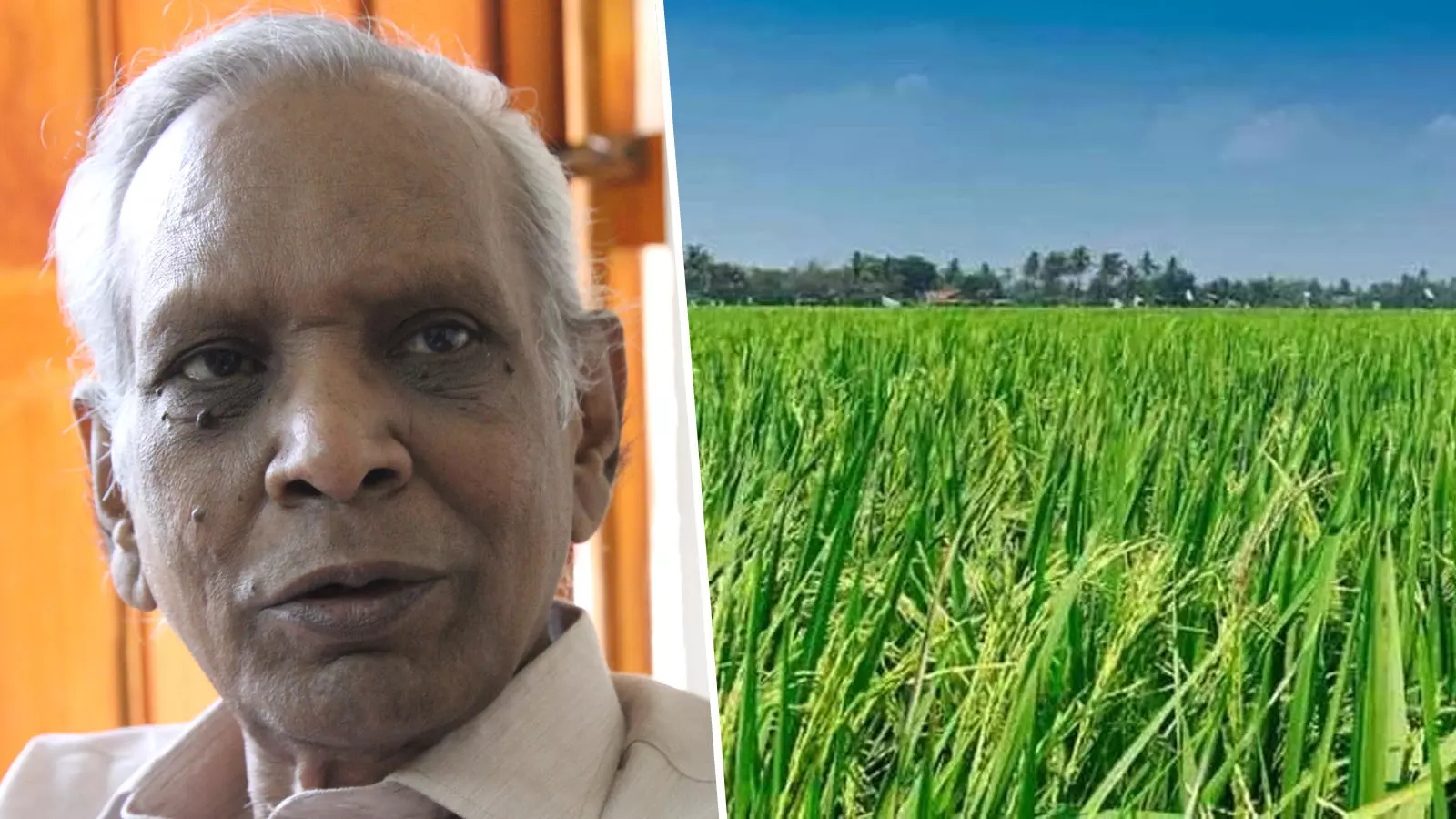
EA Siddiq obituary: A man whose arduous basmati rice research turbocharged exports
In 1962, Siddiq had joined IARI, popularly known as Pusa Institute after its original location in Bihar, as a student of MS Swaminathan, who came to be regarded as the Father of India’s Green Revolution

If basmati rice has become a major export commodity for India, earning nearly US dollars 6 billion in 2024-25, a large dollop of credit should go to Ebrahimali Abubacker Siddiq, who passed away on January 22, aged 89.
I met Siddiq at his house in Hyderabad in February 2017 at the instance of Ashok Kumar Singh, as I was writing a fortnightly column on matters agricultural for a business daily. Singh later became director of Indian Agricultural Research Institute (IARI), where Siddiq obtained his doctorate and did research on basmati.
Cultivating common rice over basmati
In 1962, Siddiq had joined IARI, popularly known as Pusa Institute after its original location in Bihar, as a student of MS Swaminathan, who came to be regarded as the Father of India’s Green Revolution. I was surprised to learn from him that there was a time when farmers in the basmati growing areas of Punjab, Haryana and western Uttar Pradesh preferred cultivating common rice even though basmati fetched a much higher price.
Also read: Should Punjab quit rice farming? Agri scientist Lather explains
The reason was the difference in productivity. Traditional basmati yielded 1.5 to 2 tonnes per hectare as against 5-7 tonnes per ha of high-yielding dwarf non-basmati varieties like IR8 and Jaya. As a result, area under basmati was shrinking.
“I thought if we shorten the height of traditional tall basmati varieties so they do not lodge (flatten due to the weight of grains), and also make them fertiliser responsive like dwarf high-yielding common rice, we will be able to increase yield. We worked for almost 24 years to evolve the first semi-dwarf high-yielding basmati variety. It was called Pusa Basmati-1,” Siddiq had said.
Arduous research journey
Looking back in 2015 on the occasion of 25 years of the Green Revolution, Siddiq wrote: “Realising that unless traditional basmati rice is made high yielding, there will be no way to conserve this unique germplasm and take advantage of its export prospects, IARI initiated an exclusive breeding programme to combine basmati quality in high yielding dwarf plant type background. We did not realise that the task would be so challenging, given the genetically very complex nature of the key traits that make basmati quality.”
Also read: Madhav Gadgil obit: An ecologist who refused easy binaries
PB-1 was released in 1989. It produced 4.5 tonnes per ha. Reminiscing on the arduous research journey, Siddiq wrote, “In the long course of its development, disappointment after disappointment at every stage and discouraging comments from higher-ups never dampened our spirit and determination to achieve the goal. The moment we achieved what we had been chasing for so long we forgot all the hassles we passed through.”
Why basmati elongates
Apart from being long, slender and aromatic, basmati elongates upon cooking, unlike other rice, which swells. It also does not become sticky or lumpy, but remains fluffy. Siddiq said they could combine all the characteristics, but had difficulty with kernel elongation. The kernel must be extra-long slender with a length-to-breadth ratio above 2.5. The science behind elongation was not known.
Siddiq said elongation could be due to the physical and chemical properties of starch in basmati. Starch has two fractions: amylose and amylopectin. In rice varieties, the amylose content is in the range of 28-30 per cent. In basmati, the fraction should be around 22 per cent. The rest is amylopectin. Gelatinisation temperature should be medium and gel consistency medium-to-low for cooked rice to be soft in texture.
Also read: How coconut shells have sparked trade boom in coastal Karnataka
Traditional basmati rice plants were up to five feet tall and tended to lodge or flatten under the weight of grains. Pusa Basmati was about 3.5 feet in height. It became instantly popular. By the turn of the century, it had about 60 per cent share of the export market, worth about US dollars 400 million annually. The real breakthrough in basmati export happened with the release of Pusa Basmati 1121 in 2003, which had better grain quality, though a slightly lower yield. But that’s another story.
Backing China’s hybrid rice programme
As for the future, Siddiq said India must reduce the gap between realised and potential yield of dwarf high-yielding rice varieties (10 tonnes per ha) by raising yields by 25 per cent. He spoke approvingly of China’s hybrid rice programme.
When asked about his attitude to transgenic (genetic modification technology), Siddiq said he supported them, “provided it is proved that they do not have any health-related risk or pose a threat to the environment. It may be the need of the hour. Caution is important, but I am not against the technology.”
High-quality research, focused on national needs like that of Siddiq’s, pays many more times the cost and improves thousands of lives. It is a thought for the Union Finance Minister Nirmala Sitharaman, as she presents the Budget 2026 on February 1, while also ensuring that the research produces tangible results.