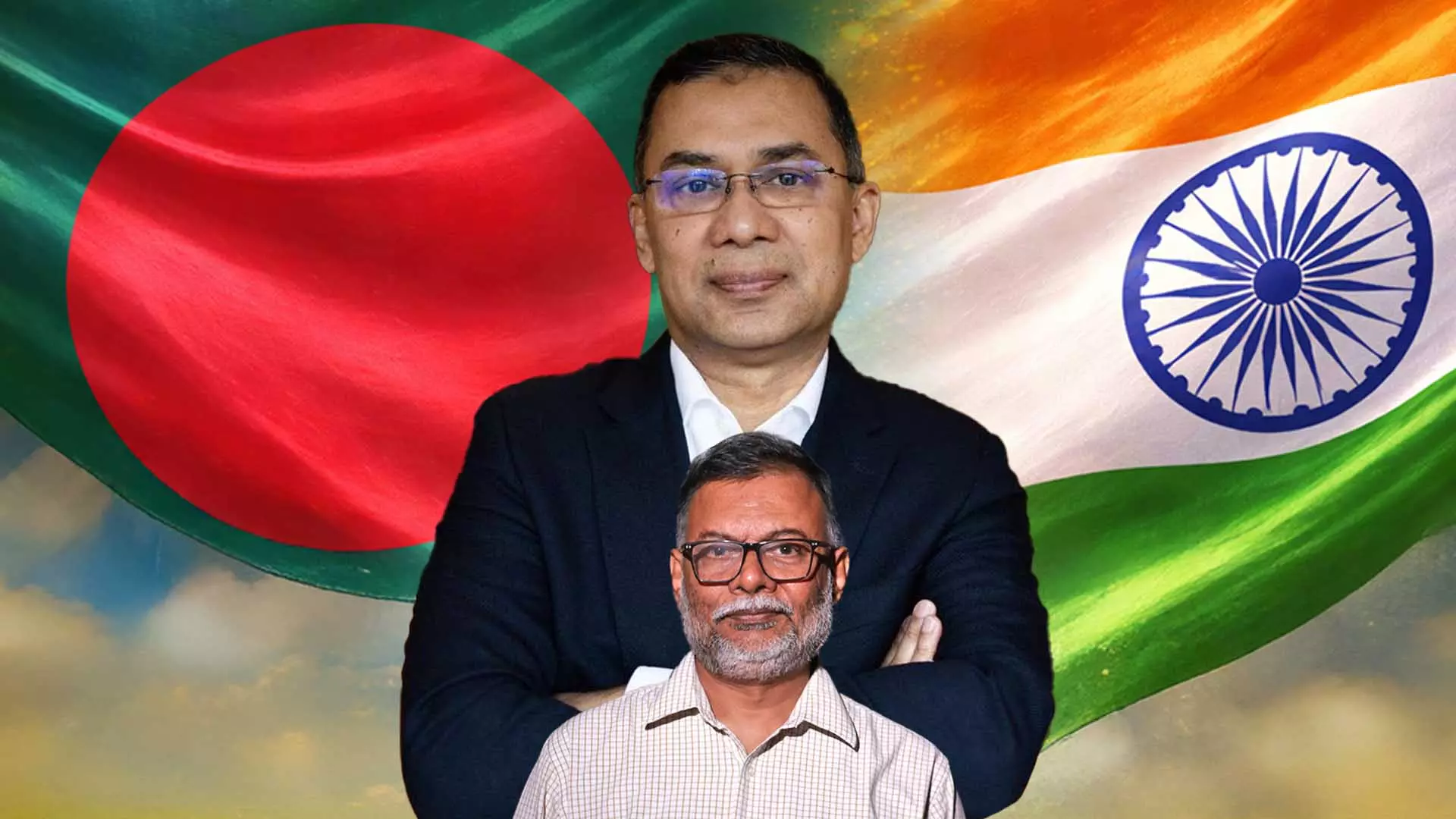
Will Tariq Rahman’s return reshape India-Bangladesh ties after Sheikh Hasina’s exit?
The BNP leader’s comeback after years in exile has raised hopes and questions amid political flux in Dhaka and strained India-Bangladesh ties

As Bangladesh navigates a fragile transition after the August 2024 student uprising and the exit of Sheikh Hasina, the return of Tariq Rahman from self-exile has become a pivotal moment. His comeback comes amid a political vacuum, regional realignments, and renewed questions about Dhaka’s ties with New Delhi, Islamabad, and beyond. In this episode of Worldly Wise, The Federal’s Consulting Editor unpacks what Rahman’s return could mean for Bangladesh’s internal stability and South Asia’s geopolitics.
Will Tariq Rahman’s return help India-Bangladesh ties?
On the face of it, his return does appear like a silver lining in an otherwise grey horizon. The situation between India and Bangladesh had been deteriorating steadily and seemed to be heading nowhere. Whether Tariq Rahman’s return will ultimately have a concrete impact remains to be seen, but prima facie, it could make a difference.
The Bangladesh Nationalist Party (BNP) has never been as close to India as the Awami League was. Yet, in the current circumstances, Rahman’s return provides a degree of hope that some balance can return. After Sheikh Hasina’s exit, Bangladesh has been struggling in a political vacuum. The interim arrangement under Muhammad Yunus is unelected and temporary, neither here nor there.
At the same time, students and other opposition forces, particularly right-wing conservative groups that have historically been anti-India, have grown powerful in this vacuum. With the Awami League banned and Sheikh Hasina out of the country, there was no major secular, pro-Bangladesh political party in contention. That made the outlook appear bleak.
From that perspective, Rahman’s return brings optimism. As far as India-Bangladesh ties are concerned, one can only hope that it will make a meaningful difference.
Can New Delhi use this moment to ease tensions with Dhaka, despite its past distance from the BNP?
India cannot take Bangladesh for granted, and it certainly cannot take Rahman or the BNP for granted. The situation has to be handled with care. Rahman has returned to Bangladesh, and elections are scheduled for February 12. For any major shift to occur, the BNP would have to win those elections.
Surveys quoted in Indian and international media suggest that Rahman is a frontrunner and that the BNP has a strong chance of returning to power. If that happens, his return will have an even greater impact.
What India needs to do is first erase much of the misunderstanding and the subterranean animosity that has existed with the BNP, and particularly with Rahman. A more practical approach is needed. In his statements after returning to Bangladesh, Rahman has been clear that his priority is “Bangladesh first” and that he will act in the country’s interests.
India should recognise that this is the framework within which he will operate. There has to be give and take, especially on sensitive issues like water sharing. The current Ganga water-sharing agreement is due to expire next year. When it comes up for renewal, India will need to show flexibility and accommodation. That would make it easier for Rahman to reciprocate and help bring the relationship back to an even keel.
A great deal of diplomatic work will still be required if Rahman does return to power.
Will Sheikh Hasina’s presence in India become a sticking point with a Rahman-led leadership in Dhaka?
This is the big question mark. Personally, Rahman and Hasina have a deeply antagonistic relationship. Rahman left Dhaka and went into self-exile in London after money laundering charges were filed against him. There was also the bomb attack on the Awami League leadership, which Hasina survived, in which Rahman was implicated.
Given this context, Rahman believed it was unsafe for him to remain in Bangladesh, which is why he stayed away for nearly 17 years. His return has been possible because the courts have now dismissed the charges against him, both the money laundering cases and the accusations related to the bomb attack.
The personal relationship between the two leaders remains extremely strained. If Rahman comes to power, the million-dollar question is whether he will insist on Hasina’s repatriation to Bangladesh or whether he will give her a wide berth and allow India to continue hosting her. At this point, there are no easy answers.
There are expectations that Rahman will restore normalcy in Bangladesh. Can he deliver on that?
This is a crucial issue for Bangladesh. In his first round of statements after arriving in Dhaka, Rahman categorically said that Bangladesh belongs to people of all religions — Islam, Hinduism, Buddhism, Christianity, and others. That is a positive sign.
It indicates a commitment to a secular Bangladesh and to the principles that guided the country’s creation. Bangladesh has long been at risk of slipping into the grip of right-wing conservative fundamentalism. In the past, the BNP governed in alliance with Jamaat-e-Islami, a party that was pro-Pakistan and opposed to the creation of Bangladesh.
That alliance was one of the reasons why the BNP-Jamaat government did not enjoy good relations with India earlier. In the current context, however, there is reason to believe that a form of secular politics could be practised. This would be a relief for minorities, including Hindus, Christians, and Buddhists.
Rahman has made this clear in his opening statement upon landing in Dhaka. While the atmosphere remains highly charged, and the situation on the ground is far from ideal, a renewed emphasis on secularism could help calm tensions and restore a degree of stability.
Since Sheikh Hasina’s exit, Bangladesh has moved closer to Pakistan. Will Rahman continue this alignment?
The BNP has traditionally been inclined to maintain relations with Pakistan, unlike the Awami League, which was never particularly friendly towards Islamabad. In that sense, Rahman and the BNP are likely to continue ties with Pakistan.
At present, Bangladesh has drawn very close to Pakistan in the post–Sheikh Hasina vacuum. Strong anti-India sentiment, driven by India’s close support for Hasina, has translated into a pronounced pro-Pakistan mood. A new axis involving Bangladesh, Pakistan, and Turkey has already emerged, with China also very much in the picture. Given China’s close ties with Pakistan, it too forms part of this alignment.
If Rahman comes to power, he is unlikely to cut off ties with Pakistan. However, if he opens the door to reconciliation with India and improves India-Bangladesh relations, it could reduce Pakistan’s current hold over Dhaka.
Even maintaining balanced ties with both India and Pakistan would be an improvement over the present situation. That, in itself, would mark a significant shift.
The content above has been transcribed from video using a fine-tuned AI model. To ensure accuracy, quality, and editorial integrity, we employ a Human-In-The-Loop (HITL) process. While AI assists in creating the initial draft, our experienced editorial team carefully reviews, edits, and refines the content before publication. At The Federal, we combine the efficiency of AI with the expertise of human editors to deliver reliable and insightful journalism.