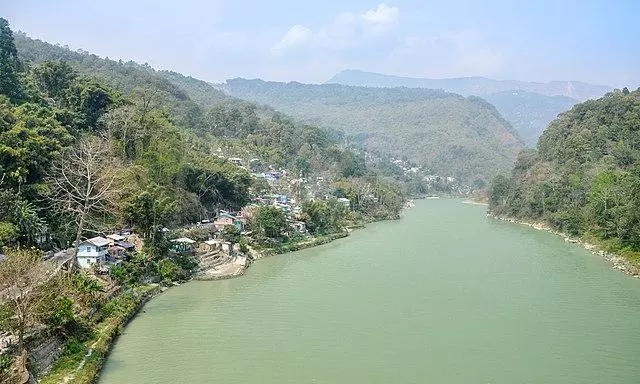
Any lasting solution to the Teesta's water challenges requires India's involvement because the river flows into Bangladesh from Indian territory. Photo: Wikimedia Commons
New Delhi-Dhaka ties: Can India afford to lose Teesta to China?
Two years after Sheikh Hasina favoured a New Delhi-led plan, the new govt in Dhaka realigns with Beijing for the massive river restoration scheme

Bangladesh's renewed push for Chinese participation in the Teesta River project could revive strategic concerns in India, as the proposed scheme lies close to the sensitive Siliguri Corridor linking the country's northeastern states with the mainland.
Dhaka's latest move is also seen as a setback for New Delhi because it had hoped to lead the project after Bangladesh's former prime minister Sheikh Hasina backed a greater Indian role shortly before her removal from power in 2024.
Bangladesh-China agreement
Bangladesh and China agreed on Thursday (June 25) to deepen cooperation in river management, including the Teesta River Comprehensive Management and Restoration Project, during a meeting between Bangladeshi Prime Minister Tarique Rahman and Chinese Water Resources Minister Li Guoying in Beijing, according to Bangladesh media reports.
Also read: With Dhaka turning to China, Teesta set to further strain Indo-Bangla ties
The agreement signals a major policy shift by Dhaka and could reopen a strategic contest between Asia's two largest powers in a region that India has traditionally viewed as its sphere of influence.
The Teesta River originates in the eastern Himalayas and flows through the Indian states of Sikkim and West Bengal before entering Bangladesh.
For decades, the river has been at the centre of a dispute between Dhaka and New Delhi over water sharing.
The latest agreement, however, carries significance beyond water politics.
Race for influence in Bangladesh
The project has become a symbol of the growing competition between India and China for influence in Bangladesh.
China first emerged as a major player in the Teesta project several years ago.
Chinese officials conducted surveys and prepared plans for a large-scale river restoration programme involving dredging, embankments, flood control works and infrastructure development.
The project was expected to cost more than US 1 billion and was seen as one of China's most ambitious river management initiatives in Bangladesh.
The proposal attracted attention in India because the project area lies close to the strategically vital Siliguri Corridor, the narrow land strip that connects India's northeastern states with the rest of the country.
Also read: BNP blames Mamata for Teesta Treaty delay, hopes for progress under BJP govt
Indian analysts argued that the project could increase Beijing's footprint in an area close to critical Indian territory.
Those concerns appeared to ease during the final months of Hasina's government.
Situation reversed after Hasina ouster
During her visit to New Delhi in June 2024, Hasina welcomed an Indian proposal to undertake conservation and management work on the Teesta River.
Prime Minister Narendra Modi announced that New Delhi would send a technical team to Bangladesh to examine the project.
Soon after, Hasina publicly indicated that she preferred India to execute the scheme.
She argued that India controlled the upstream flow of the river and was therefore better placed to address long-term water management issues.
Her remarks were widely interpreted as a setback for China and a diplomatic victory for India.
The development came after years of growing strategic cooperation between New Delhi and Hasina's government.
For India, the prospect of replacing China in the Teesta project was especially significant because it would limit Beijing's involvement in a sensitive region.
However, Bangladesh's political landscape changed dramatically after Hasina was removed from power.
Dhaka's independent foreign policy under Rahman govt
The new administration led by Rahman has adopted a different foreign-policy approach.
While maintaining ties with India, it has also sought to strengthen relations with China and other regional powers.
Officials in Dhaka have repeatedly said Bangladesh will pursue an independent foreign policy driven by economic interests rather than geopolitical alignments.
The Teesta project appears to fit within that broader strategy.
Earlier this year, Bangladeshi officials signalled renewed interest in Chinese participation in the project. Thursday's announcement is the clearest indication yet that Beijing has regained a central role.
For India, the implications are primarily strategic rather than economic.
Also read: BJP govt in Bengal sparks Teesta hope and immigrant ‘push back’ concern in Dhaka
The latest agreement does not address the unresolved Teesta water-sharing treaty between the two neighbours. Negotiations on that issue have remained stalled for more than a decade.
The main obstacle had been opposition from West Bengal’s erstwhile Mamata Banerjee-led Trinamool Congress government which argued that sharing more water with Bangladesh could affect farmers in northern parts of the state.
The message that latest Bangladesh-China agreement sends is hard to miss.
It suggests that Bangladesh's new leadership is less willing to take major infrastructure decisions around Indian concerns.
India's South Asia challenge
The agreement also highlights a broader reality confronting India across South Asia. Neighbouring countries are becoming more willing to engage China even in sectors that New Delhi considers strategically important.
The move also demonstrates Beijing's continued ability to retain influence in Bangladesh despite the political changes of the past two years.
China remains one of Bangladesh's largest trading partners and infrastructure investors. Its companies are involved in ports, bridges, highways, power plants and industrial parks across the country.
For Bangladesh, Chinese participation offers access to financing and technical expertise for a project that successive governments have identified as a national priority.
Also read: What China-Bangladesh-Pakistan trilateral mechanism means for India
Riverbank erosion and seasonal flooding affect thousands of families in the Teesta basin every year.
Officials say better river management could improve irrigation, protect agricultural land and boost economic activity in northern Bangladesh.
However, any lasting solution to the Teesta's water challenges requires India's involvement because the river flows into Bangladesh from Indian territory.
As a result, competition for influence in the region over Teesta project is likely to intensify.