Is Pongal a cultural harvest festival or a religious tradition?
Is Stalin right in his Pongal pitch? Culture, religion, politics, and more
Tamil Nadu Chief Minister MK Stalin’s 'Dravidian Pongal' remark sparks a political clash over culture, religion, and identity

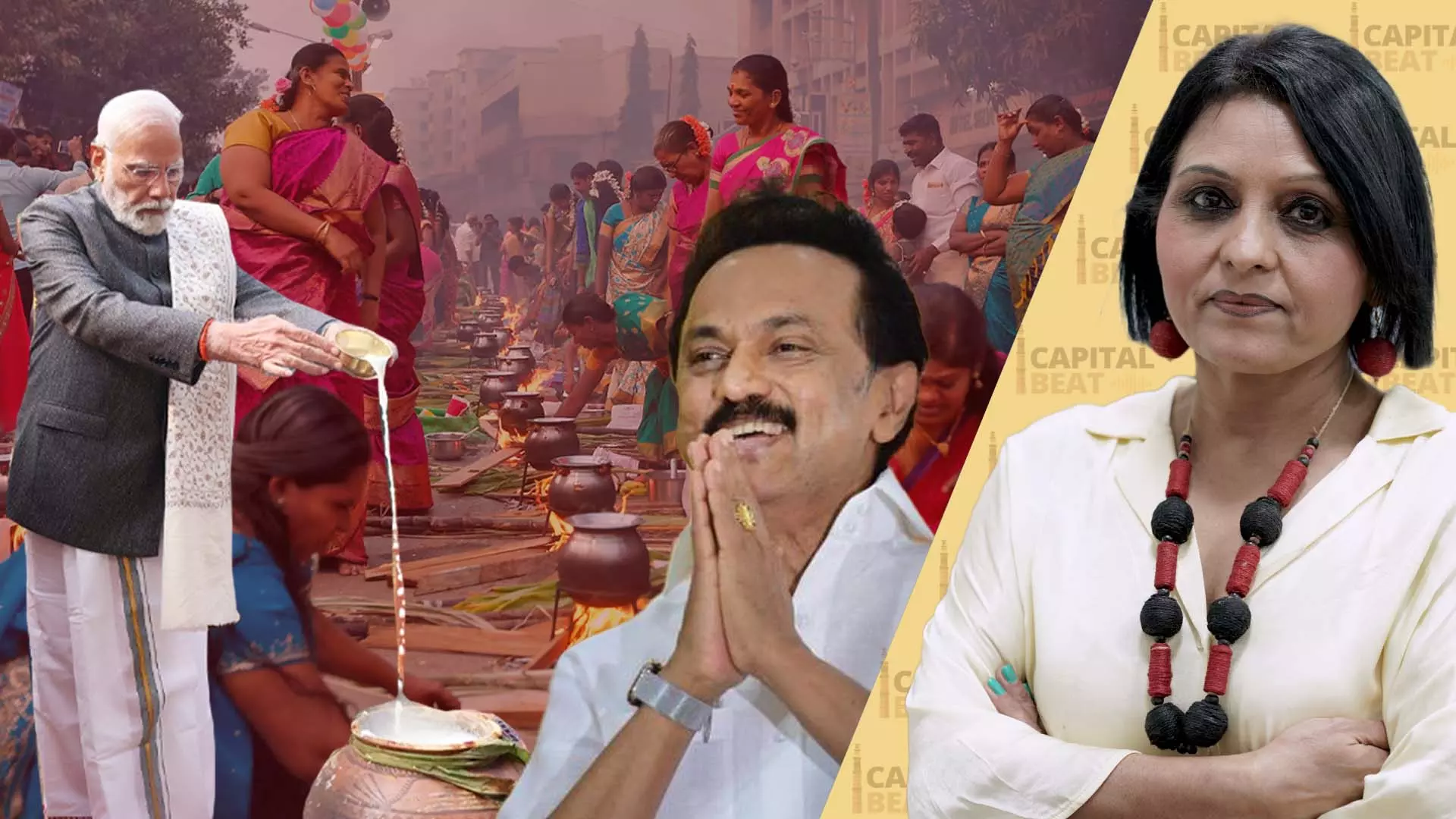
In this Capital Beat episode, our Editor-in-Chief Srinivasan S talks about the political churn around Pongal after DMK president and Tamil Nadu Chief Minister MK Stalin described it as “Dravidian Pongal”. The interview focused on how parties are framing the festival ahead of elections, and whether such labels can reshape a mass cultural celebration in Tamil Nadu.
How do you decode the politics around Pongal being played out by the DMK, the BJP, and others ahead of elections?
Let’s first understand what Pongal is.
Pongal is a harvest festival, and it is not just in Tamil Nadu. It is celebrated in four parts of India. The way the calendar works in India is rooted in an agrarian economy, where agriculture was the prime mover, and even now most of India lives in its villages.
It is one of the biggest festivals countrywide. In Tamil Nadu, it is a thanksgiving — telling nature, telling the sun god that people are happy that a good crop has come.
The first crop is cut and offered to the sun god. Pongal is essentially an outdoor festival. People place an earthen pot, add jaggery, rice, and other ingredients, and prepare pongal.
It is offered to the sun god, and the offering is distributed to villagers. The whole thing began as a nature-linked thanksgiving.
Over time, more elements were added. A full sugarcane is kept alongside. It is left to individuals how they want to celebrate it further.
Also Read: 'Parasakthi' team meets PM Modi for Pongal celebrations
It doesn’t have too many rituals. If someone wants to have a Surya Narayan puja on that day, they are free to do that. Nobody is stopping them.
Agriculture does not belong to a certain community. People from all communities, castes, and religions participate. They participate as a cultural event.
That is how it has been, and it was never controversial. In Tamil Nadu, this is the number one festival. Unlike in Delhi where Diwali is considered a big festival, people here largely consider Pongal as the big festival.
As people began to get jobs in cities and moved into IT and other sectors, they still go back to celebrate Pongal in villages. In Chennai, the city is almost emptied out. People go back to villages. Trains are booked, bus tickets that are normally Rs 400–500 get sold at premium rates of Rs 4,500–5,000.
People want to go back to their roots, be with families, and celebrate. With more disposable income, Diwali has also become important. People celebrate Diwali as a cultural festival. Crackers are children’s pleasure across communities. That is how Indian festivals have been, and Pongal is one such festival.
Also Read: Why in Tamil Nadu, Pongal celebrations unite Hindus and Muslims in common 'thanksgiving’
Politicians trying to politicise this is not unusual. Elections are less than 60 days away in Tamil Nadu. It is obvious the DMK is trying to use it by calling it “Dravidian Pongal”. There is no need to label it. Pongal does not become a great festival because a political party labels it.
The BJP response is also along the same lines, with Vanathi Srinivasan calling it “Sanatan Pongal”. These nomenclatures don’t matter.
She is trying to jump in by suggesting an attempt to take the character out of the festival. Earlier, they called it “Samathuva Pongal”, meaning inclusive Pongal.
Whether one likes it or not, Pongal is celebrated across colleges. Colleges celebrate it, including missionary colleges. Students celebrate, play outdoor games, dance, and have fun. It is a mass cultural festival.
Politicians may attempt this on either side. If DMK says Dravidian, BJP will say Sanatan. The attempt is polarisation: one side tries, the other counters. For people of Tamil Nadu, it hardly matters. Pongal is Pongal.
Will 'Dravidian Pongal' versus 'Sanatan Pongal' resonate politically just before elections?
In one word, no.
People here are not going to treat Pongal as a religious festival where other religions should not join. There is nothing like that. There is not going to be any impact.
If you extend this argument, such attempts have been made in the past. The BJP tried to make Vinayaka Chaturthi a bigger event in Tamil Nadu, like in Maharashtra. People participated, went to the seashore, immersed idols, and it ended there.
The Ram temple issue also saw celebrations in Tamil Nadu. People offered prayers if they wished, but it never became a political issue.
Then the BJP tried to find something with bigger resonance — Murugan, known in the north as Kartikeya. They attempted a vel yatra. It didn’t work. People came out and participated, but electorally they ignored it.
People see cultural and religious issues as separate from political issues. Stalin’s framing may be agreeable in principle because he talks about social justice, community bonding, and equality — which people here are already doing — but it won’t turn into an electoral issue.
Also Read: Pongal has emerged as a global festival, says PM Modi
People across parties — AIADMK, VCK, Congress — can say that what he is saying is fine, but it does not translate into votes because it cuts across.
It is common for Muslims and Christians to participate, share pongal, and celebrate with others. Some may not participate in rituals but they participate in the cultural aspect. It is like Onam in Kerala — a mass festival where people participate and have fun.
There could be hardliners, but that does not create a controversy. This issue would not have arisen if it was simply said, “Let us celebrate Pongal.”
In the past, even Periyar and CN Annadurai would greet people on Pongal but not on Diwali, and that was a controversy earlier, with questions raised at the DMK about why Diwali greetings were absent.
Are both sides trying to redefine Pongal to polarise or consolidate votes?
The political class always tries to take advantage of mass appeal, especially during election time. Pongal is a mass festival, people gather in large numbers, and it is an outdoor celebration. Politicians reach out because it is easy to make an appeal when people come out.
Some may attempt polarisation expecting electoral benefit, but it won’t have impact. That is what is happening.
After 2018, the Jallikattu controversy expanded the festival’s political visibility. There was a massive protest at Marina Beach in January 2017, driven largely by social media appeals, calling to revoke the ban imposed in 2014, and also demanding a ban on PETA in India.
People came out in large numbers, saying they should have the freedom to celebrate cultural festivals. PETA’s counter-argument was about animal harm. Regulations were made. The government stepped in. The Supreme Court laid down guidelines. Timings were restricted. Events happened under strict watch.
Also Read: TN govt rolls out Pongal cash gift of Rs 3,000 for rice ration card holders
Jallikattu has become an extension of Pongal, making it bigger than a one-day ritual of pongal preparation. Earlier, Jallikattu was restricted to individual villages and more OBC-dominated because those communities were largely agrarian.
Now it has become more of a class function because keeping a bull is expensive. Agriculture is mechanised, tractors are common, and keeping a bull is not easy.
Mattu Pongal is about thanking livestock. Cows are decorated and worshipped. Bulls are painted, horns are painted, ornaments are added.
There was political colour earlier too. In villages, horns were painted in party colours. DMK functionaries would go village to village and change flags — remove old party flags and hoist new ones on that day. A district secretary would travel on a motorcycle and do flag hoisting across villages. These political elements existed, but it remained a cultural fest.
Can Pongal be taken off the Hindu calendar, as some BJP leaders claim?
No.
It is part of the Tamil calendar. Margazhi ends and Thai begins. It is the beginning of a new month. With the arrival of the new month, the alignment of the sun shifts. It is timed with the harvest cycle.
Nobody can change it. These are outlandish claims. There is also a saying in Tamil that when this month comes, it is a month of hope. People begin new things and believe new beginnings will succeed.
This is not restricted to the south. Similar feelings exist in the north as well, where it is called Sankranti. So the idea that the calendar would be changed is far-fetched.
How does minority participation in Pongal fit into this debate, especially when the BJP frames it as 'Sanatan'?
If you read Vanathi Srinivasan’s statement carefully, she alleged the move appeared aimed at allowing minorities to participate under a secular framework.
It is funny, because secularism was earlier considered normal and is part of the Constitution and ethos. To say other religions are being included is strange.
If it is inclusive, why should it be a problem? If people from other religions want to participate, why should it be frowned upon?
These statements can be attempts to polarise, but people are not going to get polarised.
Along the coast of Tamil Nadu, the primary identity is often Tamil identity — being Tamil and speaking Tamil. Pongal is linked to Tamil identity. Religious identity is another layer.
Language is a very important identity in India. Along the coast, many communities, including trading communities and converts, are assimilated into Tamil identity.
Also Read: Pongal dampener: Jana Nayagan release delay triggers ₹60-crore refunds
There are also segments in landlocked Tamil Nadu with Muslims who speak Urdu, likely migrating through land routes, and they have different patterns. Some minorities identify first through language. But Tamil identity remains dominant in many areas.
Over time, these things get assimilated. These are good things that have happened.
Attempts to polarise for electoral benefit may happen, but it will not have major impact here.
(The content above has been transcribed from video using a fine-tuned AI model. To ensure accuracy, quality, and editorial integrity, we employ a Human-In-The-Loop (HITL) process. While AI assists in creating the initial draft, our experienced editorial team carefully reviews, edits, and refines the content before publication. At The Federal, we combine the efficiency of AI with the expertise of human editors to deliver reliable and insightful journalism.)