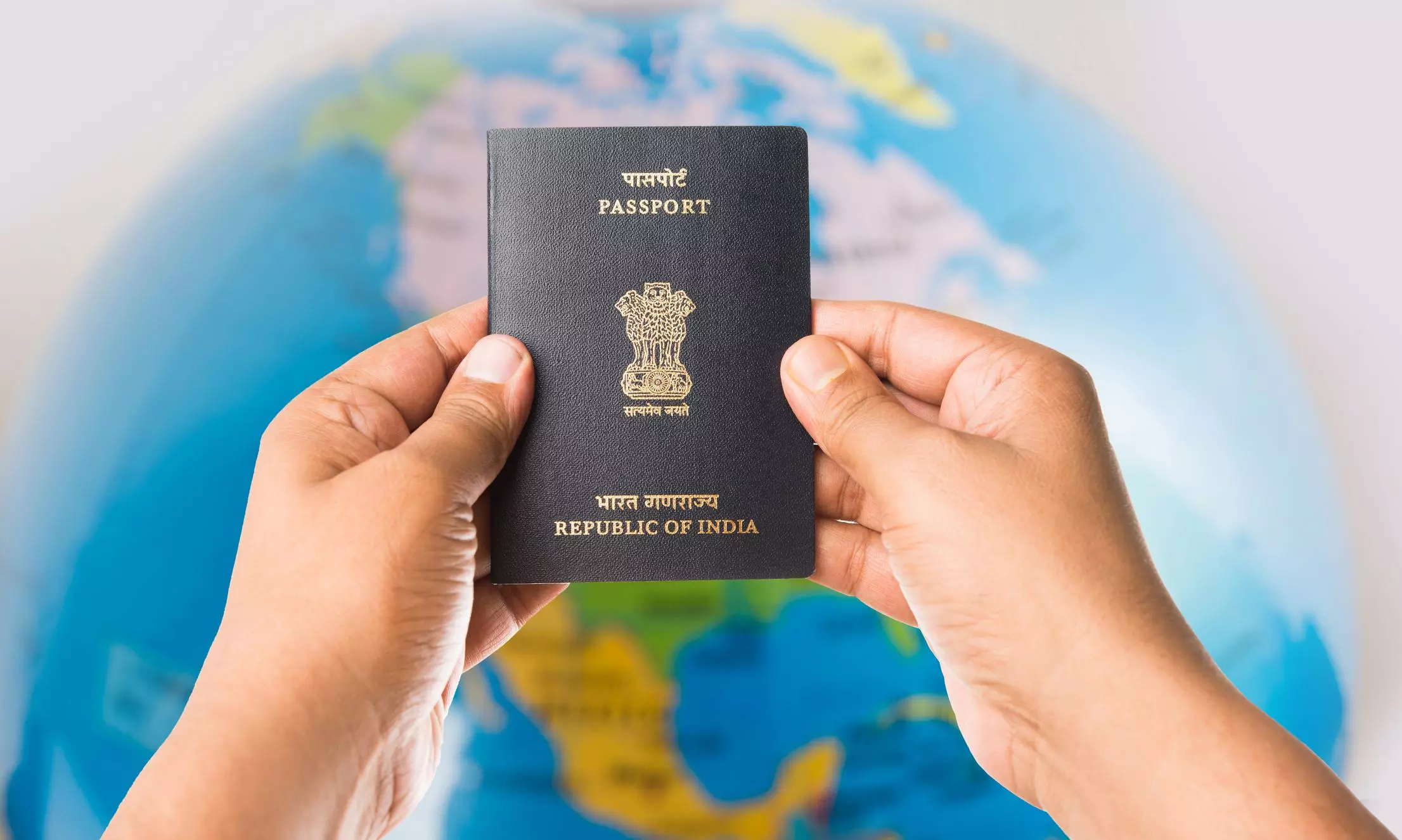
An examination of the Passports Act shows that while a passport is legally a travel document, its issuance is intrinsically tied to Indian citizenship in almost all cases
On June 24, a respected Indian daily newspaper quoted an unnamed senior Ministry of External Affairs (MEA) official as saying “Passport is a travel document, not a document of citizenship, and theoretically speaking, that distinguishes passport from other documents. Even though while travelling abroad, passport attests to your nationality, yet it is not a document of your citizenship”. The official was participating in the 14th Passport Seva Divas.
The official did not care to distinguish between nationality and citizenship, including the inevitable relationship between the two. In this context, it is interesting to note that External Affairs Minister S Jaishankar, while addressing the Annual Regional Passport Officers Conference on June 19 said, inter alia, “...a passport is not merely a booklet of pages. It is a powerful tool, a vital tool, of economic mobility, of international trade, I would even say of national identity”.
A passport, in the overwhelming majority of cases, clearly states the national identity of its holder; hence, Jaishankar was stating the obvious, but having become a consummate politician, he, too, did not enter into the relationship between a passport and citizenship.
SIR does not concern MEA
The newspaper clarified that the official was responding to a question posed by it. The question, its report stated, was “whether the Indian passport could be used to challenge an exclusion from the voter list through the special intensive revision (SIR) of electoral rolls that is currently underway in sixteen States”. Why the official got into the issue of the nature and validity of documents in the SIR exercise is unclear and somewhat mystifying. In any event, officials should stay far away from controversies, especially in areas which are not within their remit. And, SIR does not concern the MEA.
Also Read: Passport row: If a passport isn't proof of citizenship, what is? Experts explain
According to media reports, MEA officials have supported the remarks made by the unnamed senior official, that passports are not a document of citizenship. They claim that this is a long-standing position, and has the support of a Bombay High Court judgement. They have also cited Rule 20 of the Passports Act to endorse this position.
Passports Act, 1967
The issue of passports and other travel documents is governed by the Passports Act of 1967. The Act was passed after the Supreme Court held that an Indian citizen has the right to travel abroad and that this right could only be regulated through legislation. Section 6 of the Act deals with the right of the government to refuse a passport to an Indian citizen to visit a foreign country on various grounds.
It would be appropriate to recall that in 1967, Indians were not allowed to visit South Africa because of its racist policy of apartheid, and Israel, with which India did not have diplomatic relations and also condemned it for its policies towards the Palestinians. Hence, a part of the focus in the Act was on the government’s right to deny Indians permission to visit a specific foreign country or countries. Today, no such restrictions exist, and passports are valid for all countries.
Also Read: Centre clarifies passport is not proof of citizenship, says position unchanged under law
Section 6 (2) of the Act states “(2) Subject to the other provisions of this Act, the passport authority shall refuse to issue a passport or travel document for visiting any foreign country under clause (c) of sub-section (2) of section 5 on any one or more of the following grounds, and on no other ground…”. The very first ground mentioned in Section (2)(a) is “(a) that the applicant is not a citizen of India”.
Thus, it is clear that under this section, unless a person is an Indian citizen, he does not have the right to get a passport to visit specified countries. As passports are now valid for all countries, this ground for refusing a passport could have been lifted, but that has not been the case. Indeed, now passport application forms require a self-declaration which has to state “I owe allegiance to the sovereignty, unity & integrity of India, and have not voluntarily acquired citizenship or travel document of any other country. I have not lost, surrendered, or been deprived of Indian citizenship. I have not contravened any of the conditions relating to the possession and use of an Indian passport”.
Passport applications subject to enquiry
All passport applications made under Section 5 of the Act - and except for a handful under Section 20 - are subject to enquiry. This is provided for under Section 5 (2) of the Act. The enquiry is conducted by the police. The general practice is that a copy of the application form is sent to the police. The police verify whether the residential address provided by the applicant is correct, and they also check whether he has any criminal record.
Also Read: ‘Passport should prove citizenship’: Tharoor calls for legal change
As the police have the full form, they are aware of the applicant’s self-declaration regarding citizenship. Even more, the declaration requires allegiance to the unity, sovereignty, and integrity of India. Can anyone who is not an Indian citizen be asked to “swear such an allegiance”? If the police have any material to the contrary, they can issue a negative report on the applicant. These elements clearly demonstrate that applicants who fulfill the requirement of being Indians are given passports using sections 5 and 6.
Logical reasoning
There is another aspect. As far as this writer knows, there is no single document which specifically affirms Indian citizenship of those who are naturally so. Ironically, those who have acquired Indian citizenship would have at least a document to establish that their application for Indian citizenship has been accepted by the government. Thus, the self-declaration about Indian citizenship has to be accepted unless it is proved to be wrong.
Also Read: MEA says passport is not citizenship proof; so how do you prove you are Indian citizen?
It follows from this reasoning that while a passport is of course a travel document, those passport holders who have made applications under Section 5 and have fulfilled the requirement of Section 6 (2) (a) have to be considered Indian citizens. This is logical, and the MEA should have no reluctance in saying so because of the contents of Section 20.
Section 20
Section 20 states “Notwithstanding anything contained in the foregoing provisions relating to issue of a passport or travel document, the Central Government may issue, or cause to be issued, a passport or travel document to a person who is not a citizen of India if that Government is of the opinion that it is necessary so to do in the public interest”.
Many diplomats who have dealt with sensitive and security issues know that passports and travel documents are given in miniscule numbers under this section, bypassing the normal processes of Sections 5 and 6. Some of these may be to non-Indians, but these are short duration documents and some of them fudge the entry on nationality.
Also Read: BJP says passport alone is not proof of citizenship, rejects claims of new MEA rule
It would be completely wrong, indeed pathetic, to use such passports to assert that all Indian passports do not indicate citizenship of their holders. This is so even if there are judicial pronouncements on the subject. Obviously, these judgements have not looked at the totality of the circumstances.
Indian passports affirm Indian nationality of holder
The SIR exercise has been controversial. Passports may be travel documents, but through logical inference, their holders are Indian citizens. This should be acknowledged by the government in the context of the exercise, because those who have been given them under Section 20 can be ignored for obvious reasons.
Also Read: Why the 'passport is not citizenship proof' row hits Punjab hardest
One last word: Indian passports affirm Indian nationality of the holder. Nationality is used in the international context to indicate the country to which a person belongs. Citizenship is used in the Indian Constitution and in the domestic context. It represents, in one sense, the relationship between a person and his country. It can be asserted though that for India which does not recognise dual citizenship, nationality flows from citizenship.