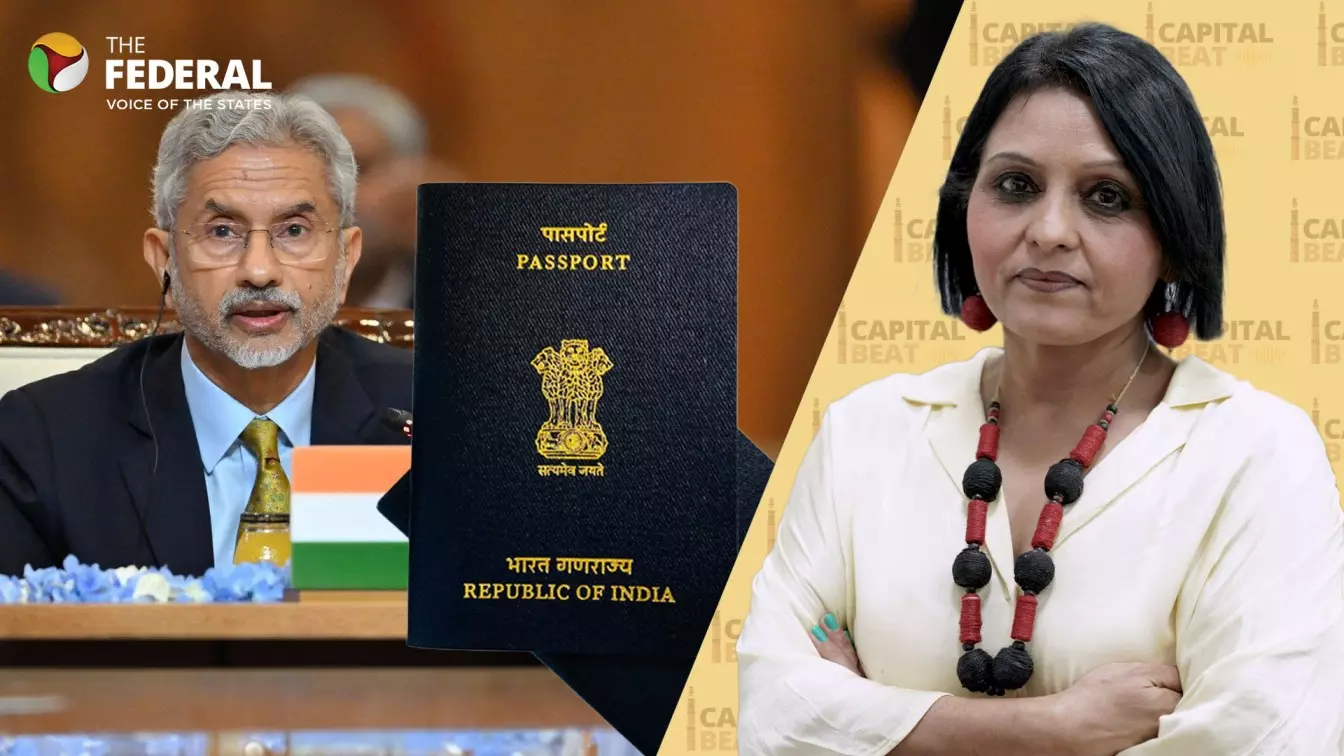
Passport row: If a passport isn't proof of citizenship, what is? Experts explain
Legal experts and activists debate whether the passport controversy reflects a technical legal distinction or a deeper concern about voting rights and citizenship verification

A controversy has erupted after the Ministry of External Affairs (MEA) clarified that an Indian passport is primarily a travel document and not conclusive proof of citizenship.
The clarification has ignited intense debate on social media, with Opposition leaders and activists questioning how citizens are expected to establish their citizenship if even a passport is not considered definitive proof.
On the latest episode of Capital Beat, The Federal spoke to senior Supreme Court lawyer Aruneshwar Gupta, activist Tara Rao, and lawyer-activist Ayushman Pandey to understand whether the outrage is legally justified or politically driven.
'No citizenship certificate available'
Gupta argued that much of the controversy stems from confusion between the legal definition of citizenship and the practical role of a passport.
Also read: MEA says passport is not citizenship proof; so how do you prove you are Indian citizen?
According to him, citizenship in India is governed by the Citizenship Act, 1955, which provides multiple routes through which a person may become an Indian citizen, including birth, descent, registration, naturalisation, and incorporation of territory.
"There is nothing called a citizenship certificate available for every Indian citizen," Gupta said. "Citizenship is acquired through legal provisions under the Citizenship Act."
He noted that millions of Indians do not possess passports but remain citizens by virtue of birth or descent. Therefore, he argued, a passport cannot be treated as the sole determinant of citizenship.
Gupta maintained that the passport's primary purpose is international travel and identification abroad. "If a person never intends to travel outside India, there is no need for a passport," he said.
Political outrage
While Gupta described the social media backlash as largely political, Pandey argued that the controversy cannot be separated from the broader political environment.
Also read: Centre clarifies passport is not proof of citizenship, says position unchanged under law
Pandey pointed out that passports are issued only after extensive documentation and police verification processes. He cited provisions of the Passports Act, 1967, which provide for passports to be issued to Indian citizens, while travel documents are issued to non-citizens under separate categories.
"The passport came to be accepted across the world as proof of citizenship," Pandey said. "If I travel abroad, I cannot prove my citizenship using Aadhaar or a municipal birth certificate. The document recognised internationally is the passport."
He argued that while a passport is indeed a travel document, it remains a travel document issued specifically to citizens.
According to Pandey, public concern has grown because citizens increasingly feel that documents traditionally accepted as proof of identity or status are being questioned by authorities.
Voting rights concerns
The discussion repeatedly returned to concerns surrounding voter verification exercises and citizenship-related documentation.
Pandey argued that the larger issue is not merely the passport itself but the possibility of citizens being asked to repeatedly establish their eligibility to vote.
Referring to constitutional provisions, he said the right to vote is one of the most significant rights associated with citizenship. Any ambiguity surrounding citizenship documentation, therefore, naturally raises public anxiety.
"The concern is not only about passports. It is about whether citizens may be asked to continuously prove who they are," he said.
Pandey maintained that citizenship can only be questioned through due process of law and not through arbitrary administrative decisions.
SIR connection
Rao connected the passport controversy to concerns about voter verification exercises and electoral processes.
She argued that many citizens fear exclusion from electoral rolls and worry that narrowing the list of acceptable documents could make it harder for legitimate voters to establish eligibility.
Rao claimed that large numbers of voters have already faced difficulties during electoral verification exercises and suggested that the passport clarification would deepen those concerns.
"If passports are also questioned, people naturally ask what document remains available to them," she said.
According to Rao, the controversy is not merely technical but relates to citizens' confidence in democratic institutions and electoral processes.
She argued that the government should focus on simplifying documentation requirements rather than creating additional uncertainty around documents that citizens have long considered reliable.
Rebuttable presumption
Seeking a middle ground, Gupta acknowledged that passports do carry significant evidentiary value.
He explained that possession of a valid Indian passport creates what lawyers call a "rebuttable presumption" of citizenship.
In practical terms, that means a passport holder is presumed to be an Indian citizen unless evidence emerges proving otherwise.
"A passport is issued to citizens of India and citizenship is verified before it is issued," Gupta said. "However, legally speaking, that presumption can be challenged if contrary evidence exists."
This distinction, he suggested, may explain why the government describes passports as travel documents while still issuing them only to citizens.
Need for clarity
The discussion concluded with a broader question: whether India requires a clearer and more universally accepted framework for proving citizenship.
Gupta suggested that future legal developments could potentially address existing ambiguities. He noted that many of the current disputes arise because there is no single universally recognised citizenship certificate available to all Indians.
Pandey and Rao, however, argued that the immediate concern is not the creation of new documentation but ensuring that existing citizens are not burdened with repeatedly proving their status.
The debate highlights a larger tension between legal definitions and public perception. While legal experts may distinguish between citizenship itself and documents associated with citizenship, many citizens view the passport as the strongest official recognition of their status as Indians.
As the controversy continues, the central question remains unchanged: if a passport is not considered conclusive proof of citizenship, what document should citizens rely upon when their citizenship is questioned?
(The content above has been transcribed from video using a fine-tuned AI model. To ensure accuracy, quality, and editorial integrity, we employ a Human-In-The-Loop (HITL) process. While AI assists in creating the initial draft, our experienced editorial team carefully reviews, edits, and refines the content before publication. At The Federal, we combine the efficiency of AI with the expertise of human editors to deliver reliable and insightful journalism.)