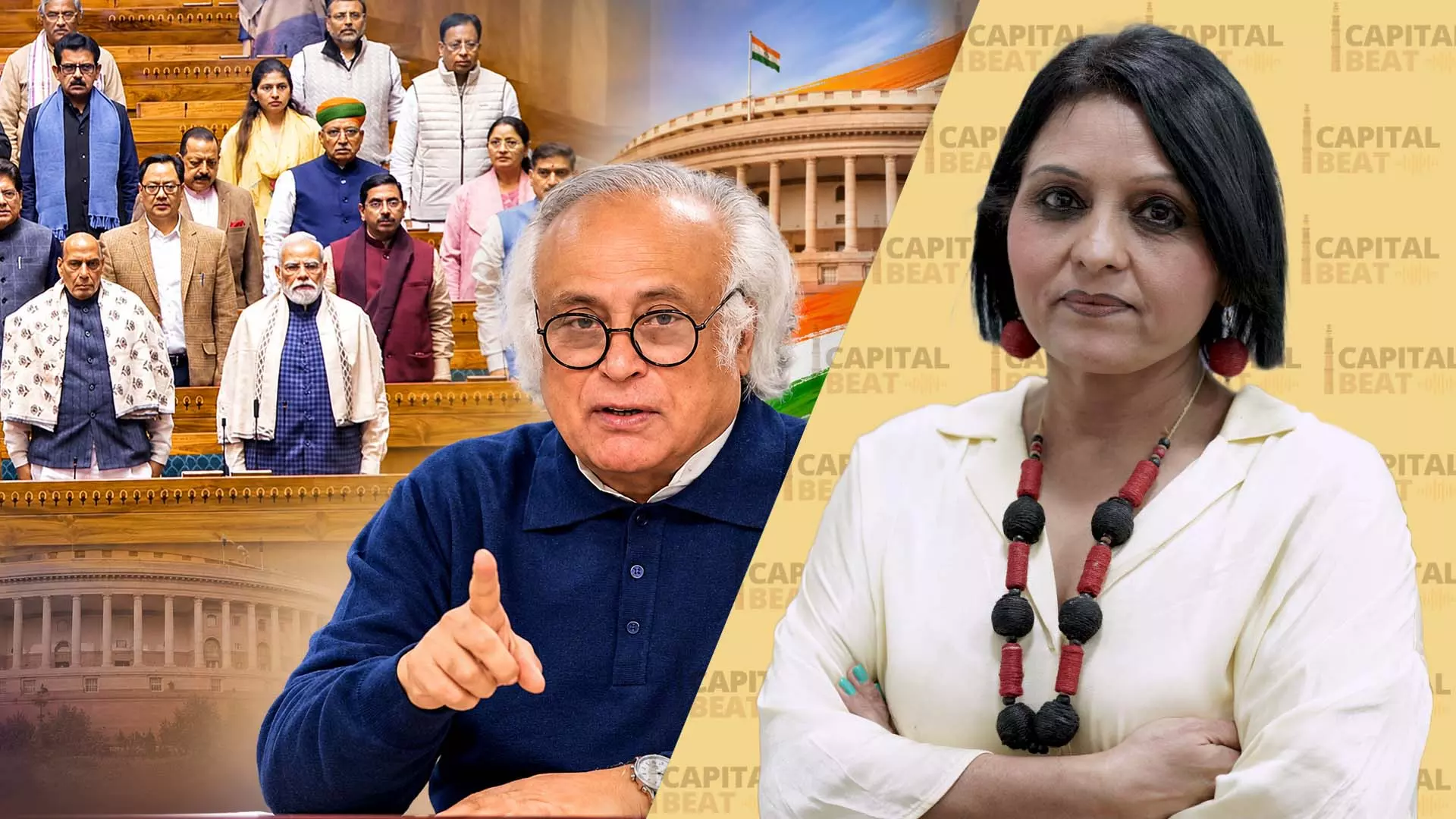
Why hasn’t Parliament reconvened? Inside BJP’s delimitation numbers game
As Congress questions the delay, analysts point to two-thirds amendment maths, regional seat-share bargains, and efforts to stave off a motion against the CEC

Congress general secretary in charge of communications, Jairam Ramesh, in a social media post on Monday (November 23), questioned Prime Minister Narendra Modi and Union Home Minister Amit Shah about the unannounced dates for the winter session of Parliament, the non-prorogation of the monsoon session, and clarity on the delimitation issue.
Political analyst Tehseen Poonawalla, speaking on The Federal’s special programme Capital Beat, stated that the government is delaying the winter session because it is seeking the required numbers for a constitutional amendment to pass the delimitation bill. Poonawalla noted that the winter session may be delayed until January, similar to 2017 ahead of the Gujarat elections, rather than being cancelled entirely.
Also read: Delimitation Bill: Why Stalin and Akhilesh hold the key to BJP’s gameplan
“The government is maintaining silence because they want to pass the delimitation bill, in which case they need those numbers for the constitutional amendment,” Poonawalla stated.
Pawar play at work
Poonawalla criticized both the government’s approach to parliamentary functioning and the Opposition’s strategy in holding the executive accountable on issues such as inflation and electoral matters. He further stated that the Nationalist Congress Party (NCP) faction led by Sharad Pawar and Supriya Sule would support the delimitation bill, claiming that the Pawars and the Uddhav Thackeray-led Shiv Sena (UBT) had weakened the Congress in Maharashtra.
“The Supriya Sule-led NCP will vote for delimitation, and she has made that abundantly clear in multiple recent interviews,” Poonawalla stated, arguing that even a uniform 50 per cent increase in Lok Sabha seats would leave Maharashtra further behind Uttar Pradesh in parliamentary representation.
Resistance from male BJP MPs?
Senior journalist Smita Gupta argued that the government has kept the previous session open without proroguing it because it is still attempting to gather roughly 50 additional votes beyond what it had in April, approaching parties including the NCP, DMK, YSR Congress Party, Shiv Sena (UBT), Samajwadi Party, and AIMIM.
Also read: Inside the delimitation battle: What Centre wants and why Opposition is resisting
Gupta observed that keeping the session open allows the government to reconvene Parliament with two days’ notice rather than the two weeks required for a fresh session. While expressing scepticism that Sharad Pawar would join the National Democratic Alliance (NDA), Gupta noted that the BJP has unofficially conveyed to regional parties—particularly in southern and northeastern states concerned about losing representation due to population control—that seats could be increased by 50 per cent across all states rather than strictly by population growth.
“The Congress formula is that we remain where we are (543 seats), we don’t increase the number of seats, we freeze it for 25 years,” Gupta stated, adding that linking the women’s reservation bill to delimitation was done to delay the implementation due to resistance from male BJP MPs.
Regarding parliamentary disruptions, Gupta noted that Opposition parties cannot force debates unless the Lok Sabha Speaker or Rajya Sabha Chairman admits discussions under rules that hold the government accountable, recalling that the BJP had similarly stalled proceedings during the 10 years of the Manmohan Singh government.
The Gyanesh Kumar factor
Political analyst Ayushman Pandey stated that the government did not prorogue the monsoon session because convening a fresh session would allow the Opposition to push for a discussion on the impeachment of Chief Election Commissioner Gyanesh Kumar. Pandey questioned why the government had not introduced the delimitation bill during the monsoon session if it already possessed the requisite numbers.
Also read: Explained: DMK's 3 conditions that could make or break Delimitation Bill
“The session was not prorogued for one reason: That if it is taken to another session, then the Opposition would want to discuss the impeachment of Gyanesh Kumar,” Pandey stated.
Pandey further stated that the government might attempt to pass the constitutional amendment by suspending around 100 Opposition MPs to lower the effective strength of the House, while warning that the proposed delimitation bill would grant the executive unchecked authority to appoint the delimitation commissioner.
Upcoming assembly elections
Assessing the political calendar, Gupta stated that the government’s primary focus is the upcoming assembly elections in states such as Uttar Pradesh, Punjab, Uttarakhand, Karnataka, and Madhya Pradesh. She noted that even if the delimitation bill is passed, actual delimitation is a lengthy exercise that will not alter seat counts for the upcoming state assembly polls, though passing a constitutional amendment would create political momentum ahead of 2029.
“Given the kind of resources, the kind of 24/7 kind of work that the BJP does to the exclusion of everything else, when you are fighting an enemy as formidable in terms of strength, money, powers, you have to go that extra mile,” Gupta stated regarding the Opposition’s challenge.
Also read: Why delimitation Bills appear more ominous than originally thought
Pandey countered Poonawalla’s characterization of the Opposition, stating that Opposition parties had fought against the odds to defeat the bill once in Parliament earlier. “I would say that the Opposition has put up a brave fight against all odds; they have defeated the bill once in Parliament,” Pandey stated.