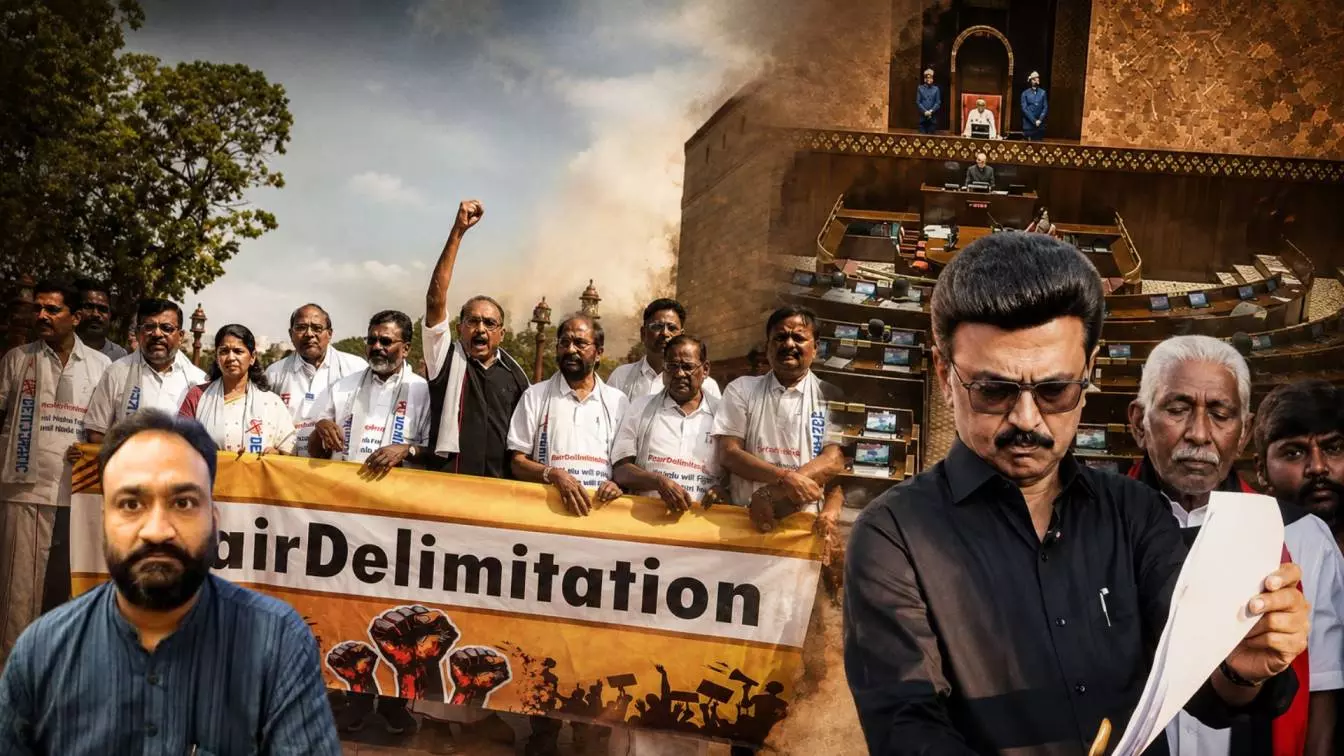
The DMK had called delimitation a trap in April but is now reportedly open to backing the bill if it gets written assurances on seat increases and a freeze.
Explained: DMK's 3 conditions that could make or break Delimitation Bill
A possible U-turn by DMK could help the Modi govt clear the numbers, but the party wants written safeguards to defend its position in Tamil Nadu; what are they?

With just four days left in the Monsoon Session of Parliament, attention is turning to whether the Centre will reintroduce the Delimitation Bill and the Constitution (131st Amendment) Bill. It currently has the support of 325 MPs on paper, leaving it 35 votes short of the 360-threshold to clear the proposed constitutional amendment.
The numbers could, however, shift depending on the DMK’s position on delimitation. The Dravidian party had opposed the bill when it was first introduced in April 2026. Its stance now appears to be evolving, raising the possibility that the party could reconsider its position if the legislation is brought back before Parliament.
Also read: Why delimitation Bills appear more ominous than originally thought
What are the numbers behind the Opposition’s position? How can the DMK use its support as leverage in the debate over delimitation? Here are some answers.
The Centre suffered a setback on April 17 when the 131st Amendment Bill failed to secure the required two-thirds majority. Has the arithmetic changed now?
Yes, it appears so.
The Centre needs a two-thirds majority to pass a Constitution amendment. There are essentially two bills that we are interested in here. One is the Constitution (131st Amendment) Bill, which the government wants to make another attempt at pushing through Parliament. The second is the related Delimitation Bill, which is not a Constitution amendment.
The Delimitation Bill itself can be passed by a simple majority. The requirement for a constitutional amendment arises because the government wants to change the constitutional scheme under which delimitation is conducted.
The numbers are crucial. The government currently has the support of 325 Lok Sabha MPs, against the two-thirds majority mark of 360, up from 298 votes when the Constitution amendment bill was put to vote in April.
The increase includes 20 of the TMC’s 28 MPs who have defected to the Nationalist Citizens Party of India, and six of Shiv Sena (UBT)’s nine MPs who have joined the Eknath Shinde-led faction. Shiromani Akali Dal’s lone MP, Harsimrat Kaur Badal, has also said she will support the delimitation bill.
That pushes the number to 325. The two-thirds mark is 360. So, on paper, the government is still short of the two-thirds mark. Whether it can show up enough numbers and reach that 360 figure depends on whether it can negotiate support with the DMK and with at least another two dozen or slightly fewer than two dozen MPs from Opposition parties.
The DMK had called delimitation a trap in April but is now reportedly open to backing the bill if it gets written assurances on seat increases and a freeze. Is the DMK using its leverage to extract concessions?
Whether this bill passes or not will ultimately boil down to the position that the DMK takes. That kind of burden comes with its own pros and cons, and there are more cons here than pros because of the very strong and strident position that the DMK had taken against this bill just a few months ago in April.
Also read: Inside the delimitation battle: What Centre wants and why Opposition is resisting
If it decides to do a complete U-turn and support the government on delimitation, it will need a face-saver. It will need grounds to go to the public in Tamil Nadu in the 2029 elections and defend its U-turn.
How does the DMK do that?
If the bill passes, naturally the Opposition is going to make a lot of noise about it and against it.
Particularly in Tamil Nadu — whether it is the ruling TVK, the Congress or the Left parties, who are now part of an alliance — they are all going to paint the DMK as the single villain of the delimitation exercise. So, naturally, the DMK wants assurances. From the back-channel negotiations they have been having, there are three things that the DMK has asked for. It wants very explicit written assurances from the government.
1) The first demand is that the 1971 Census be used as the base for any increase in Lok Sabha seats, with the revised number then frozen for the next 25 years. The party had opposed the government’s earlier proposal to base delimitation on the 2011 Census. For the bill to secure DMK’s support, the government may therefore have to assure the party that the 2011 Census will not be used as the basis.
2) The second demand is that the government’s earlier oral assurance of a 50 per cent increase in Lok Sabha seats for every state be incorporated into the bill. The party wants the provision to apply uniformly across all states, rather than remain a verbal commitment. This would ensure that each state’s share of total Lok Sabha representation remains unchanged after delimitation.
Also read: DMK shapes its ‘support’ for Delimitation Bill around a single point: seat freeze
3) The third demand is that the bill should clearly specify the number of Lok Sabha seats allocated to each state after delimitation. It wants the revised figures to be included in the legislation as a schedule, ensuring the proposed seat distribution is formally recorded in writing.
If the government accepts all three, the DMK can improve its position politically because then it can go back to Tamil Nadu and defend its U-turn by saying that it did this in the interest of Tamil Nadu.
The Opposition that defeated the bill in April has since lost the support of two major blocks through defections. Does it enter this round visibly weaker?
They haven’t lost the two blocks entirely. The TMC of Mamata Banerjee, as well as Shiv Sena (UBT), is still very much part of the Opposition ecosystem. What has happened is that, because of the defections in these two parties, the INDIA bloc is much weaker in numbers in the Lok Sabha now.
The Trinamool Congress, which had 28 MPs in April, now has only eight, with the remaining 20 having defected. Whether all eight will vote together, abstain or cross-vote remains uncertain.
Also read: ‘Women’s reservation shouldn’t be tied to delimitation’ I Interview
Similarly, Shiv Sena (UBT) has been reduced from nine MPs to three after six defections. Together, the two parties have lost 26 MPs, weakening the INDIA bloc’s numbers ahead of the vote.
Additionally, the DMK, which had been at the forefront of protests against the delimitation bill in April, is now no longer an ally of the Congress and has more or less walked out of the INDIA bloc.