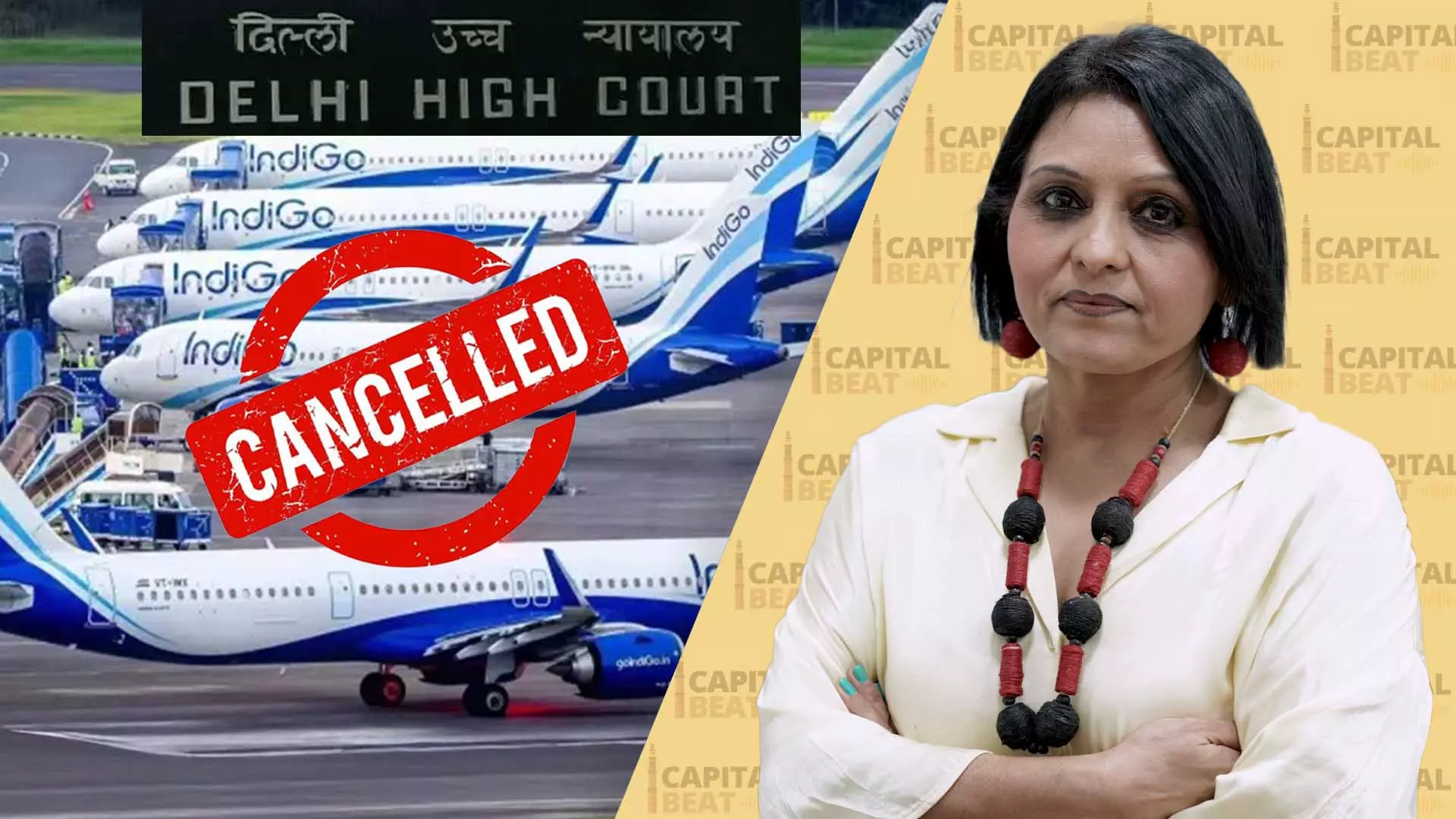
Indigo flight chaos: Is DGCA working efficiently? | Capital Beat
A court order demands passenger compensation as experts Amit Singh and Captain Saurabh Bhatnagar point to enforcement failures, fare opacity and crew shortfalls behind the mayhem

The Delhi High Court’s observations on the large-scale flight cancellations by IndiGo formed the central focus of a recent Capital Beat discussion featuring aviation safety expert Amit Singh and senior pilot Captain Saurabh Bhatnagar. The panel examined the court’s demand for passenger compensation, the regulatory gaps highlighted in the courtroom, and the operational failures that triggered widespread disruption across major routes.
The bench, led by Chief Justice D K Upadhyaya, directed the Ministry of Civil Aviation, Directorate General of Civil Aviation (DGCA) and IndiGo to compensate the stranded passengers at the earliest. The court noted that the spike in airfares—to as high as Rs 40,000 on some routes—had created an alarming situation with broader economic implications. IndiGo’s cancellations had also contributed to sharp fare surges, including a Delhi-Mumbai non-stop ticket that touched Rs 65,460 recently.
Also read: DGCA to station personnel at IndiGo headquarters to monitor ops
The episode has brought regulatory oversight, fare transparency, and pilot availability into sharper scrutiny, raising larger questions about crisis management in India’s aviation sector.
Court intervention and passenger compensation
The high court noted that authorities allowed the situation to escalate before taking corrective actions. It questioned why other airlines were permitted to increase fares during the disruption and sought a report on the steps taken to address the pricing spike. The additional solicitor general informed the bench that a show-cause notice had already been issued to IndiGo.
Amit Singh explained that the current debate required clarity on the difference between refunds and compensation. He said existing rules define refunds strictly as the return of the amount paid by passengers, whereas compensation is subjective and requires a broader policy intervention. He emphasised that while refunds were mandated, compensation frameworks remained inadequate without a passenger's rights charter.
Also read: How IndiGo crisis exposes India’s fragile skies
The discussion also highlighted concerns over fare transparency. Singh said that Rule 135 (of Aircraft Rules, 1937) requires airlines to publish their minimum and maximum fare slabs publicly, but instances had emerged where these were not available. This raised questions over compliance and oversight by the DGCA.
Gaps in DGCA oversight and regulatory enforcement
Multiple sections of the discussion centred on alleged deficiencies in the DGCA’s monitoring mechanisms. Singh pointed out that regulations mandating adequate pilot strength existed, but their enforcement was weak. He said repeated delays, seasonal patterns, and predictable operational bottlenecks continued to trigger fare spikes every year.
He further noted that while airlines had obligations to maintain updated fare sheets and adhere to regulatory circulars, the absence of timely DGCA intervention contributed to prolonged disorder. Singh said that oversight issues — and not isolated incidents — lie at the core of the current aviation disruption.
Also read: PM Modi says ‘rules must ease life’ as DGCA trims IndiGo schedule by 5% amid chaos
The panel linked these lapses to structural weaknesses in regulatory audits. Singh stated that systemic issues often surfaced only during special audits, whereas routine audits failed to detect the same discrepancies.
Impact of FDTL norms and crew shortages
The revised Flight Duty Time Limitations (FDTL) that came into effect on November 1 emerged as another critical factor in the crisis. Captain Bhatnagar noted that changes such as reduced night-landing allowances and expanded night-hour definitions significantly increased staffing requirements.
He said the crisis did not emerge overnight because the new rules had been known since January 2024. According to him, IndiGo required 900-1,000 additional pilots to operate its expanded winter schedule, but hired only around 400. The resulting shortfall, he said, pushed the airline into unsustainable rosters despite favourable weather conditions and no major air-traffic congestion.
Also read: IndiGo refunds Rs 1,158 crore for 12.5 lakh cancelled tickets in 19 days
Bhatnagar said IndiGo operated as a lean airline with limited buffer staff, making it vulnerable to disruptions under the revised norms. He added that the DGCA had approved the airline’s increased winter schedule without fully assessing crew availability.
Escalation during peak travel season
The panel noted that cancellations intensified between December 1 and 3, coinciding with major marriage dates across the country when passenger movement increases sharply. This aggravated the disruptions, leaving thousands of travellers stranded. IndiGo reported a shortage of 124 pilots, including 65 captains and 59 first officers, but the panel questioned whether this alone could cause widespread nationwide cancellations.
The high court asked the Centre why guidelines for phased implementation of the new norms were not adhered to, and what action was being taken if airlines had failed to recruit adequate pilots. The next hearing is scheduled for January 22.
Also read: IndiGo flight cancellations: Delhi HC calls it 'crisis', questions Centre
Bhatnagar said that fare-capping mechanisms existed under Rule 135 and had been applied during the post-COVID period. The rule empowers the DGCA to intervene when fare hikes cross extraordinary thresholds. He said compensation rules under CAR Section 3, Series M, Part IV established fixed slabs, but the low amounts required reconsideration in light of large-scale disruptions.
Need for stronger institutional processes
In one of the two direct quotes selected for this story, Bhatnagar stated, “The crisis of this magnitude doesn’t happen overnight. This was something that was known, and action was not taken in time.”
Singh observed that aviation safety systems in India often relied on minimal compliance rather than proactive measures. He described a pattern where normal audits failed to detect systemic problems that only surfaced when special inspections were ordered after incidents.
The second direct quote highlighted his concern, “So long as nobody is watching, you keep doing whatever you want. That is the bottom-most level of safety culture.”
Also read: IndiGo crisis: Could the chaos have been prevented? | Ex-AirAsia CFO explains
The panel referred to past examples in which technical or operational lapses were detected only after flights had operated for long durations without meeting mandatory safety requirements. Singh said such trends pointed to deeper issues in organisational processes and regulatory validation.
Debate over structural reform
Bhatnagar suggested that the DGCA's leadership should ideally come from an aviation background to ensure better rule enforcement. He pointed out that several pilot associations had made similar recommendations earlier. The discussion also mentioned the need for more airlines and increased competition to prevent concentration-driven vulnerabilities.
The session ended with questions on whether inquiries underway would lead to structural changes or remain limited to crisis-specific corrections.
The content above has been transcribed from video using a fine-tuned AI model. To ensure accuracy, quality, and editorial integrity, we employ a Human-In-The-Loop (HITL) process. While AI assists in creating the initial draft, our experienced editorial team carefully reviews, edits, and refines the content before publication. At The Federal, we combine the efficiency of AI with the expertise of human editors to deliver reliable and insightful journalism.