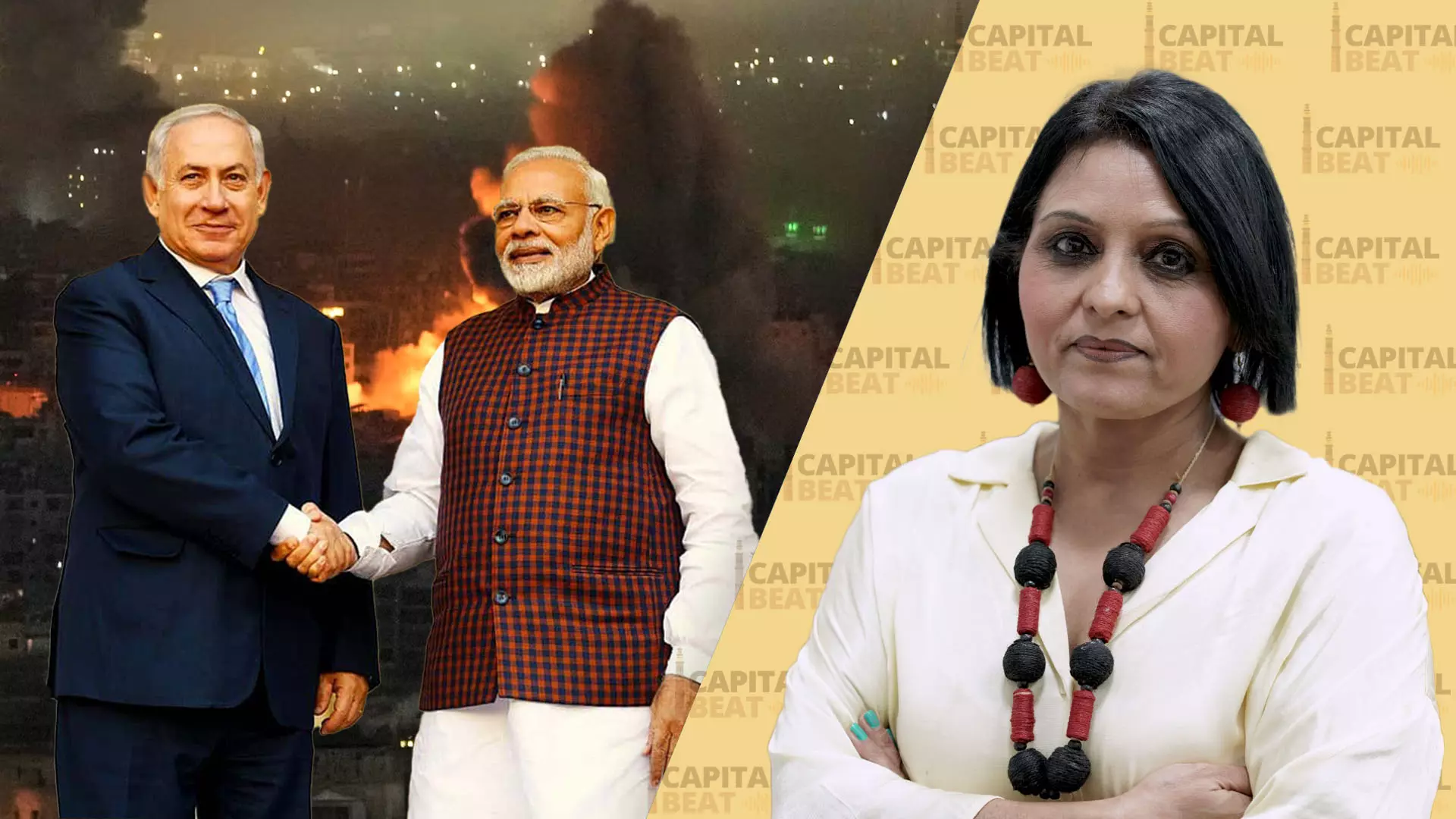
India has lost its voice on West Asia: Former Delhi LG Najeeb Jung | Capital Beat
Najeeb Jung analyses India’s diplomatic balancing act, pressures shaping our foreign policy, and what the ongoing crisis means for India’s strategic interests

India has very limited influence in the ongoing West Asia crisis and therefore has little room to act decisively, said former Delhi Lieutenant Governor and veteran bureaucrat Najeeb Jung in a conversation with The Federal.
Pointing out that India has not acted at all in this episode, he pointed out that India’s influence in the world is exaggerated and that India does not count very much for the Americans right now... In his view, therefore, New Delhi is being pragmatic by remaining cautious.
Amid rising criticism of India’s stance on the Iran–Israel conflict and accusations that New Delhi is tilting towards Washington and Tel Aviv, The Federal spoke to Najeeb Jung about India’s foreign policy choices, the limits of its global influence, and what options remain for the country as the conflict escalates.
How do you see the Iran–Israel war and the criticism of India’s foreign policy in this conflict?
There are two parts to your question. First is the Israel–Iran war, and the other is our foreign policy.
On the war itself, you hear very different narratives. If you see YouTubers and many commentators, you get the sense that Iran seems to be doing well and hitting Gulf countries. If you listen to right-wing Western media, you get the impression that the Americans and Israelis are doing extremely well and that Iran is getting demolished. The truth lies somewhere in between.
Also read: Live! Iran makes ominous threat to Netanyahu; Trump urges allies to send warships to Hormuz
There is no doubt in my mind that Iran is taking a very heavy beating on the field. Their cities have been destroyed. Tragically, historic cities like Isfahan have been hit. And yesterday, Kharg Island was hit, which will bring enormous hardship to Iranians.
On the other hand, this is also a war of attrition. Iran is hitting back vigorously and causing damage to West Asian countries. The Americans seem indifferent to the damage and loss of life being caused. To my mind, that is extremely inhuman because there was no need for this war at all.
Did India act too late, given it has good relations with the US and Israel and could have engaged Iran earlier?
Look, India has not acted at all in this episode. Signing a condolence book is neither here nor there. We also tend to exaggerate India’s influence in the world. I don’t think India counts very much for the Americans right now.
I also think India was currying needless favour with the Israelis, when the Prime Minister went to Israel knowing fully well that the war was only days away. Strategically, to my mind, that was a mistake. It sent out the wrong message to Muslims in India that he was visiting Israel during Ramadan.
Vis-à-vis Israel, we want to be friends. We want their technology. We want to buy spyware, arms, and ammunition. That is fine. But you cannot influence Israel to go to war or stop a war. India may be a growing power, but internationally America has shown us that we don’t count for very much.
Many diplomats argue that India is simply being pragmatic and balancing relations with multiple powers. What is wrong with that approach?
I think it is an approach where India has no choice because you know your limitations. You know that your voice will not be heard. So, you stay in your corner and don’t enter the boxing ring because you will be knocked out and nobody will care.
You can say we are the world’s third or fourth largest economy, but that does not matter much globally. We conceded to the Americans when they said don’t buy Russian oil. To my mind that was insulting. And now we hear that the United States is permitting us to buy oil for 30 days. That again is quite insulting.
Also read: Iran weighs 'China-only' terms for limited reopening of Strait of Hormuz
There was a time when India commanded respect — when Indira Gandhi stood up to President Nixon in 1971, when President Kennedy personally reviewed rooms in Blair House before Jawaharlal Nehru visited, or when Nehru went to the USSR and was welcomed warmly.
Today, we are in a different age of realpolitik. America knows its power and the pressure it can apply on the developing world. And it still sees India as part of that developing world.
Some say India’s silence is actually a smart diplomatic move. Do you think silence is strategic?
Let me tell you a story. During football matches in Delhi in the old days, there was a famous wrestler from the Jama Masjid area called Badshah Pehlwan. During the finals he would say ‘dono acche, dono acche’ — meaning everyone is good.
That is the approach we seem to be taking now. It is less about strategy and more about the fact that we cannot do very much because we don’t count for much. If India says something today, nobody will care. Look at the Iranian leadership. They have spoken to President Xi and others. We have only spoken to the President of Iran. Something is missing.
We must understand our limitations.
Should India have directly engaged Iran’s top leadership, including Ayatollah Mujtaba Khamenei?
Yes, I believe the Prime Minister should have spoken to Mujtaba because he is the one who counts. The Iranian president has already been embarrassed after statements he made had to be retracted. Iran has a deep culture of sacrifice going back to Karbala. You cannot beat Iran into submission. You may destroy them militarily, but this will become a war of attrition.
Iran may be badly damaged economically, but they will not lose unless every Iranian is killed or the country is nuked.
There are also claims that India’s foreign policy is under pressure from global economic or political factors. How do you see this?
I come back to the same point. You can call it pragmatism or a realistic understanding of where you stand. India has done what it could. Beyond that, I don’t think India can convince anyone on how to act in this war.
Also read: Why Kharg Island is the lifeline of Iran’s oil empire and what happens if it goes offline
You may say ‘enough is enough’ but who will listen? Decisions will ultimately be taken by Israeli influence or the Zionist influence in the United States.
In an era of weaponised hard power, what should India be doing?
From a moral standpoint, I would go back to Gandhi. If India had a Gandhi today, India would say what is happening in the Gulf is wrong. India would say we cannot go back to inhuman conditions and must restore humanity.
That is probably the stand India would have taken in earlier times.
What options does India have now to make its foreign policy more robust?
You have answered the question yourself. We have lost most of our options. America is not listening. Donald Trump will not care for what we say today.
We have tried to please Israel by hugging Netanyahu even when an illegal war was coming. Our neighbourhood options are also limited. We are not friends with China. Relations with Pakistan are hostile. Afghanistan counts for very little internationally. We have poor relations with Bangladesh and no relations with Myanmar.
So where exactly does our foreign policy stand today?
Perhaps, we should consult experienced diplomats like Shivshankar Menon or Shyam Saran. They should be advising policymakers in South Block instead of only speaking on television.
Some argue India is playing smart by maintaining strategic autonomy in energy, technology and economic ties. What do you think of that view?
Akbaruddin writes good English. That is all I will say. All those points about autonomy and flexibility may be true. But the real question is where India actually stands in terms of global power. Many experts say India should intervene. Even some voices in the EU and the US say that. But I ask — intervene with whom? What will we say? And who will listen?
You can say anything. But the other side must respect what you say.
India is wise in understanding its limitations. Call it pragmatism or realism. Staying quiet may be the only option.
Do you think India risks losing trust with Iran, especially if the Strait of Hormuz crisis worsens?
I think reports that Iran will allow Indian ships through Hormuz while blocking others may be exaggerated. We will have to see in the next few days.
Iranians will not easily forget the feeling that they were let down at a crucial moment. Look at China. Chinese ships are passing through easily. Sometimes other ships even carry the Chinese flag to get passage. That shows economic power.
China has said very little publicly, but it has demonstrated its influence through the Hormuz situation.
From Iran’s perspective, what would repair relations with India? Would a phone call from the Prime Minister be enough?
I don’t know Mujtaba’s state of mind right now. He has lost his father, his wife, and his daughter. I am told he himself is injured.
When someone is going through such tragedy and believes a country stayed silent for 15 days while he was being attacked, I don’t know if a phone call will be enough. Perhaps something more — like the foreign minister travelling there — could be a gesture. But I doubt whether India can afford that with the Americans and Israelis watching us.
What should India prioritise now as the crisis unfolds?
This situation is changing every hour. India will probably be considering its options primarily regarding the Strait of Hormuz crisis because that will hit us badly. The telephone lines will have to be worked constantly with Iran. Their ambassador here has spoken positively about friendship, but I don’t know how much weight that carries in Tehran.
For now, we have to wait and watch.
The content above has been transcribed from video using a fine-tuned AI model. To ensure accuracy, quality, and editorial integrity, we employ a Human-In-The-Loop (HITL) process. While AI assists in creating the initial draft, our experienced editorial team carefully reviews, edits, and refines the content before publication. At The Federal, we combine the efficiency of AI with the expertise of human editors to deliver reliable and insightful journalism.