



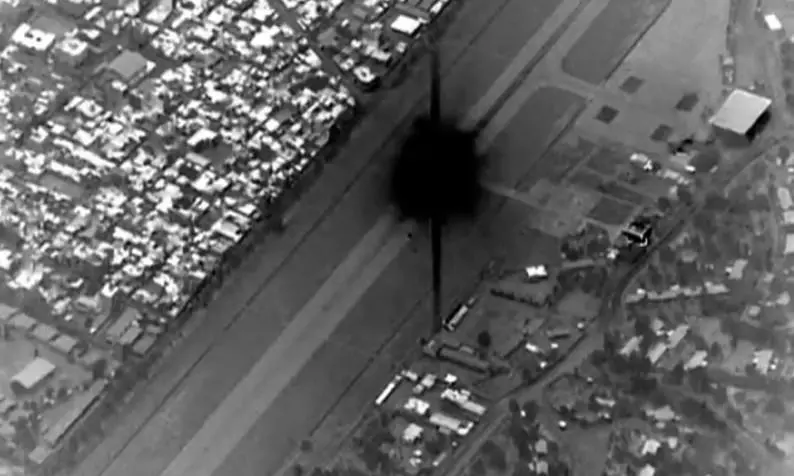
Ninety per cent of Iran’s oil exports, approximately handling 950 million barrels annually, are processed on the island, located 34 miles northwest of the Bushehr port. Screegrab: Trump/Truth Social
Why Kharg Island is the lifeline of Iran’s oil empire and what happens if it goes offline
Kharg Island handles most of Iran’s oil exports. Here’s why the strategic Gulf terminal matters and what its disruption could mean for global energy markets

The US, by bombing Iran’s Kharg Island, the nerve centre of the Islamic Republic’s energy empire, seems to have sent a clear message to the Iranian regime that if it continues disrupting shipping in the Strait of Hormuz, then its oil infrastructure will be targeted in the ongoing war.
President Donald Trump made it clear in his post on Truth Social, wherein he announced the US Air Force’s bombing of the military infrastructure on Kharg Island, adding that if Iran continues to disrupt shipping in the Strait of Hormuz, then his military would not hesitate to strike the oil infrastructure on the island.
"For reasons of decency, I have chosen NOT to wipe out the oil infrastructure on the island. However, should Iran, or anyone else, do anything to interfere with the free and safe passage of ships through the Strait of Hormuz, I will immediately reconsider this decision,” stated Trump.
Why Kharg matters
So why is this 22-square-kilometre island of coral of such importance to Iran's economy? The statistics make it crystal clear. According to a report in Al Jazeera, 90 per cent of Iran’s oil exports, approximately handling 950 million barrels annually, are processed on the island, located 34 miles, northwest of the Bushehr port and 15 nautical miles from mainland Iran.
Also Read: US says it won't allow Iran to block Strait of Hormuz, calls threat ‘sheer desperation’
Natural geography plays a decisive role. The waters around the island are deep enough to accommodate the largest crude carriers, sparing tankers the navigational limits that complicate access to many Gulf ports.
Once loaded, these vessels head largely toward Asian buyers, with China accounting for the largest share.
Pipelines and export infrastructure
The infrastructure on the island links several offshore fields to the global market. Crude extracted from Aboozar, Forouzan and Dorood travels through an extensive network of subsea pipelines before reaching storage tanks and loading points along Kharg’s coastline.
Also Read: Strait of Hormuz not closed, some ships still passing: Khamenei’s representative
Even under the strain of international sanctions, Iran has continued expanding this logistical hub. In May 2025, S&P Global Commodity Insights reported that Tehran restored two storage tanks- numbers 25 and 26 - each capable of holding about 1 million barrels, effectively increasing the terminal’s storage capacity by two million barrels.
At full capability, the island’s loading system has historically handled as much as 7million barrels per day. Current export volumes are far lower, averaging around 1.6 million barrels daily, though the facilities still play a crucial role in balancing domestic supply and foreign sales.
An island tied to global energy
Kharg’s strategic value has also made it a repeated target during modern conflict. Iraqi aircraft bombed the island’s oil facilities extensively during the Iran-Iraq war of the 1980s in an effort to disrupt Iranian exports.
Today, the island remains heavily militarised, with restricted access keeping most visitors away. The tight security has had an unintended effect: much of its natural coastline and archaeological heritage has remained largely undisturbed.
Also Read: Trump tells G7 Iran ‘near surrender’, but then Tehran vows retaliation
Out in the Gulf, tankers still depart from its terminals carrying crude drawn from beneath Iranian waters. Onshore, the weathered graves and ancient shrines stand quietly above the coral shore, reminders that long before energy politics turned Kharg into a strategic prize, generations of traders, settlers and pilgrims had already passed through this small island at the edge of the Gulf.
The fate of global energy markets, and Iran’s most powerful economic lever, now remains entangled with the uncertain course of the 2026 war, as President Trump’s warning that he may yet “reconsider” sparing the island’s oil facilities continues to loom over the conflict.