Only PR or tangible benefit? Decoding the importance of AI Impact Summit
Is India truly ready to lead the global AI revolution, or are we hosting high-profile summits without fixing the core issues?

Is the India AI Impact Summit a serious strategic step in the global AI race — or a grand spectacle heavy on optics and light on substance?
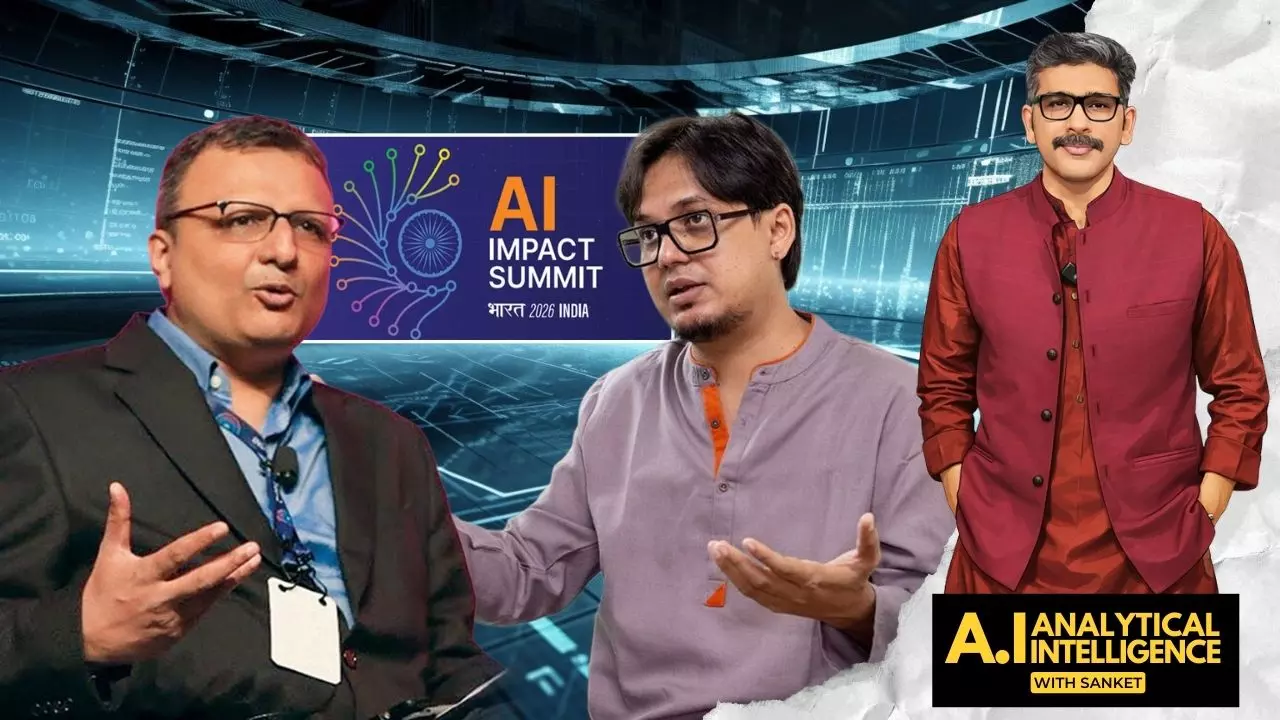
As India positions itself as a voice of the Global South in the fast-evolving AI landscape, The Federal, in the latest episode of AI With Sanket, spoke to Shashi Shekhar Vempati, co-founder of Deep Tech for Bharat and former CEO of Prasar Bharati, and Abhishek Asthana, columnist and social media commentator popularly known as Gabbar Singh, to decode whether the summit delivers real value or remains largely a public relations exercise.
India’s AI moment
Vempati argued that India hosting such a summit is strategically significant. The global AI debate, he noted, has largely been dominated by the United States and China. “Most of the global buzz has been about what is happening in the US and China. But it is India that provides the largest talent pool for technologies like AI and semiconductors,” he said.
He pointed to last year’s AI summit in Paris, where there was a visible divide — the US advocating rapid innovation with minimal government intervention, and Europe stressing regulation and safety. According to Vempati, Prime Minister Narendra Modi articulated a middle path balancing innovation with safety concerns, which helped bring the summit to India.
For him, the summit’s opportunity lies in three areas: amplifying India’s voice in sovereign AI models, showcasing the country’s talent pool, and providing a platform for Indian innovators to build solutions not just for India but for the world.
Beyond a talk shop?
Big international summits often attract criticism for becoming expensive talk shops. Vempati dismissed that concern, saying the real value lies beyond official declarations.
“For many Indian AI startups, this is the first time they have an international audience to showcase their products,” he said. Even if the official agenda remains limited to declarations on ethics and transparency, the networking opportunities could create long-term value.
Also read: Will Bill Gates attend AI Impact Summit? Foundation says yes, reports say no
He emphasized that exposure to global researchers, potential customers, and collaborators could benefit Indian startups in ways that are not immediately visible.
However, Asthana took a contrasting view. Speaking bluntly, he described such events at Bharat Mandapam as largely PR-driven. “What usually comes out of Bharat Mandapam is PR,” he said, adding that while governments need to project their work, AI is fundamentally a deep-tech challenge that requires sustained R&D investment.
The R&D gap
Asthana highlighted a core structural issue: India’s low investment in research and development. “We are just spending 0.7 per cent on R&D. That is an abysmal amount,” he said.
Using a vivid analogy, he argued that hosting grand events without strengthening core capabilities is misplaced. “It’s like organising a wedding without the bride and groom — the tent is up, the food is ready, but the essentials are missing,” he said.
Citing China’s DeepSeek and the rise of ByteDance, Asthana pointed out that such breakthroughs were not born at summits but through sustained institutional and state-backed support. He referred to structured talent pipelines and state-supported programs in China that identify and nurture top students into high-impact technology roles.
His central argument: unless India significantly increases R&D spending and prioritizes foundational innovation, summits alone cannot create global AI champions.
Sovereign models push
Vempati acknowledged India’s historic weakness in private sector investment in foundational technologies. “Corporate India has been extremely averse to investing in innovation,” he said.
He credited the government’s India AI Mission for stepping in. According to him, 12 model developers have been shortlisted, with key players like Sarvam and BharatGen developing sovereign AI models. Sarvam is working on a 100-billion parameter model, while BharatGen has showcased a 17-billion parameter model supporting more than 12 Indian languages.
Also read: Will AI summit deliver outcomes benefiting Global South? Why critics are sceptical
“That moment has now arrived where we will have more than one foundational model that we can call completely sovereign and Indian,” he said.
In his view, this summit provides a stage for these models to gain visibility and attract real-world use cases.
Jobs and disruption
The AI revolution also raises concerns about employment, particularly in India’s IT services sector. The rise of AI coding tools like Claude has sparked fears of job losses.
Vempati described the current phase as an “existential moment” for Indian IT firms that historically thrived on cost arbitrage. With 80–85 per cent of code generation now possible through AI tools, traditional roles are evolving.
However, he rejected the idea that jobs will vanish altogether. “It is not that jobs will completely disappear. The nature of those jobs will fundamentally change,” he said.
As AI lowers the cost of software development, enterprise IT systems may become more complex, creating demand for roles such as “agent orchestrators” who manage AI agents and system integrations.
Asthana, however, maintained that without deep investment in innovation, India risks remaining dependent on global players while facing job disruptions at home.
Measuring success
What would make the summit successful? Vempati pointed to democratization of AI access as the key benchmark. He said India should push for multilateral efforts ensuring that AI does not remain limited to a handful of corporations and wealthy nations.
“A global commons of sorts — through open-source models and shared infrastructure — is what would define success,” he said.
Also read: 'Clash of Civilizations' returns as Munich summit exposes a fractured world order
He also stressed the importance of education reform. India must prevent a widening digital-plus-AI divide. That requires curriculum reform, AI-enabled classrooms, equipping students with laptops, and a shift in teaching culture away from a policing mindset to one encouraging critical thinking.
Leading or following?
On whether India is leading or following the AI revolution, Vempati struck a cautiously optimistic note. He cited remarks by the CEO of Anthropic, who emphasized India’s scale as critical to global AI adoption.
“With India’s numbers, English-savvy population, and open digital culture, global AI cannot scale without India,” he said. Increasingly, he argued, use cases are being built and tested in India before being exported globally.
Asthana remained sceptical. He questioned whether the headlines around the summit — including discussions about global personalities attending — overshadowed substantive breakthroughs. “The headline should be that a new model came out and the world noticed. Instead, the debate is about who attended and who didn’t,” he said.
Optics vs outcomes
At its core, the debate reflects a broader tension in India’s development strategy: balancing global optics with structural reform.
Vempati sees the summit as a catalytic platform that strengthens India’s global AI standing, accelerates sovereign model development, and democratizes access.
Also read: A hollow obsession with data-centre proliferation
Asthana sees it as incomplete without a radical boost in R&D funding and foundational ecosystem building.
Whether the India AI Summit becomes a turning point in the global AI race or another high-profile event will depend not on attendance lists, but on whether India can convert momentum into measurable innovation outcomes.
(The content above has been transcribed from video using a fine-tuned AI model. To ensure accuracy, quality, and editorial integrity, we employ a Human-In-The-Loop (HITL) process. While AI assists in creating the initial draft, our experienced editorial team carefully reviews, edits, and refines the content before publication. At The Federal, we combine the efficiency of AI with the expertise of human editors to deliver reliable and insightful journalism.)