



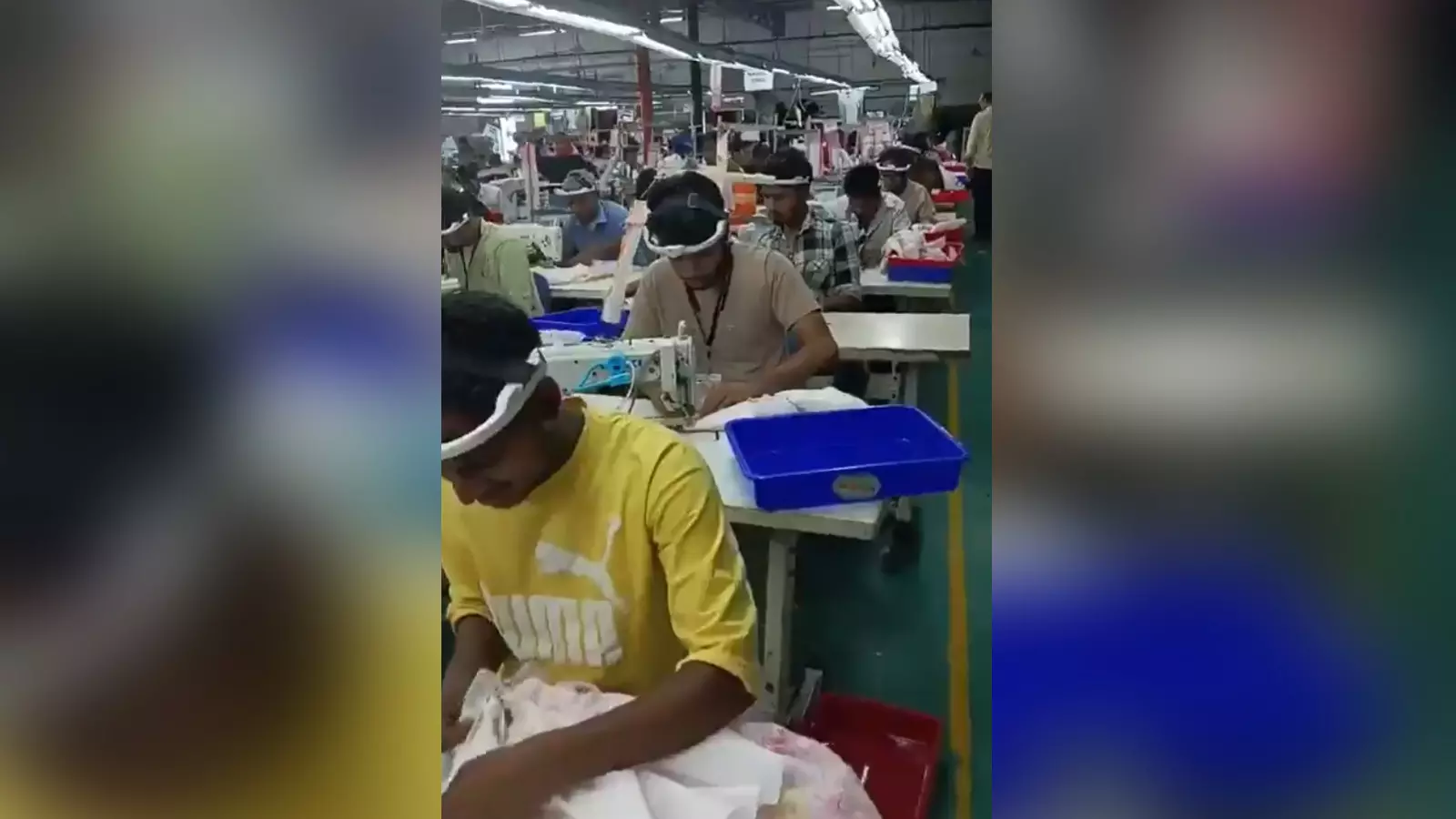
Workers in a garment factory in India were recently seen wearing head-mounted cameras, triggering speculation that they were teaching their jobs to AI. Photo: X screengrab
Finding their own replacement? Factory workers with cameras on head trigger AI fears
Speculation is rife whether manpower is used to train the very systems that would snatch their jobs

One of the most unsettling ironies of the current times is that people facilitating artificial intelligence (AI) infrastructure by feeding it data, correcting outputs, and optimising workflows, which could eventually lead to their own replacement at jobs. From a topic of a joke to a complaint to fear, the issue has been snowballing every moment.
A similar scene has now unfolded in India, too.
Several video clips have been circulating online showing workers seated across rows in large cloth factories wearing cameras on their heads as they work. While the uninitiated ask why they carry the unusual device during their duty hours, one wide explanation is that the cameras are being used to record first-person perspectives of skilled labour, possibly for the purpose of training AI systems and robots.
Also read: Vijay’s ‘Jana Nayagan’ leak: Hacked or insider job?
One user mentioned that factories might be capturing “egocentric” video data to assist machines in learning intricate hand movements, like fabric manipulation through imitation learning, thus eliminating the necessity for costly motion-capture technology.
The trend has also raised concerns and sparked discussions regarding the future of employment. Some individuals noted that employees may inadvertently be aiding in the automation process that could ultimately displace them.
Conversely, others adopted a more practical perspective, proposing that the workers ought to adjust and work alongside management to remain pertinent as technology advances.
What Marx might have thought today
Had Karl Marx and Friedrich Engels been around, they perhaps would add two words more to the famous rallying cry from the Communist Manifesto of 1848, “Workers of the world, unite”, to “Workers of the world, unite against AI”.
Also read: How ‘baithakis’ — intimate gatherings over conversation, culture and cuisine — are making a comeback
Simultaneously, concerns regarding ethics and labour rights have also emerged. Numerous users have requested government regulation, inquiring whether employees are adequately informed, justly compensated, or safeguarded by appropriate contracts during the collection of such data.
Similar trend is seen in IT firms
Such a pattern is not restricted to industries dependent on manual labour only. Many top technology-based companies in India are openly informing investors that they will require fewer people as AI handles a larger amount of work, while putting to use current employees to build those machine-backed capabilities. These include: running internal “AI upskilling” programmes and using employee interactions with internal tools to improve the tools, among others.
Also read: TCS Nashik case: N Chandrasekaran orders urgent investigation
There are also firms that employ people for tasks such as data labelling. The work is the AI training pipeline, and once the models are reliably functional, the work vanishes, reiterating the fear that the AI is set to devour its own creator.