AI With Sanket
Andhra elections 2024 'anomaly': Quraishi calls for answers | AI With Sanket
The former CEC tells The Federal that the EC must respond to concerns over voting surge in hours after polling and protect trust in electoral integrity

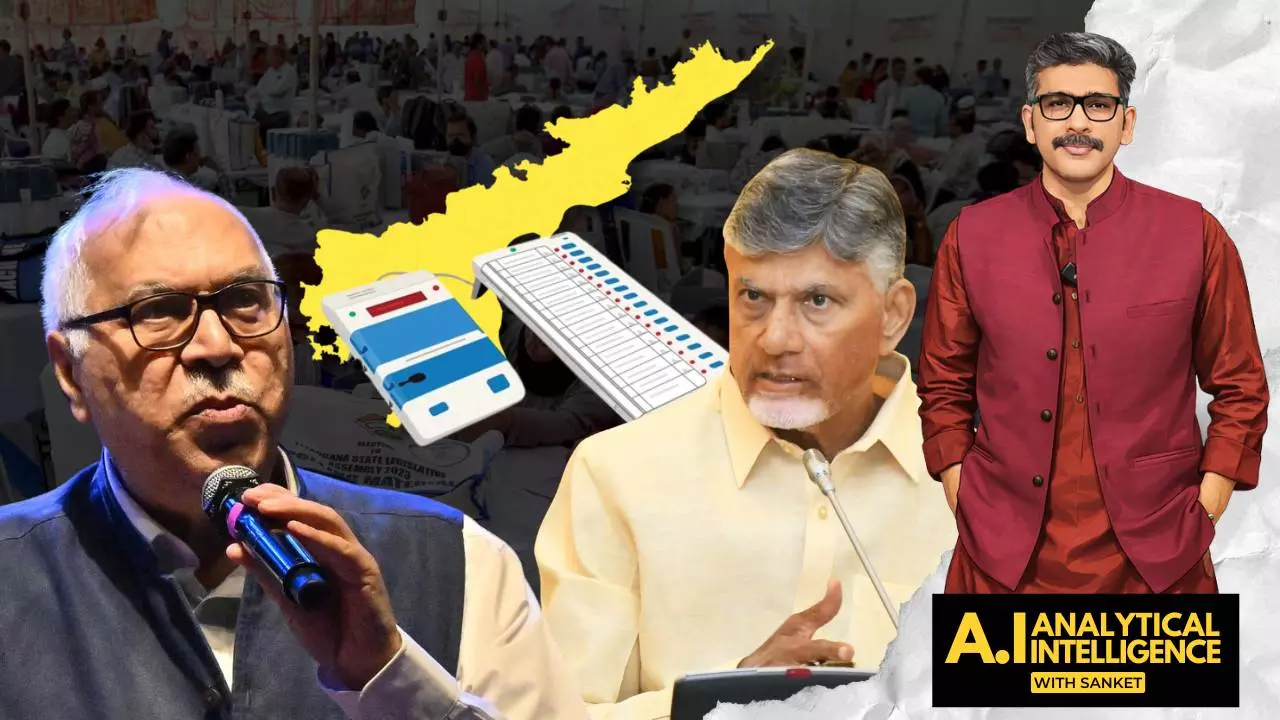
“A constitutional body must answer questions—arrogance is not an option,” says former chief election commissioner S Y Quraishi, reacting to allegations of unusual voting patterns in the 2024 Andhra Pradesh assembly elections.
Also read: Is Hindutva a shared political language in 2026 polls? | Talking Sense With Srini
Claims of 52 lakh votes cast in the state after polling hours have raised serious concerns over transparency and trust in the electoral process. The Federal spoke to Quraishi in this episode of AI With Sanket to unpack the controversy and the systems meant to safeguard elections.
The National Democratic Alliance, led by Chief Minister Chandrababu Naidu's Telugu Desam Party, secured an emphatic victory in that election, winning more than 160 out of the state assembly's 175 seats.
Here are some excerpts from the interview:
Is the Election Commission responding appropriately to these allegations?
The Election Commission is a very powerful body, no doubt. But at the same time, it has to create an atmosphere of trust and full faith in its functioning. It should be open to comment, criticism, and questions, and it must answer them to the satisfaction of the people. Arrogance is not an option.
Also read: Palakkad election battle escalates with new entrants, BJP-CPI(M) ‘deal’ row
To dismiss these complaints outright, especially from political parties that have even approached the Supreme Court in recent years, saying the commission is not listening, is not desirable. The commission should do some introspection.
What do you make of the delay in raising these concerns?
Yes, two years is indeed a long time, and that delay must be explained. But the credibility of the institution is so important that whether questions are raised belatedly or on time, they will affect its reputation.
Simply saying it is too late and refusing to answer is not the best response. These are questions of fact, and the commission should have the answers and must provide them.
Do the voting figures and timelines raise valid concerns?
I saw the presentation a few days ago, and I was shocked by the statistics. What surprised me most was the delay after polling closed.
Normally, polling ends at 5:00 pm, and by 5:30 pm, an official press conference announces how many votes were cast. It is also clarified that people still in the queue will be allowed to vote, which may take one to three hours. The final figure is then updated later that night.
Also read: TN elections: Why BJP is missing from Tirupparankundram
But here, why were people voting for nine hours after closure? If 1,000 votes are cast in 10 hours, how can voting continue for nine more hours? These figures are mind-boggling and require an explanation.
Is it possible for votes to increase after polling ends?
These figures should not be a mystery. They are known at one minute past 5:00 pm. Once polling ends, the doors close, and only those already in the queue are allowed to vote.
We issue slips to everyone in the queue at 5:00 pm. The last person gets number one, and the first person at the door gets the highest number. So, even if someone tries to join later, the queue cannot expand beyond that fixed number.
We have taken all precautions to ensure there is no manipulation. So, how many people were issued slips at 5:00 pm is already known and should be publicly available.
Are such large post-poll voting numbers humanly possible?
That is exactly why these figures raise curiosity in my mind as well. Why did voting continue until 2:00 am, when only residual votes should remain?
Most people vote during the 10-hour polling window. For voting to continue for nine more hours, and with similar volumes, raises questions that need answers.
Could such a large-scale fraud happen without detection?
Each polling booth has about 10 officials—five inside and five outside. Across 3,500 booths, that is 35,000 personnel.
Is it possible to take 35,000 people into confidence for a fraud? If there was wrongdoing, why did no one raise a voice or leak information?
Additionally, each booth has polling agents from multiple political parties. Even if four agents are present per booth, that is around 14,000 people. Did none of them object at the time?
Also read: Delimitation explained: Will 2029 Lok Sabha elections tilt against southern states?
To that extent, the Election Commission’s point is valid. If objections had been raised then, the situation would be different. But even now, the issues raised are serious and must be answered.
How do forms like 17A and 17C ensure transparency?
There is an unnecessary delay in releasing the final figures, which is not acceptable. These are real-time figures.
Form 17A is essentially a roll call. As each voter enters, their name is recorded. At any point, the last entry tells you how many votes have been cast. This data is generated in real time.
Form 17C is the summary of the entire day. It must be given to every polling agent, with a signed receipt. Without this, the presiding officer cannot leave the booth.
So, thousands of agents would already have these figures on the polling day itself.
Then where does the controversy arise from?
The controversy arises because figures released two or three days later differ from those given on the polling day.
This has been happening for the past few years. How can figures change when they are already recorded and distributed?
Even a discrepancy of one vote should not be possible, given how the data is generated. The system is simple and transparent.
Is it fair for the Election Commission to question the timing of these allegations?
To the extent that Form 17C was given and signed, the commission is right. These figures were shared with polling agents.
But the controversy is about differences between the initial and later figures. That is the core issue.
Also read: Bengal Leftists shed atheist avatar to keep up with times, don religion on sleeve
To say that it takes time to compile these figures does not make sense. These are real-time numbers.
Is a jump in voter turnout after polling day normal?
I would not say “smell a rat”, but it is unusual and needs explanation.
The number of people in the queue at 5:00 pm is already known. Not even one extra person can be added after that. So, such a large increase does not make much sense to me.
Has public trust in the Election Commission declined?
Trust is directly linked to performance. If you do well, trust increases; if you do poorly, it declines.
We cannot live in a fool’s paradise and say everything is fine. Every day, we witness indicators of changing public trust.
Ultimately, transparency and accountability are essential to maintain faith in the electoral process.
The content above has been transcribed from video using a fine-tuned AI model. To ensure accuracy, quality, and editorial integrity, we employ a Human-In-The-Loop (HITL) process. While AI assists in creating the initial draft, our experienced editorial team carefully reviews, edits, and refines the content before publication. At The Federal, we combine the efficiency of AI with the expertise of human editors to deliver reliable and insightful journalism.