In Assembly Elections 2026, why is every party flirting with Hindutva?
From Kerala to Bengal and Tamil Nadu, regional parties recalibrate strategies as Hindutva’s influence expands beyond the BJP, reshaping political discourse

As five politically diverse regions – Tamil Nadu, Kerala, West Bengal, Assam and Puducherry – head into the 2026 Assembly elections, a striking common thread is emerging: the ideological grammar of Hindutva is no longer confined to one party.
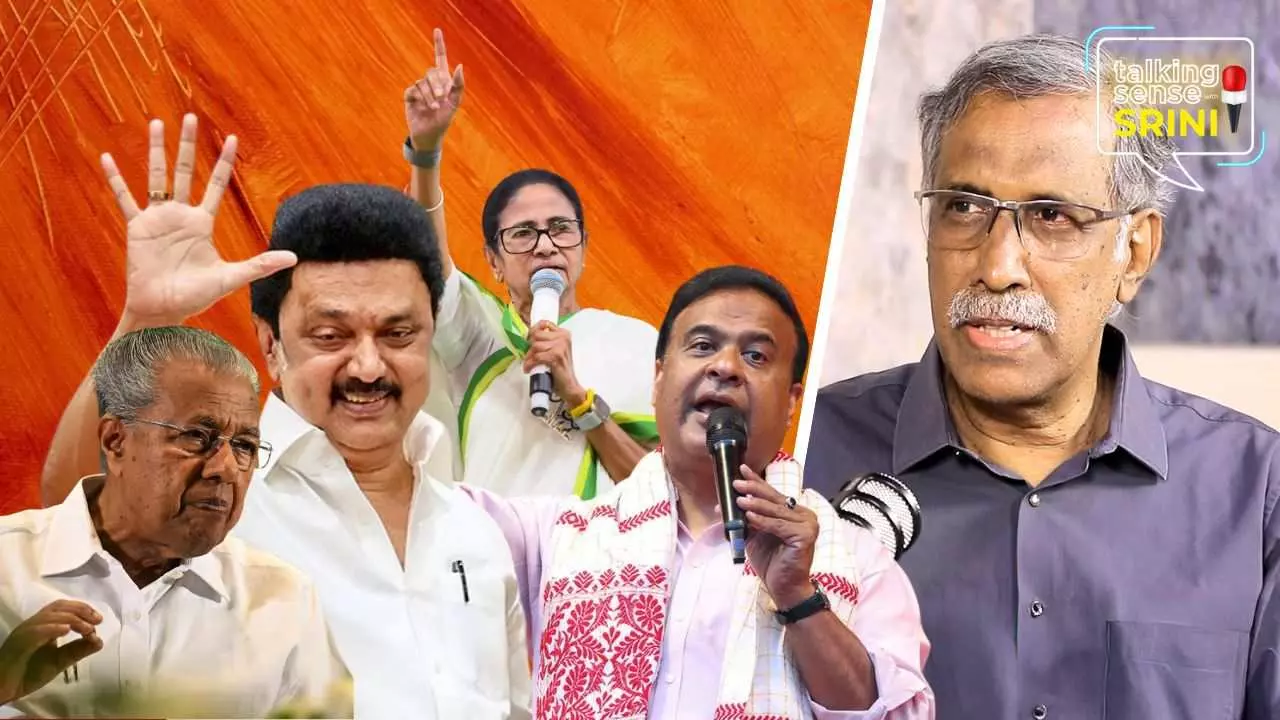
On Talking Sense with Srini, S Srinivasan, Editor-in-Chief of The Federal, argued that while the Bharatiya Janata Party (BJP) may not dominate electorally in all these states, its ideological influence has undeniably permeated the political spectrum.
Also read | Two manifestoes, one destination: LDF and UDF battle for a 'New Kerala'
The clearest admission came from TM Thomas Isaac, the Marxist veteran from Kerala, who acknowledged that the Sabarimala verdict controversy provided the BJP with a critical opening. As Srinivasan noted, this reflects a deeper shift: even parties rooted in secular or left traditions are recalibrating their stance to retain Hindu voter support.
Ideological shift across states
In Kerala, the Communist Party of India (Marxist) has softened its earlier unequivocal support of temple entry reforms, signalling electoral pragmatism. In Tamil Nadu, the legacy of Periyar EV Ramasamy’s rationalist, anti-religious politics has gradually given way to a more accommodative posture, with the Dravida Munnetra Kazhagam (DMK) openly highlighting temple renovations and religious outreach.
West Bengal presents a similar evolution. Mamata Banerjee, once seen as the face of minority-centric politics, now publicly invokes Hindu rituals and symbolism. Srinivasan suggests these moves are responses to the BJP’s sustained ideological pressure.
Also read | TN elections: Annamalai back in reckoning, may get Modakurichi seat
In Assam, Chief Minister Himanta Biswa Sarma exemplifies how identity politics has been sharpened into an electoral tool, reframing regional anxieties into a broader civilisational narrative.
Shared political language
Across these states, Srinivasan’s core argument holds: Hindutva has evolved from a party ideology into a shared political language. Parties that once resisted it are now, in varying degrees, adapting to it, some subtly, others overtly.
The 2026 elections, then, are not merely a contest of seats. It is a moment of ideological convergence, where opposition to saffron has, paradoxically, begun to speak in its hues.