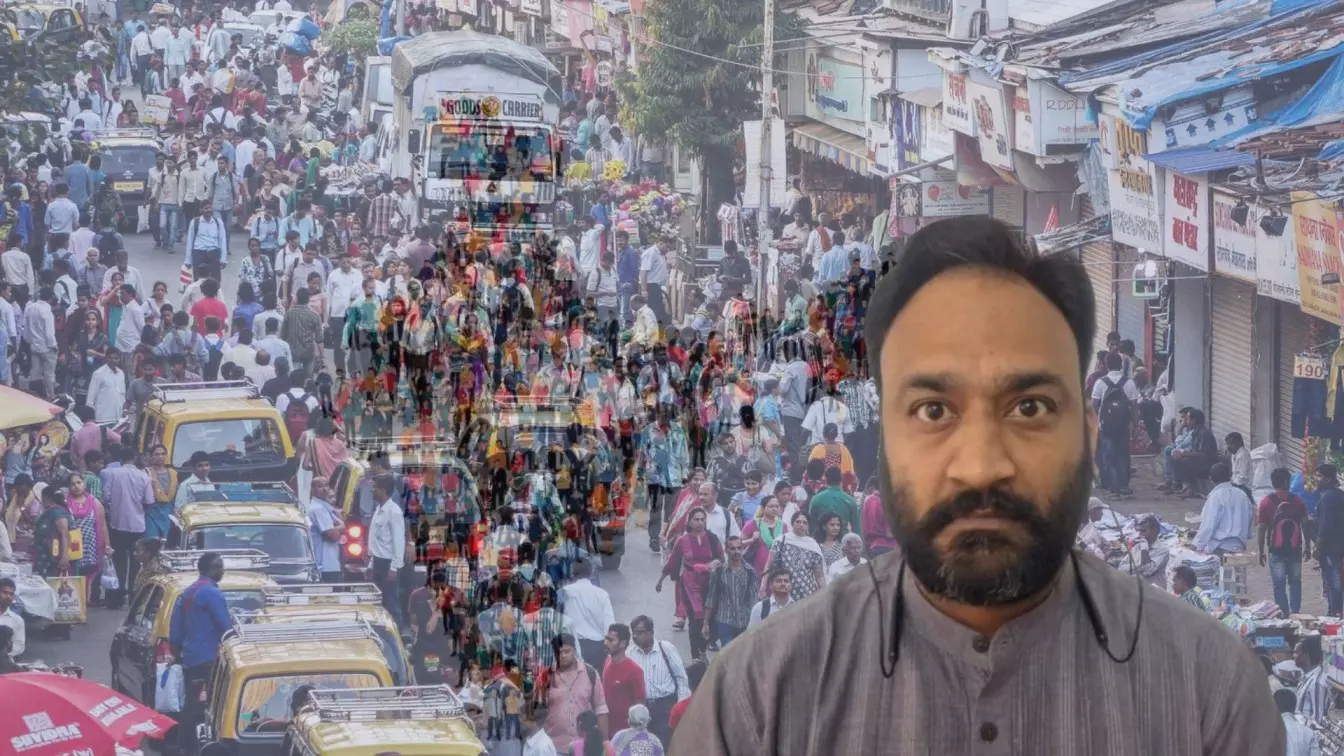
Delimitation explained: Will 2029 Lok Sabha elections tilt against southern states?
As Census 2027 begins, Centre’s delimitation drive sparks fears of political imbalance — will the 2029 Lok Sabha polls redraw India’s power map?

The Centre’s move to potentially “short-circuit” the delimitation process to fast-track women’s reservation has sparked fresh political tensions, with the Opposition alleging both strategic timing and a lack of transparency. As the government explores amendments to advance implementation, questions over fairness, federal balance, and constitutional principles have come sharply into focus. Puneet Nicholas Yadav, Political Editor, The Federal, unpacks what’s at stake in this discussion.
Why is the Opposition once again on the back foot over the women’s reservation bill amendments?
There is a clear difference between what happened in 2023 and what is happening now. In 2023, the Opposition was caught off-guard because the bill was brought in during a special session, at a time when the INDIA bloc was taking shape. It was part of a broader narrative push by the government in the run-up to the 2024 elections.
At that time, no Opposition party could oppose the bill because it concerns half the country’s population. Even Sonia Gandhi had said that the Congress would support it, calling it “our bill” since it had been passed in the Rajya Sabha during the UPA years.
Also Read: Revanth Reddy slams 'unfair' delimitation exercise, warns of 'northern dominance'
But the key issue then was that the law had no clear timeline for implementation. It said reservation would only be implemented after the first Census conducted after 2026, followed by delimitation. Since the Census itself was delayed, nobody knew whether implementation would happen in 2029, 2034, or even later.
Now, the government wants to change that by advancing the timeline. That’s where the Opposition is again feeling cornered.
What exactly is the government proposing to change now?
Under the current law, women’s reservation cannot realistically be implemented before 2034 because it depends on the Census and delimitation.
Now that the Census process has begun and data may only be ready by 2029, delimitation would take additional time. So, the 2029 elections would likely not see implementation under the existing framework.
What the government is proposing is to bypass this timeline by using the 2011 Census instead of waiting for the next Census. That would allow delimitation — and therefore women’s reservation — to be implemented earlier, possibly by 2029.
This has triggered concern because it fundamentally alters the sequence laid out in the 2023 law.
Why is the Opposition objecting to this shift?
The Opposition had already argued in 2023 that delimitation should not be linked to women’s reservation at all. Their position was that reservation could be implemented immediately without waiting for a Census or redrawing boundaries.
Their argument is simple: women make up roughly 50 per cent of the population in every constituency, so there is no need to redraw boundaries to identify where women live.
Also Read: Centre’s plan to increase Lok Sabha size by 50 pc will disadvantage southern states: Cong
Now, by bringing delimitation back into the picture through amendments, the Opposition fears that the government is introducing it “through the back door", which raises larger political and structural concerns.
There are also concerns about transparency. What is the issue there?
There is a clear complaint from the Opposition about how these discussions are being conducted. Informal consultations have been held with select MPs rather than through a formal, transparent process.
Mallikarjun Kharge had clearly told the government that such discussions should happen in an all-party meeting, where proposals are put on the table openly. He even suggested holding such a meeting after the ongoing state elections conclude.
But the government has not taken that route. Instead, it has indicated that discussions can happen in Parliament after the bill is introduced.
The Opposition sees this as a lack of transparency and a strategic attempt to control the narrative.
How does delimitation tie into the concerns of southern states?
This is where the issue becomes more complex. Southern states have long feared that delimitation based on population would reduce their political representation because they have successfully controlled population growth.
The government’s proposal is to increase Lok Sabha seats by 50 per cent across all states, taking the total from 543 to 816. On the surface, this looks equitable.
Also Read: ‘Delimitation by stealth’: Opposition sees Centre’s ploy in early women reservation rollout
But the Opposition argues that this is misleading. States with fewer seats will still end up with fewer seats even after the increase. For example, Telangana’s seats may go from 17 to 26, while Uttar Pradesh’s will go from 80 to 120.
So, the gap between states actually widens. This raises concerns that southern states could be pushed to the margins of political representation.
Is there a broader political implication behind this redistribution?
Yes, and that is exactly what the Opposition is pointing to. The argument is that the political strength of parties like the BJP is concentrated in the northern and Hindi-speaking states.
If the number of seats increases in those regions, it could make it structurally harder to dislodge the ruling party from power.
For instance, in an 816-member Lok Sabha, the halfway mark would be 408. The northern and central regions together could account for a significantly larger share of seats, making the southern states less decisive in government formation.
This is why the Opposition believes the changes could have long-term political consequences.
Could these changes face constitutional challenges?
Yes, particularly on the principle of “one person, one vote, one value” under Article 81. This principle requires that each MP represents roughly an equal number of people.
Currently, there is already some imbalance due to the freeze on delimitation since 1976. For example, an MP in Uttar Pradesh represents around 24 lakh people, while in Tamil Nadu it is about 18.5 lakh.
If the proposed changes go through, this disparity could increase significantly, with MPs in some states representing far more people than in others.
This could be challenged in court as a violation of the basic structure of the Constitution.
What about the demand for quota within quota for OBC women?
This is another key issue. The demand for reservation within reservation — especially for OBC women — depends on caste data.
The 2011 Census does not have caste data, but the upcoming Census is expected to include it. By choosing to rely on 2011 data, the government effectively sidesteps this demand.
Also Read: Women's reservation is finally coming, but the formula carries its own tension
Without caste data, it becomes very difficult to implement a quota within quota. So, the Opposition believes this is a deliberate attempt to avoid that demand.
Is there clarity on how women’s reservation will be implemented — rotation or fixed seats?
There is no clarity yet. There are two possible models. One is the rotational system used in local bodies, where reserved seats change in every election through a lottery system.
The other is the model used for SC/ST reservations in Parliament, where seats remain fixed until the next delimitation.
The government has not indicated which model it intends to follow, and this remains another unresolved issue.
(The content above has been transcribed from video using a fine-tuned AI model. To ensure accuracy, quality, and editorial integrity, we employ a Human-In-The-Loop (HITL) process. While AI assists in creating the initial draft, our experienced editorial team carefully reviews, edits, and refines the content before publication. At The Federal, we combine the efficiency of AI with the expertise of human editors to deliver reliable and insightful journalism.)