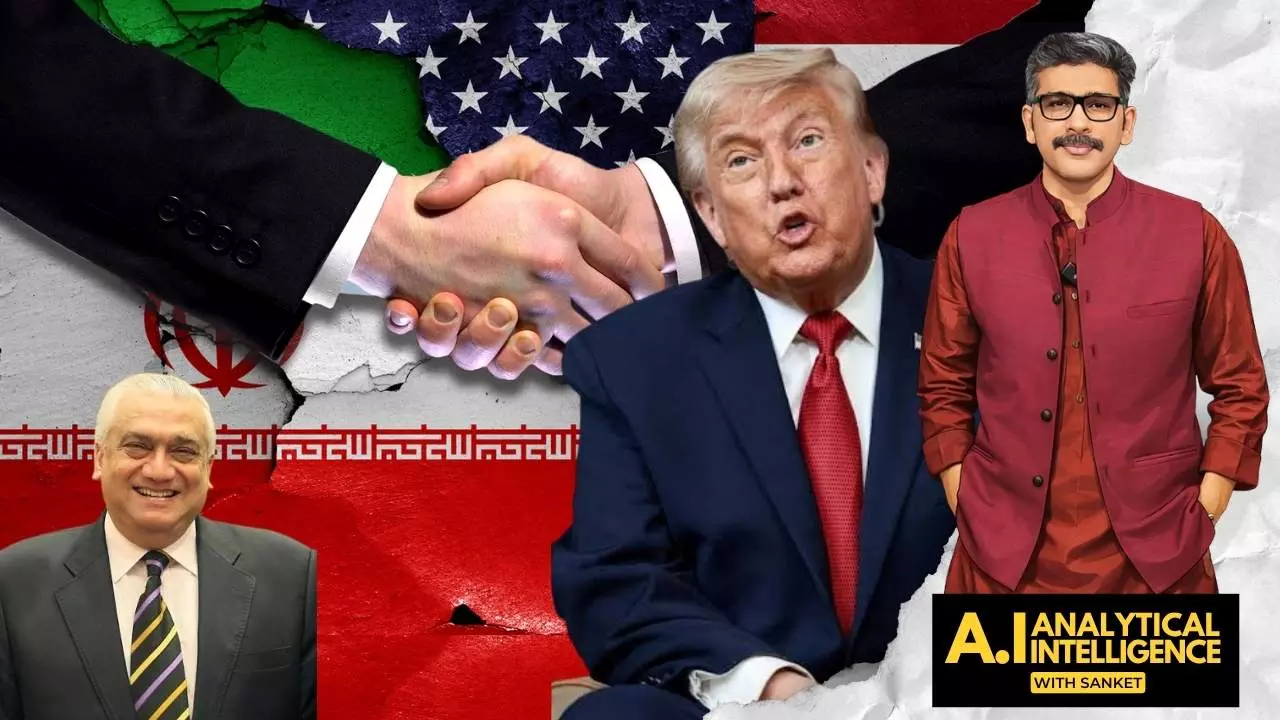
'US achieved very little from the war': Talmiz Ahmad | AI With Sanket
The former envoy told The Federal about Washington's strategic failures, explaining how Tehran survived a joint assault to emerge as a resilient regional power

The United States entered the war with Iran earlier in 2026, expecting regime change in Tehran, and got almost none of its objectives. The West Asian nation, despite severe damage, efxtracted terms that had been pending for four decades.
Also read: Trump may claim victory but MoU shows Iran had the last laugh
A peace accord between Iran and the United States has been signed, ending weeks of intense military conflict that reshaped West Asia's security landscape. But as the dust settles, the question being asked across global capitals is: who actually won? The Federal spoke with Talmiz Ahmad, former Indian Ambassador to Saudi Arabia, Oman and the UAE, and author of West Asia At War: Repression, Resistance and Great Power Games, in a quest to get those answers.
Here are some excerpts from the interview:
At the end of this war, what has each side actually achieved?
The United States has achieved very little. It got into this war under pressure from (Benjamin) Netanyahu, the prime minister of Israel. He had given the impression that it would be a short and sharp strike on Iran — that a large number of top Iranian leaders would be killed on day one, that there would be regime change, and that Donald Trump would emerge as one of the greatest presidents the United States has produced. This was a folly. It was completely wrong for the United States to have embroiled itself in this conflict.
Also read: Trump warns Iran of renewed military strikes if peace deal falls short
They were already in dialogue with the Iranians. Two rounds had already taken place. It made no sense whatsoever. It was very clear within the first 15 days that there was not going to be any regime change. Iran had been very badly wounded, but there was not enough damage inflicted for it to roll over. Astonishingly, Iran was also able to give a very good account of itself militarily — it was able to strike both Israeli and US targets.
So, what we have finally achieved in this deal is something that the Iranians would have wanted for a very long time. The deal calls for a permanent end to hostilities, the removal of all sanctions, serious addressing of the nuclear issue, and the unfreezing of Iranian assets. All these matters have been pending on the international agenda for at least 40 years. They are seeking to resolve all of this over the next 60 days of negotiations.
But this war was not exactly a gift for Iran either — their economy was battered, there was a leadership crisis. So, was peace simply in everyone's interest?
I agree. Wars very rarely yield clear winners and losers. When the Americans attacked Afghanistan, they toppled the regime and put a person of their choice in Kabul — but they faced sustained opposition from the Taliban and finally packed their bags and ran. Something similar happened in Iraq. They killed half a million people, destroyed large parts of the country, effected regime change — but their occupation could not be sustained.
The American record from Vietnam till today has been a record of sustained folly. They have extraordinary lethal power. They are able to inflict extraordinary damage. They are constantly developing their technology. But there is a near-total absence of any visionary or strategic thinking.
You mentioned Israel's role — how much of this war was actually driven by Netanyahu?
Israel is the one that has very frequently called the shots. It has influenced Washington's policy approach. It has seduced the United States repeatedly to carry out actions which are harmful to Iran but serve no interest as far as the Americans are concerned. I am not even clear whether they serve any Israeli interest.
Also read: Israel, the only factor that can ruin Iran-US deal
As far as the Israelis are concerned, what I have seen is that conflict, war and violence are ends in themselves. They have no strategic purpose that I can see. Very often, American presidents in the midst of conflict have told Netanyahu that he has no vision, no strategy — but it doesn't matter to him.
If the Americans are finally able to distance themselves from the Israelis and recognise that Israel has an agenda completely separate from American interests, you might have the emergence of some good sense and the possibility of peace. But I am very worried about the future — I am not sure that the Israelis are on board with the peace process.
How deeply embedded is Israel in the American political establishment?
No American president since John F. Kennedy has been able to do anything that the Israeli prime minister of the day does not want. This is particularly true of Netanyahu. From the time of (Bill) Clinton up to now — both of Trump's terms and (Joe) Biden — he has been able to have his way.
Some of the most serious mistakes the Americans have made were made at his behest. He encouraged the assault on the Iraqi government in 2003. He encouraged Trump to withdraw from the JCPOA (Joint Comprehensive Plan of Action). He encouraged Trump to kill Qasem Soleimani. He ensured that the first ceasefire arrangement in Gaza in January last year became abortive. He has ensured that the second peace agreement in Gaza is effectively a non-starter. They have killed more than a thousand people in Gaza since October last year.
So, it would be an extraordinary development — which we have not seen in nearly 40 years — for an American president to finally tell the Israeli prime minister that he is wrong.
Do you fear Israel will subvert this peace deal as it did with the JCPOA?
The old Jewish lobby has now withered away. A large number of Jews within the United States have turned against the extremist policies of Netanyahu. But they are able to get new people who come on board — the Christian evangelical community, Jewish billionaires who support Israeli extremist interests. You constantly have elements that rise.
Also read: Collapsed US-Iran talks expose a broken global order
At the moment, the Republican Party is very viscerally anti-Iran. Within the political establishment itself, there will be elements working with Israel to ensure that the agreement is subverted — as they did with the JCPOA. When the presidential change occurred, within a few weeks Netanyahu was able to get Trump to withdraw from that agreement and reinstate sanctions. He is a very wily and extremely diabolical character with an extraordinary political capacity to manipulate matters in Washington DC.
There is also Trump's very limited attention span. He very frequently gets into an agreement but does not have the stamina, the staying power, or the diplomatic commitment required to see through complex agreements. The first Gaza ceasefire was something he had insisted upon and then backed off from after two months, giving Netanyahu a free hand.
The Gaza Board of Peace he created — made himself chairman in perpetuity, brought in a lot of people — and then lost interest entirely. From the first meeting in early February, we have not heard anything about that peace process since. That is an abysmal record.
Has Iran emerged stronger in global and regional geopolitics after this conflict?
I would not categorically say that Iran has emerged as a high-flying leader of the region. It remains very severely afflicted by sanctions. It is seriously damaged from the recent war. Its economy is in a shambles. It has to repair its top leadership — including the transition following the death of Supreme Leader Ali Khamenei during the conflict, with his son Mojtaba Khamenei now succeeding him. It has to repair infrastructure, education and medical facilities.
Many issues that went onto the backburner because of the war also have to be addressed: the domestic economy, social life, the place of Islam within the country, the role of the IRGC (Islamic Revolutionary Guard Corps). If I were sitting in a leadership position in Iran, I would not start strutting on the regional stage anytime soon.
Also read: 'Idea of invincible US has eroded; Iran showed maturity' | AI With Sanket
Iran has to work with its neighbours. The GCC countries have to become its friends and invest in its development. Iran has not been allowed to become a normal country. It has been a siege economy for far too long. The Iran-Iraq war (1980-88), when the entire international community supported Iraq and even permitted the use of chemical weapons against Iran that has played a very deep role in the psychology of Iranian leadership and its people. They will have to recover from that psychologically. For that, you need a prolonged period of peace.
What about Iran's reformist President Pezeshkian — does he have the space to deliver?
He has all the right ideas. I believe he could be in the tradition of former president Rouhani and could genuinely lead the country in terms of its economic and social progress. But he needs space and support.
I have seen with great happiness that on the streets of Iran, the atmosphere is very relaxed, very casual, very friendly — many women do not have the hijab. I want to make one point: the hijab should not be the criterion by which we judge whether a country is progressive or regressive. It is a personal decision.
Iranian women, even under the earlier strictures, are some of the most accomplished women you find in West Asia — filmmakers of international standing, writers, poets, artists. What we need to worry about is that Iran is finally given an opportunity, after over 40 years, to fulfil its potential in terms of its resources and its civilisational heritage. Given this opportunity, it will be a stabilising and non-conflicting presence in the region.
Last question — who do you think extracted better terms from this peace accord, Iran or the United States?
It has to be Iran, because we expected so little from it. With a very weak hand, they gave an outstanding account of themselves. We knew about their courage. You remember the eight-year war they had with Iraq, when the entire international community supported Baghdad. At that time, they held their own.
What I was worried about was that so much damage might be inflicted that Iran might not be able to function effectively. But their missiles and drones enabled them to give a very good account of themselves. They inflicted damage on Israel that is not fully in the public domain. Both their adversaries were able to see that this is not a pushover — it is a country worthy of great respect.
The content above has been transcribed from video using a fine-tuned AI model. To ensure accuracy, quality, and editorial integrity, we employ a Human-In-The-Loop (HITL) process. While AI assists in creating the initial draft, our experienced editorial team carefully reviews, edits, and refines the content before publication. At The Federal, we combine the efficiency of AI with the expertise of human editors to deliver reliable and insightful journalism.
----------