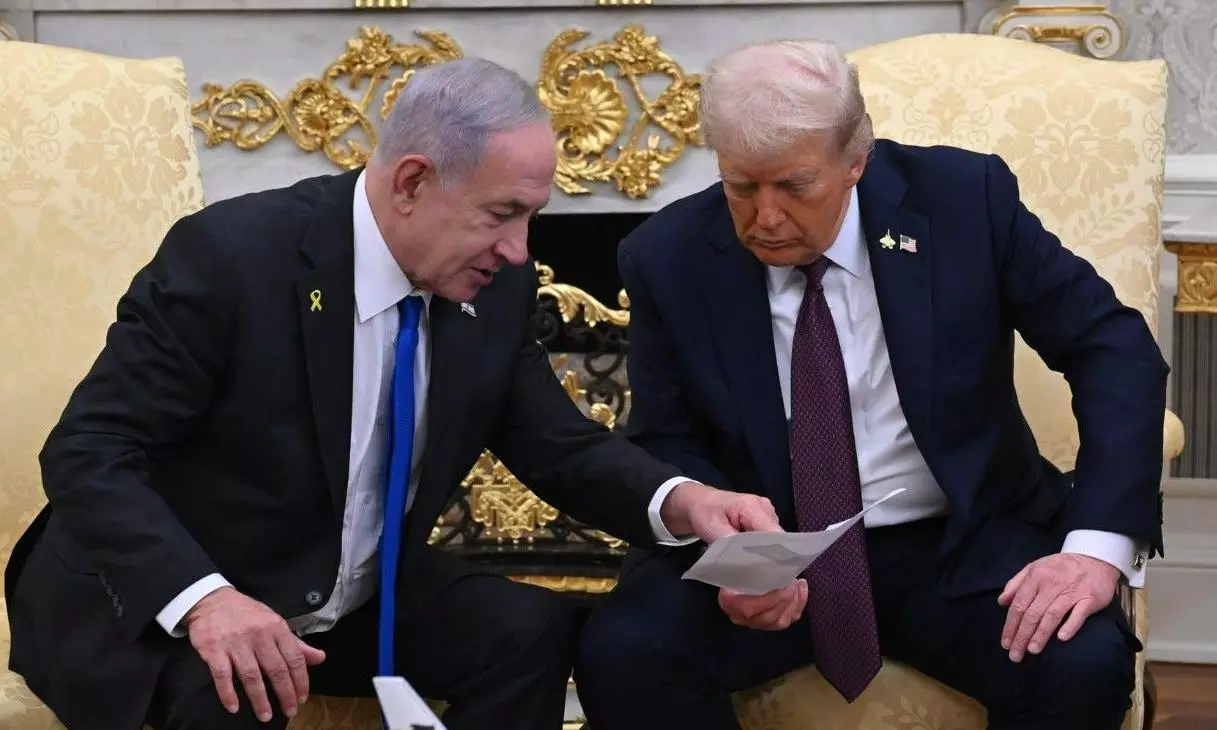
Israeli PM Benjamin Netanyahu, who has been kept out of the peace talks, sees no gains for his country or himself in the deal
So often in the last three months has United States President Donald Trump claimed the war with Iran was ending that the latest one too is being consumed with a spoonful of salt. Yet, compared to the earlier claims of a deal, this one has a better chance of survival as the Iranian leadership has broadly concurred with Trump. The deal, however, comes with a caveat — Israel, the dominant “unknown” that can potentially torpedo the deal.
Clearly, the intense global pressure, including from among the US’s allies, and within the Republican party besides the huge disapproval ratings, forced Trump into the deal, even at the risk of scarring the US’s time-tested organic relationship with Israel.
What Iran stands to gain
Though the memorandum of understanding agreed upon by the US and Iran has not yet been publicised, reports indicate that the key issue in the deal is the opening of the Strait of Hormuz in its entirety, to the pre-war status. This is expected to lift the huge burden on Trump who found himself the target of anger across the world, particularly his friends in Western Europe.
Follow LIVE updates on the Iran-US peace deal
For Iran, removing the toll-regime it had imposed for commercial ships passing through the Hormuz Strait needed to be compensated. The deal, which is to be formally signed on June 19 in Geneva, takes this into account by starting the process of unfreezing Iranian bank accounts worldwide. The other sop for Iran is a plan for development and reconstruction of the country, guaranteed by the United States.
The biggest sticking point — Iran’s nuclear programme — has been pushed to a later stage. The deal, after it is formally signed in Geneva, will pave the way for a more intense negotiation for 60 days at which time the question of what to do with the enriched uranium stored in Iran and the overall nuclear project will be decided.
Depending on the progress of the negotiations, the various sanctions imposed on Iran over the decades will be dismantled.
The elephant in the room
The current peace deal is just a scratch on the surface of a complex body of issues that would require serious negotiations if it has to succeed. The 2015 nuclear deal that Iran signed with the Barack Obama-led consortium of nations took three years of non-stop 24/7 talks for it to work. But this was unilaterally and arbitrarily abrogated by Trump in 2018.
Having severely criticised the 2015 nuclear deal, Trump is now desperate to come up with a deal that must look different from that of his predecessor’s. This stipulation increases the challenge for the negotiators manifold, as Iran will not agree to any condition that impinges on its sovereignty, or makes it look weaker. President Masoud Pezeshkian has repeatedly said he will not allow Iran to be arm-twisted into signing a deal.
Also read: Pakistan says US, Iran may sign deal in 24 hrs; what’s in the ‘Islamabad Agreement’?
The cliched “elephant in the room” is Israel, which Trump has completely kept out of all the negotiations thus far. Israeli Prime Minister Benjamin Netanyahu, whose life wish was to militarily attack Iran, has singularly indicated his preference to continue the war.
Architect of the war
It was, in fact, Netanyahu who, a few weeks before the US and Israel attacked Iran, made a PowerPoint presentation to Trump and his close team of advisers claiming a war on Tehran would take just a few days to dislodge Iran’s theocratic leadership. Netanyahu quoted Israel’s intelligence agency Mossad as informing him that the time was ripe for an attack on Iran, given the widespread public protests there due to a severe economic crisis.
Trump fell for Netanyahu’s prognosis despite reservations from his aides including Vice President JD Vance. But, as the world has witnessed, the war never went according to plan. And, Iran ended up valiantly fighting in ways that neither Israel nor the US ever expected, with the result that they have achieved none of their initial aims – of toppling the theocratic leadership and neutralising Iran’s nuclear programme.
A frustrated Netanyahu has all but defied Trump despite a couple of heated telephone exchanges between him and the US president. Israel’s obduracy in not only ending the war but also expanding it to Lebanon, where it has occupied vast swathes of territory in the south, has proved hugely unpopular among its supporters.
Also read: US Navy rescues 14 sailors aboard Indian-flagged dhow off Oman coast
A Pew Research in April reported that 60 per cent of US adults have an unfavourable view of Israel, up from 53 per cent a year earlier. A similar percentage of people have no confidence in Netanyahu and his foreign policy, up from 52 per cent a year before. In both Democratic and Republican parties, a majority (under the age of 50) views Netanyahu unfavourably. These are telling reactions, and could have far-reaching consequences for US-Israeli relations going forward.
No gains for Israel or Netanyahu
Netanyahu is possibly the biggest threat to the successful culmination of a peace deal, as, among other things, it directly impacts his poll prospects later this year. A majority of his right-wing supporters do not want him to stop the attack on Lebanon, and in fact, would like Israel to permanently occupy the lands it has already captured south of the Litany river.
To make matters more complicated, Israel has been incessantly bombing Beirut, causing scores of deaths, large-scale displacement and widespread damage to the Lebanese capital.
Netanyahu, in particular, sees no gains for Israel or himself in the peace deal. He can defy Trump but that would move Israeli-US into uncharted territory. Though the US has a powerful pro-Israeli lobby, open defiance from Netanyahu could even stretch the ability of this lobby to damage-control.
Also read: TN sailor dies on stranded vessel in Gulf; crew uses water bottles to slow body's rotting
If Israel has been able to attack Gaza to genocidal levels, and carry on its project of annexing parts of the other Palestinian territory in the West Bank, that has been made possible with the support of the US which has consistently vetoed any of these issues from being discussed at the UN Security Council.
Whether Netanyahu will risk sabotaging the latest peace deal at the expense of the overall US-Israel relationship is to be seen. But, in the event he does, it would prevent a resolution of the Iran conflict for the foreseeable future, with grave consequences for the rest of the world.