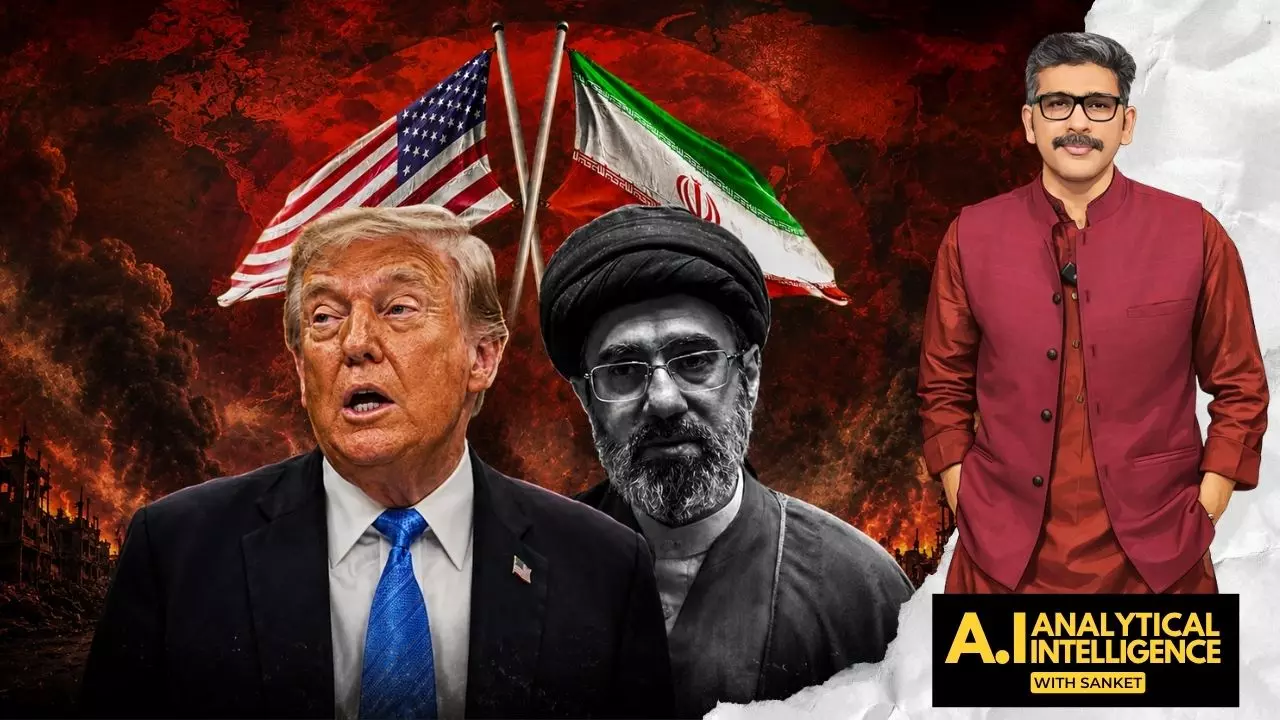
'Idea of invincible US has eroded; Iran showed maturity' | AI With Sanket
Did Iran emerge stronger from its conflict with the US and Israel? Has Trump's handling of the crisis weakened America's global standing? What does the Iran-US peace deal mean? Expert speaks.

In the latest episode of AI With Sanket, former diplomat Rajiv Dogra says Iran demonstrated greater strategic maturity throughout the conflict. Ambassador Rajiv Dogra said that Iran did not overplay its hand and avoided unnecessary escalation, even while responding decisively when required.
Is this peace durable or inherently fragile?
I cautioned against viewing this situation as stable or long-term. I would describe the arrangement as fragile and unpredictable. It is like walking on eggshells; you never know when one of the eggs will break. In my view, the origins of the conflict lie in overlapping political and personal ambitions across leaderships in Israel and the United States, which makes any path to lasting peace extremely complicated.
Ultimately, the durability of peace will depend heavily on whether Israel refrains from acting as a “spoiler” in the region.
Can Israel or internal US politics derail the peace process?
I believe Israel remains the most unpredictable factor in this equation, given its history of disrupting ceasefires and regional arrangements.
I see clear internal divisions within Israel itself. On one side are those who are weary of war, and on the other are more conservative factions pursuing long-term regional dominance.
Also Read: Israel, the only factor that can ruin Iran-US deal
I also see political lobbying and ideological narratives playing a major role in shaping US policy toward Israel.
On the US side, President Trump’s political and legal vulnerabilities, including public controversies and declining approval ratings, influenced decision-making during the conflict.
In my assessment, both battlefield pressure and domestic political fallout eventually pushed Washington toward de-escalation.
What role does Israel–US strategy play in this conflict?
If I look at the broader trajectory, I would say Israel’s current military engagement is very different from its past wars.
I do not see Israel decisively dominating Iran in the way it did in earlier regional conflicts.
In this case, I have my doubts about whether America can roll back all the negatives it has accumulated. Repeated military interventions and foreign policy decisions have eroded global trust in the United States, whether in Vietnam, Iraq, Libya, Syria, or Afghanistan.
I also see growing fatigue among Jewish communities globally, given the psychological and humanitarian costs of prolonged conflict.
Constant state of war is psychologically ruinous. Even within Israel, there is increasing reflection on whether long-term conflict strategies are sustainable.
Is America’s global position weakening under current leadership?
I study the rise and decline of nations across 5,000 years of history, and I have come to believe that leadership is the decisive factor in shaping national trajectories. I do not see America’s challenges as limited to one presidency; they reflect a broader pattern across administrations.
In this case, I have my doubts about whether America can roll back all the negatives it has accumulated. Repeated military interventions and foreign policy decisions have eroded global trust in the United States, whether in Vietnam, Iraq, Libya, Syria, or Afghanistan.
Is this the “unmaking” of America’s world order?
I do not believe the current global shift can be attributed solely to one leader, although I do believe Donald Trump has accelerated certain trends.
I see America’s trajectory as comparable to historical empires in decline, including the Roman Empire.
I believe overexpansion, internal excesses, and political spectacle are weakening American global authority.
Even historical patterns such as Roman-era entertainment culture show how imperial systems begin to reflect fatigue in their political symbolism.
I also see China already positioned as a rising power that will challenge US dominance in the coming decades.
Has this war accelerated America’s decline globally?
I believe this conflict has contributed to a broader shift in global perceptions of American power.
I see smaller and mid-sized powers increasingly willing to resist major powers, as seen in conflicts like Ukraine–Russia, where a stronger military force has not achieved quick results.
In my view, the world order will no longer be dictated by America’s whims.
This Iran conflict also showed me that even combined US–Israel pressure does not guarantee swift victories.
To me, this signals the erosion of the idea of an “invincible America.”
I believe America will no longer be the raging bull it has been so far. Countries with strategic autonomy will increasingly assert themselves.
What does this mean for the future world order?
I believe the global order is undergoing structural change, where US dominance will no longer be absolute or unchallenged. I also see even European countries beginning to reassess their dependence on Washington after the economic and geopolitical pressures linked to ongoing conflicts.
I would describe Iran as a “dividing line” in global strategic thinking, marking a shift toward a multipolar world.
In my view, the world order will no longer be dictated by America’s whims.
The content above has been transcribed from video using a fine-tuned AI model. To ensure accuracy, quality, and editorial integrity, we employ a Human-In-The-Loop (HITL) process. While AI assists in creating the initial draft, our experienced editorial team carefully reviews, edits, and refines the content before publication. At The Federal, we combine the efficiency of AI with the expertise of human editors to deliver reliable and insightful journalism.