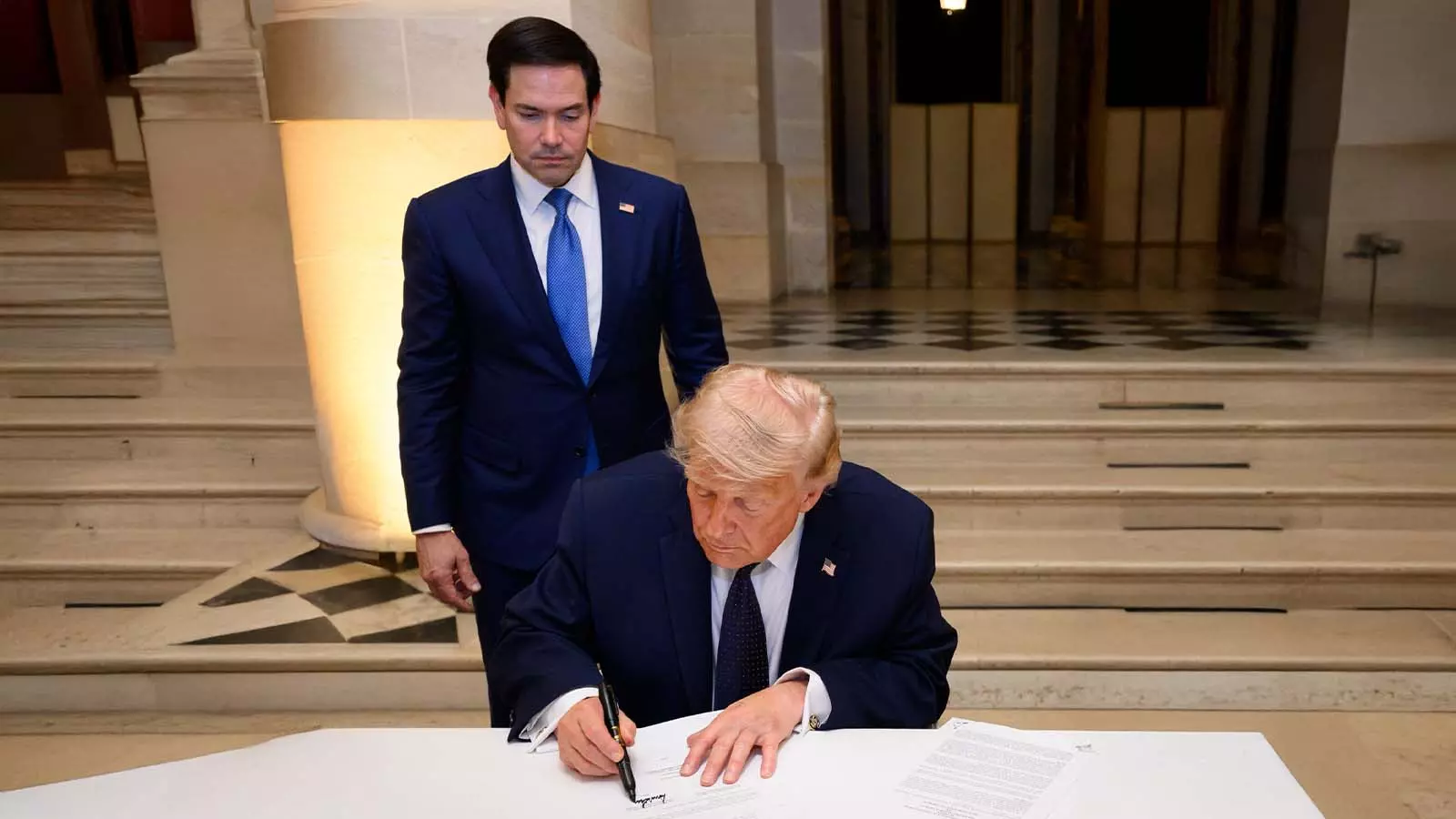
Even as Trump signed MoU, Grossi's bid for UN chief, Israel's unchecked arsenal, and 60-day deadline favouring Washington frame diplomacy as managed surrender
The cancellation of US-Iran talks in the Swiss village of Obbürgen was presented as a temporary diplomatic setback. Officials spoke of scheduling difficulties, ceasefire violations, and the need to create better conditions for negotiations.
Yet, the significance of what happened extends far beyond a missed meeting. The collapse of these talks reveals a deeper crisis—one that has been building for years within the institutions charged with maintaining international peace and security.
The talks, meticulously arranged to implement a peace deal following the electronic signing of a Memorandum of Understanding (MoU) on June 17, were derailed by yet another Israeli ceasefire violation and the inevitable Hezbollah response. But the real cancellation happened long ago—it was the cancellation of any pretence that international institutions serve the cause of justice rather than the geopolitical ambitions of Washington and its allies.
Grossi’s masterclass in bureaucratic evasion
Consider the central figure in this diplomatic theatre: Rafael Mariano Grossi, Director-General of the International Atomic Energy Agency (IAEA), who now audaciously campaigns for the position of UN Secretary-General against three distinguished women candidates.
The MoU itself represents a “surrender” according to the US Republican Senators. Perhaps, it is capitulation to the framework of American hegemony
The same Grossi who, according to Iranian officials, issued reports that served as the casus belli for an unprovoked 12-day war against Iran last year. The same Grossi who now insists that “nobody can ever believe that the report of the IAEA is the cause of a war”.
Also read: Trump may claim victory but MoU shows Iran had the last laugh
Grossi's performance at a press conference in Geneva on June 18 was a masterclass in bureaucratic evasion. When pressed by this writer about Israel's nuclear arsenal—estimated at some 100 warheads despite its non-membership in the Nuclear Non-Proliferation Treaty (NPT)—he retreated to procedural boilerplate: "We don't have opinions on countries."
Rafael Mariano Grossi, Director-General of the IAEA, is campaigning for the position of UN Secretary-General. Photo: X/@rafaelmgrossi
When asked about US attacks on an NPT member state, he demurred: "Our role here is to perform work which is technical." Technical. As if uranium enrichment percentages exist in a political vacuum. As if the IAEA's "indispensable role" in the MoU is somehow disconnected from the very real bombs that fell on Iranian soil.
Fundamental dishonesty
This is the fundamental dishonesty that permeates the entire diplomatic apparatus. The IAEA is explicitly referenced in paragraph seven of the MoU as the mechanism for verifying sanctions termination—a provision that effectively outsources American compliance to an agency whose director has already demonstrated his willingness to serve as a geopolitical instrument.
Iranian Foreign Minister Abbas Araghchi aptly described the IAEA's pre-war reporting as "Orwellian double-speak"—a characterisation that Grossi's subsequent performance has done nothing to refute.
The MoU itself represents a “surrender” according to the US Republican Senators. Perhaps, it is capitulation to the framework of American hegemony. Vice-President JD Vance's explanation that the $300 billion package is designed to make Iran "behave like a normal country" reveals the colonial assumptions underlying this entire enterprise. Normal.
Why the moral high ground?
As if the United States, which has maintained crippling sanctions, assassinated Iranian generals, and supported every act of Israeli aggression in the region, occupies some moral high ground from which to define normality. As if the country that invaded Iraq on false pretences, destabilised Libya, and continues to arm Saudi Arabia's genocidal campaign in Yemen possesses any credibility in lecturing others about international behaviour.
Also read: US-Iran MoU brings relief to Lebanon, but many are skeptical of Israeli compliance, says expert
US President Donald Trump's characteristically unhinged response to domestic critics—dismissing them as "jealous, bad people, or stupid" while boasting about stock market records—should not distract from the deeper tragedy.
This is not a serious negotiation between equals; it is an exercise in managed surrender, conducted under the watchful eye of an international bureaucracy whose leadership has already proven its subservience to Western interests.
JD Vance's explanation that the $300 billion package is designed to make Iran "behave like a normal country" reveals the colonial assumptions underlying this entire enterprise.
The 60-day timeline for finalising a comprehensive agreement is fraught with several roadblocks. The IAEA chief's vague assurances about "necessary technical deployment" and his admonition against "speculating about what could cause a problem" are designed to obscure the fundamental asymmetry at play.
Iran is required to submit to verification, to open its facilities to inspectors, to accept limitations on its sovereignty—all while Israel bombs its territory with impunity, while US sanctions remain a sword of Damocles, while the international community treats its legitimate security concerns as bargaining chips.
Selective application of law
Grossi's advocacy for NPT universality is particularly rich. "All countries should adhere to the NPT," he declares, without acknowledging that Israel's non-adherence has been facilitated by American vetoes at the Security Council for decades.
This is not diplomacy; it is the selective application of international law, calibrated to preserve the privileges of the powerful while constraining the ambitions of the weak.
The IAEA director's response to questions about his UN Secretary-General candidacy reveals the narcissism that drives this entire enterprise. "What is more decisive than anything else is what I am doing now at the IAEA," he claims, suggesting that his work on Iran, Ukraine, and nuclear facilities somehow qualifies him to lead an organisation whose mandate extends far beyond technical verification.
But his tenure has demonstrated precisely the opposite: that technical competence without political courage, procedural rectitude without moral clarity, is ultimately a tool of oppression rather than liberation.
As Grossi campaigns for the UN's top job, we must ask: What vision of international governance does he represent? A vision where technical experts make the decisions that politicians dare not face?
The three women candidates competing against Grossi—Maria Fernanda Espinosa, Michelle Bachelet, and Rebecca Grynspan—represent a stark contrast. Espinosa's experience as UN General Assembly President, Bachelet's record on human rights, Grynspan's work on development—these are credentials grounded in the actual work of building peace, not in enabling its destruction through technical euphemism.
That Grossi could seriously entertain leading the United Nations while his agency's credibility lies in ruins is a testament to the patriarchal arrogance that continues to define international governance.
Management of decline
What, then, should we conclude from this diplomatic spectacle in the Swiss Alps? The cancellation of talks is not the story; it is a symptom. The real narrative is the ongoing subjugation of international institutions to American power, the corruption of technical neutrality into political servitude, and the breathtaking hypocrisy of a system that demands accountability from Iran while shielding Israel from consequences.
The MoU's promise to "terminate all types of sanctions" is contingent upon Iranian compliance—compliance verified by an agency whose director has already demonstrated his willingness to serve as a witness for the prosecution.
The 60-day window for negotiations is not an opportunity for genuine reconciliation but a deadline for acceptance of American terms. And the broader framework of international law—the NPT, the UN Charter, the very concept of sovereign equality—is reduced to a stage set for American geopolitical theatre.
Grossi's vision
As Grossi campaigns for the UN's top job, we must ask: What vision of international governance does he represent? A vision where technical experts make the decisions that politicians dare not face? A vision where nuclear verification serves as a cover for regime change? A vision where the aspirations of millions for justice, dignity, and security are subordinated to the bureaucratic imperatives of the powerful?
The answer is evident in his responses—the evasions, the retreats to procedure, the refusal to condemn the obvious violators of international law. This is not leadership; it is management of decline.
And the decline in question is not just of American power but of the entire post-WWII international order, which has revealed itself as a vehicle for Western interests rather than a guardian of universal values.
What the world deserves
The Swiss setting is fitting: a country whose neutrality has historically served as a bank for war criminals, whose picturesque villages have hosted endless negotiations that change nothing. Obbürgen's tiny streets will witness more diplomatic theatre in the coming weeks, but the fundamental issues will remain unaddressed.
The nuclear question cannot be separated from the occupation question. The enrichment issue cannot be divorced from the sanctions regime. The IAEA's role cannot be considered apart from its political context.
The US and Iran will resume talks. The technical delegations will exchange documents. The IAEA inspectors will conduct their verification. And Grossi will continue his campaign for UN leadership, presenting himself as the impartial technocrat who navigated the complexities of nuclear diplomacy.
But the citizens of the world—Iranian, American, and everyone in between—deserve something more than this theatre of the absurd. They deserve institutions that serve peace rather than power, that hold all nations accountable rather than enabling some to prey on others.
Crisis of legitimacy
The cancellation of this week's talks may be temporary, but the crisis of legitimacy that produced it is permanent. Until the international community confronts the structural inequities that make such diplomatic charades possible, until the UN Secretary-General is chosen for moral courage rather than bureaucratic agility, until the IAEA returns to genuine technical impartiality, we will continue to witness these grotesque performances—negotiations that negotiate nothing, agreements that agree to everything, and peace processes that prepare for war.
The cancellation in Obbürgen is not a setback for diplomacy; it is the diplomacy itself, stripped of its pretensions. And what we see is not pretty.
(The Federal seeks to present views and opinions from all sides of the spectrum. The information, ideas, or opinions in the articles are of the author and do not necessarily reflect the views of The Federal.)