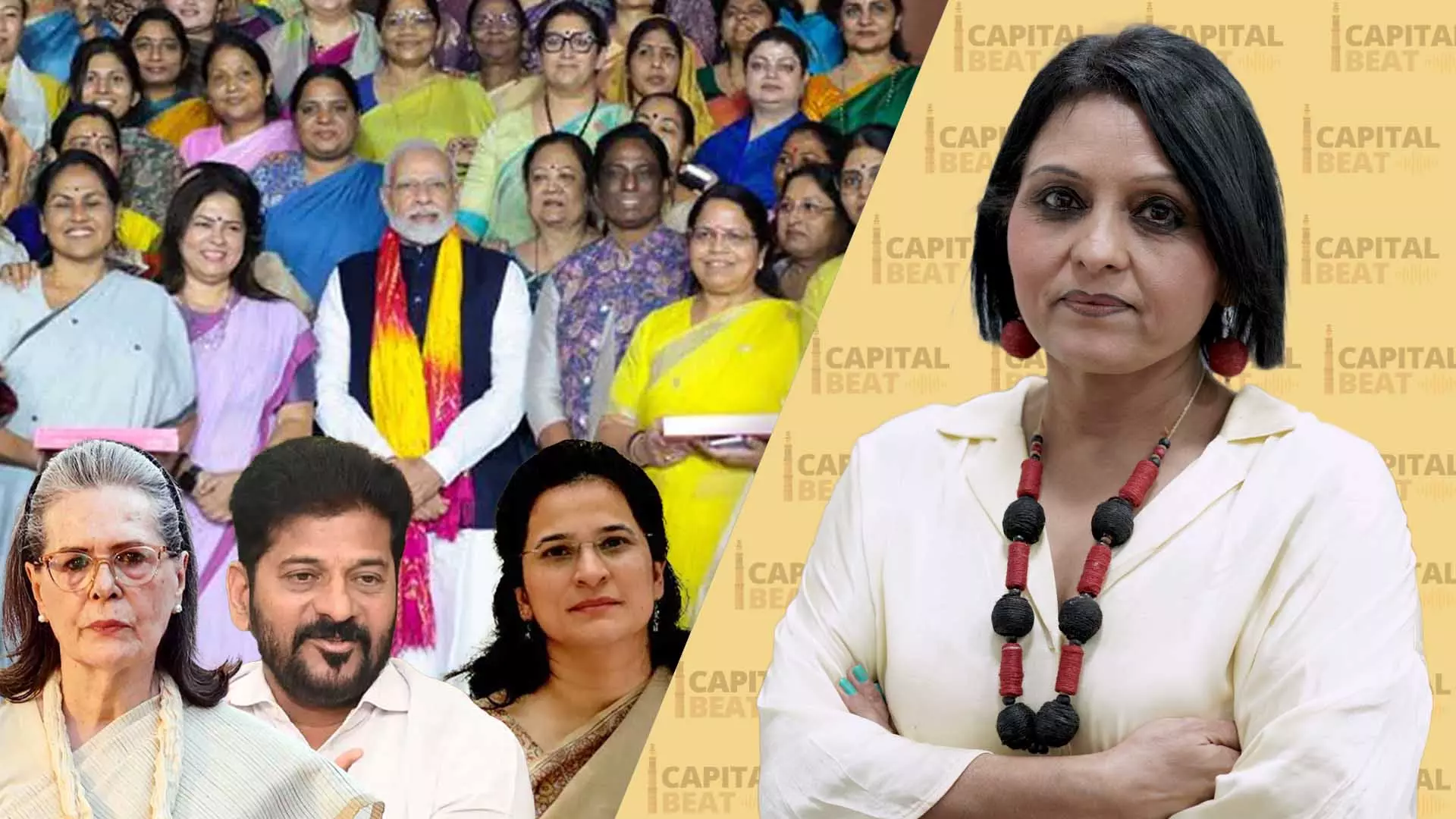
Women’s reservation a smokescreen for delimitation, warns activist Anjali Bhardwaj
Transparency Rights activist flags lack of transparency in the process, says linking women’s quota to delimitation could alter political balance and disadvantage southern states

The Centre’s push to fast-track amendments to operationalise the Women’s Reservation Act has triggered a sharp political debate, with concerns around delimitation and representation. In this Capital Beat episode, The Federal spoke to Anjali Bhardwaj, Transparency Rights activist, to unpack the intent, timing, and implications of the proposed changes.
Do you think the Women’s Reservation Bill will see the light of day? Can the Opposition build consensus or stall it?
What happens will have to be seen, but a constitutional amendment requires a two-thirds majority in Parliament, which the NDA does not have on its own. Without support from at least some Opposition MPs, the government will not be able to push this through.
Also Read: Stalin announces black-flag protest in TN on April 16 over delimitation proposal
However, what is more important is to understand what exactly the government is trying to bring. The session starts tomorrow and the draft legislation was circulated only yesterday afternoon. MPs have been given barely 36 hours to examine a constitutional amendment they are expected to vote on. This makes a mockery of Parliament and the legislative process.
Why do you say women’s reservation is being used as a 'smokescreen'?
When the Women’s Reservation law was passed in 2023, there was a strong demand to delink it from the Census and delimitation. That was entirely possible. The law could simply have stated that one-third of the existing seats — 543 in the Lok Sabha and corresponding seats in state assemblies — would be reserved for women.
If that had been done, reservation could have been implemented in the 2024 elections. The government instead linked it to the Census and delimitation, despite opposition. Now, within less than 30 months, it wants to reverse course. That raises serious questions about intent.
The government has now delinked it from the Census but linked it to delimitation. What does that mean?
There is still an “umbilical connection” between women’s reservation and delimitation. In fact, three bills are being introduced, and the delimitation bill is the most important — the “mother bill”. Without it, the changes to women’s reservation cannot be implemented.
Also Read: Congress accuses PM Modi of engaging in 'deliberate deceit' on delimitation
If the government truly wanted faster implementation, it could have brought a simple one-line amendment delinking the law from both the Census and delimitation. Instead, it has introduced three complex bills, making the process contentious.
Why is the delimitation aspect so controversial?
Delimitation has the potential to completely change the political landscape of the country. It determines constituencies, the number of MPs and MLAs.
The new proposal allows the government — through Parliament — to decide which Census will be used for delimitation, instead of this being fixed constitutionally. The last Census was in 2011, and the 2021 Census was not conducted. The next is due in 2026.
The question is: why the hurry? Why not wait for updated population data?
How could delimitation impact the balance between northern and southern states?
If delimitation is based on population, states with higher population growth — largely in the northern Hindi-speaking belt — will gain more seats. Southern states, which have controlled population growth, will see relatively smaller increases.
Also Read: TMC's Derek O'Brien calls delimitation a 'devious' agenda
This effectively penalises states that implemented population control measures. It risks deepening the north-south divide and altering political representation significantly.
There are concerns from southern leaders about losing representation. Are these valid?
Yes, these concerns are very real. There were earlier assurances that southern states would not lose out, but the details emerging now suggest otherwise.
Alternative models — like proportional increases across states — could have been explored. But a purely population-based approach disadvantages southern states.
You’ve also raised concerns about transparency. What is the issue there?
The manner in which these bills have been introduced is deeply problematic. There has been no transparency, no public consultation, and no adherence to the pre-legislative consultation policy, which requires draft laws to be shared at least 30 days before they are taken up in Parliament.
Also Read: Why delimitation Bills appear more ominous than originally thought
MPs received the draft just hours before the session. Citizens, who will be affected, have not even seen it. This kind of secrecy indicates that the government may be trying to push through contentious changes without scrutiny.
Could this have long-term political consequences?
Yes, very serious ones. If the number of Lok Sabha seats increases significantly — from 543 to around 850 — and most of that increase comes from northern states, it could create a permanent political majority for parties dominant in that region.
This would make it difficult for southern states to influence national legislation, even if their interests are at stake.
Can the Opposition push to delink women’s reservation from delimitation?
This requires a constitutional amendment, which needs a two-thirds majority. The Opposition alone cannot enforce changes unless it has the numbers.
Women’s groups have demanded reservation for over 30 years. If it could have been implemented earlier, it would have been. The current situation cannot be resolved without broad political agreement.
Do you believe the bill will eventually pass?
Unfortunately, the government has shown in the past that it can secure the numbers for constitutional amendments. How it manages that arithmetic is unclear, but it has done so before.
Also Read: Delimitation: Govt proposes to increase Lok Sabha seats to 850
I hope the Opposition comes together and blocks this amendment in its current form. This is not about opposing women’s reservation — it is about opposing a problematic delimitation framework being pushed under its cover.
What should the government do instead?
It should bring a simple amendment stating that one-third of seats in Parliament and state legislatures will be reserved for women — effective immediately.
On delimitation, it should go back to the drawing board, consult all political parties, engage with citizens, and build consensus. That is the only way forward.
Are we heading towards political or social unrest over this issue?
The concerns are serious, especially in southern states. There is a strong sense that they are being unfairly treated.
Also Read: Delimitation will divide North and South India, says Congress
If this bill is pushed through in its current form, it could trigger significant political and social reactions. That is why it is important for the government to reconsider and adopt a more consultative approach.
(The content above has been transcribed using a fine-tuned AI model. To ensure accuracy, quality, and editorial integrity, we employ a Human-In-The-Loop (HITL) process. While AI assists in creating the initial draft, our experienced editorial team carefully reviews, edits, and refines the content before publication. At The Federal, we combine the efficiency of AI with the expertise of human editors to deliver reliable and insightful journalism.)