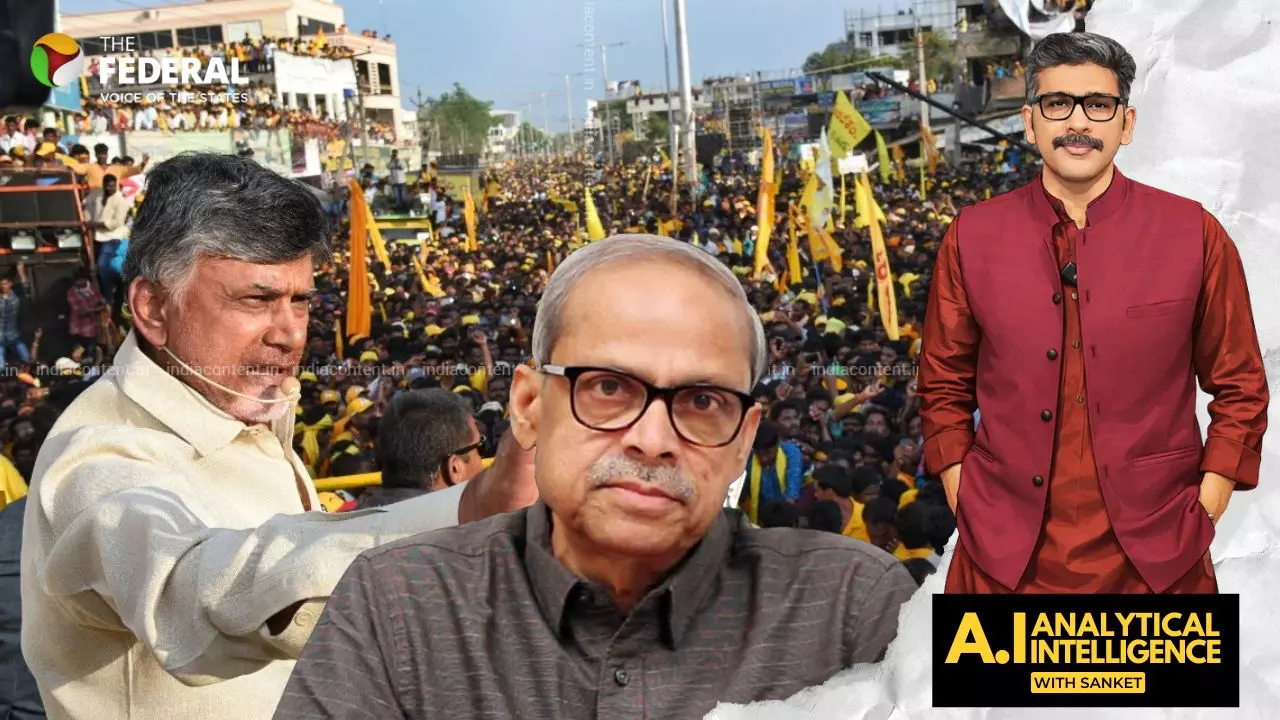
Chandra Babu Naidu
Parakala Prabhakar flags 2024 Andhra polls: 'Three seconds per vote, humanly possible?'
Speaking to The Federal, the economist questions late-night vote surge and asked the EC to release verifiable evidence

Questions have not stopped pouring in over the alleged voting irregularities in the 2024 assembly election in Andhra Pradesh, which was swept by the National Democratic Alliance led by Chief Minister Chandrababu Naidu's Telugu Desam Party.
Also read: Andhra elections 2024 'anomaly': Quraishi calls for answers | AI With Sanket
The Federal spoke with economist Parakala Prabhakar, who hails from the state, in this episode of AI With Sanket on the matter, and he expressed utter surprise, saying, "Show me how it is humanly possible for a voter to cast two votes in six seconds." He also raised serious questions over polling data related to the 2024 election.
At the heart of the controversy is a claimed surge in votes late into the night—well beyond official polling hours.
Here are some excerpts from the interview during which Prabhakar explained why he believed the voting numbers in that election point to “unusual” patterns that demand answers.
What is the source of your data and claims?
The first thing I want to say is that whatever I have said, I am prepared to be challenged on every word, every data point, every decimal. You can interrogate me.
This is not my data. Everything comes from the Election Commission of India’s portal and statements made by the chief electoral officer (CEO) of Andhra Pradesh. All this data has been in the public domain, hiding in plain sight.
What I have done is simply interpret it as a time series.
What exactly did you find unusual in the Andhra Pradesh elections?
Let me explain step by step. Until 5 pm, polling was 68.04 per cent. By 8 pm, it rose marginally to 68.12 per cent.
But then, between 8 pm and 11:45 pm, polling jumped by 8.38 per cent. And from 11:45 pm to 2 am, it increased by another 4.16 per cent.
Also read: Andhra Assembly passes resolution seeking Amaravati as legal capital
This 4.16 per cent translates to about 17.2 lakh votes. According to the CEO, polling was ongoing only in 3,500 booths during this time.
Now, if you calculate this, it means 491 votes per booth in 135 minutes. That comes to 3.6 votes per minute.
Why is that calculation significant?
Because it means one voter every 20 seconds.
In that time, a voter has to enter, verify identity, sign records, get inked, vote on two machines (Lok Sabha and Assembly), and exit.
Also, each vote has a seven-second delay due to the VVPAT (voter verifiable paper audit trail) display. That’s 14 seconds gone.
So effectively, you are left with six seconds per voter, or three seconds per vote.
Tell me, how is that humanly possible?
What about the rules for voting after 6 pm?
The rules are very clear. Anyone in the queue at 6 pm can vote. But three conditions must be met.
The gates must be closed. Tokens must be distributed to all voters in the queue. And the presiding officer must record the number of such voters.
Also read: Will infighting end Congress’ Kerala story? | AI With Sanket
There must also be videography of all those in the queue, with clearly visible faces.
Now, if the last vote was cast at 2 am, that person must have entered the queue at 6 pm and waited 8 hours. Is that believable?
If all procedures were followed, shouldn’t there be evidence?
Exactly. Show me the tokens. Show me the presiding officer’s diary. Show me the videography.
If this was such a massive celebration of democracy, why isn’t there even a single image or video of people voting at 2 am?
Also, the Election Commission has not told us which 3,500 booths had voting till 2 am.
Is it possible that such large-scale activity happened without officials noticing?
That’s a very important question. If 35,000 officials and agents were present, managing such a situation would be extremely difficult.
Which is why the fundamental question is: did this polling actually happen?
If it did, show the proof.
The Election Commission says no political party has raised objections. Your response?
This may sound like a strong argument, but it is not.
First, I am not asking for the cancellation of elections. I am asking how this is possible.
Second, civil society groups have been raising concerns since 2017-18. Multiple memorandums were submitted—in 2022, 2023, 2024, and 2025.
None of them were answered. So how can the Election Commission say nobody approached them? Should only political parties raise such concerns?
Absolutely not. Elections are not a game between political parties and the Election Commission.
They are conducted for citizens like you and me.
Also read: Why did BJP skip personal attack on Mamata in Bengal campaigning? | AI With Sanket
I have every right as a citizen to ask what happened in Andhra Pradesh, even if I live elsewhere.
The Election Commission is answerable to the people of India.
What should the Election Commission do now?
They must be transparent.
Put Form 17C data in the public domain. Share the videography. Show the presiding officers’ records.
If the evidence proves everything is correct, I will shut up.
My concern is not who won or lost. It is about the integrity of the electoral process.
The content above has been transcribed from video using a fine-tuned AI model. To ensure accuracy, quality, and editorial integrity, we employ a Human-In-The-Loop (HITL) process. While AI assists in creating the initial draft, our experienced editorial team carefully reviews, edits, and refines the content before publication. At The Federal, we combine the efficiency of AI with the expertise of human editors to deliver reliable and insightful journalism.