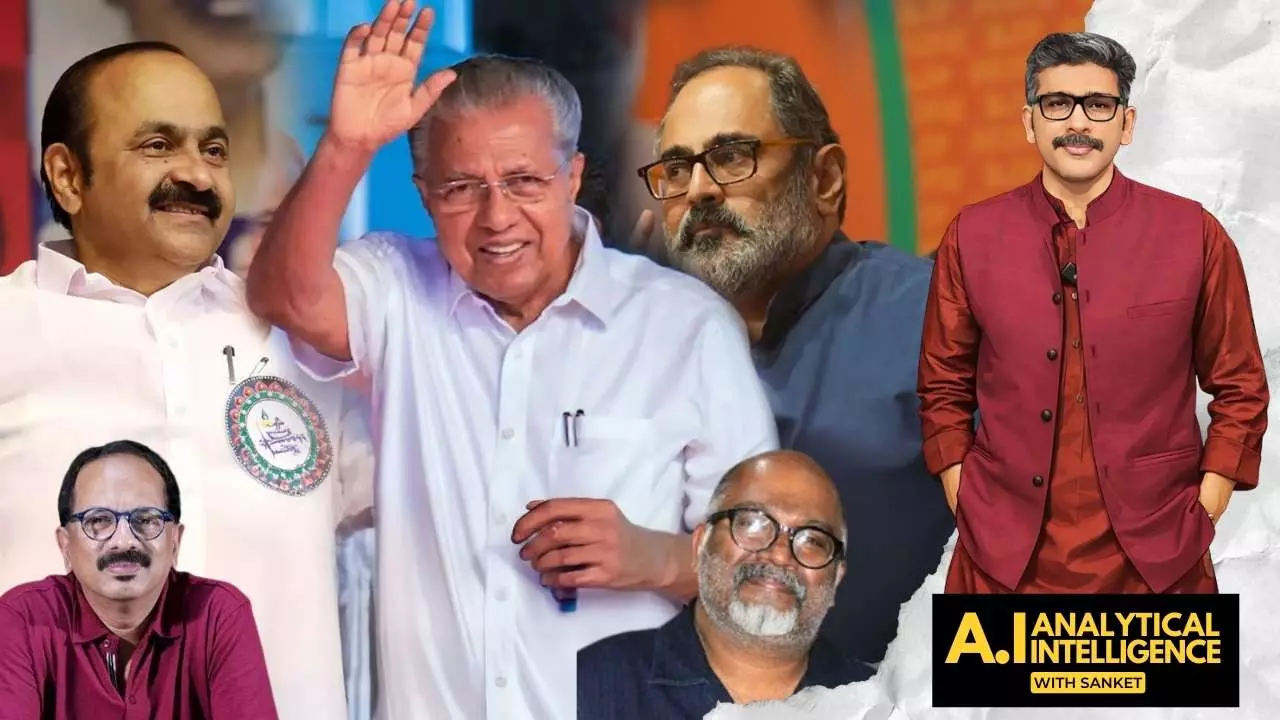
Will infighting end Congress’ Kerala story? | AI With Sanket
With LDF vs UDF, Congress infighting, and BJP’s gradual rise shaping Kerala’s 140-seat battle, is this existential for the Left and do-or-die for Congress?

The Kerala Assembly election is shaping up as an “existential battle” for both the Left and the Congress, with internal conflicts within the Opposition threatening to give the ruling front an advantage. As the state heads into a crucial political contest, the stakes go far beyond regional politics. On AI With Sanket, KA Johny, senior news editor at Mathrubhumi, and Rajeev Ramachandran, Associate Editor at The Federal, discussed the dynamics shaping Kerala’s high-stakes election.
How Kerala votes
Kerala has 140 Assembly constituencies, and the contest is primarily fought between two major alliances — the Left Democratic Front (LDF) and the United Democratic Front (UDF). Unlike a typical two-party system, Kerala’s politics operates through these competing coalitions.
Rajeev pointed out that Kerala historically followed a pattern of “institutionalised anti-incumbency,” where governments alternated. However, that trend was disrupted when Pinarayi Vijayan led the LDF to consecutive victories in 2016 and 2021.
“The LDF currently holds 97 seats after some recent resignations, while the Congress-led UDF has 41 MLAs,” he said, laying out the present numbers in the Assembly. He added that while the BJP-led NDA has attempted to enter the space, it has struggled to make a sustained impact, managing just one seat in 2016, which it lost in 2021.
High stakes
Both panelists agreed that this election carries unusually high stakes for Kerala’s dominant political forces.
Johny described the election as “quite decisive” for both the CPI(M) and the Congress. For the Left, which governs only one major state in India, retaining Kerala is critical.
For the Congress, the stakes are even higher. “It is a do-or-die situation. They have been out of power for 10 years. If they lose again, it could be a doomsday scenario,” he said.
At the same time, Johny noted that the BJP-led NDA is not yet in a position to seriously challenge for power, with expectations of winning at best one or two seats.
Congress crisis
A major theme emerging from the discussion was the internal turmoil within the Congress in Kerala.
Johny highlighted that the party has failed to even finalise its candidate list in time, with factionalism and leadership disputes coming to the fore. “The way top leaders are wrangling and rebelling has put the Congress in a very tight spot,” he said.
This is particularly significant because the Congress initially had an advantage due to anti-incumbency against the Pinarayi Vijayan government. However, that advantage is slipping. “When leaders lock horns and MPs bargain for seats, the high command finds it difficult to handle the situation,” Johny added.
Rajeev reinforced this point with real-time developments, noting resignations and open dissent within the party. He cited the resignation of KSU state president Aloshious Xavier and the pressure tactics by senior leader K. Sudhakaran over seat allocation.
Leadership tussle
The Congress’s internal challenges appear to stem from competing ambitions among its leaders.
Rajeev said multiple leaders, including K Sudhakaran and Adoor Prakash, were demanding specific constituencies, leading to chaos within the party. “This is happening across the organisation right now,” he said. Even intervention by senior leaders like AK Antony and Ramesh Chennithala has only partially stabilised the situation.
Johny pointed out that this reflects a deeper structural issue. “The Congress is not a cadre-based party. It is a confluence of leaders, each with their own followers,” he explained. This makes it harder to enforce discipline, especially during high-stakes elections.
LDF advantage
In contrast, the Left appears more organised and disciplined. Johny noted that the CPI(M) operates under a centralised leadership model, with Pinarayi Vijayan as the unquestioned leader. “His word is final, and nobody questions him,” he said.
Even when facing dissent, such as the exit of senior leader G Sudhakaran, the party has maintained a firm stance and organisational cohesion.
Rajeev added that while there are rebellions within the LDF as well, the cadre-based structure allows it to manage dissent more effectively. “They have the mechanism to counter rebels and keep the organisation intact,” he said.
This organisational strength could prove decisive in an election where the Opposition is struggling with internal unity.
Rebellion factor
The panel also discussed whether pre-election rebellion is unique to the Congress. Rajeev clarified that the LDF, too, faces defections and independent candidates backed by rivals. However, the key difference lies in how the parties respond.
“In the LDF, the cadre system ensures control. In the UDF, personalities are bigger than the cadre,” he said.
Johny echoed this, noting that while the Left has historically faced rebellions — such as the well-known revolt involving VS Achuthanandan — it has managed to contain them effectively.
By contrast, Congress leaders openly bargaining for tickets sends a negative signal to voters.
BJP strategy
The BJP’s role in Kerala remains limited but evolving. Rajeev observed that the party has steadily increased its vote share over the past decade, reaching nearly 20% in the 2024 Lok Sabha elections before dropping again in local polls.
“They are focusing on around 10 to 11 constituencies where they have a realistic chance,” he said. However, he cautioned that voting patterns in Kerala differ in Lok Sabha and Assembly elections, with voters often favouring the Left in state polls.
Long-term game
Johny described the BJP’s approach as a long-term strategy rather than an immediate push for power.
“They know they will not get a share in power in the near future,” he said, adding that the party aims to expand its base, particularly among Hindu voters. A key challenge for the BJP has been the lack of strong regional allies, unlike in other states.
Johny also noted that the party has experimented with non-political and celebrity candidates, with mixed results. “Only Suresh Gopi’s victory stood out, and even that was seen more as an individual win,” he said.
For now, the BJP’s goal remains modest — to establish a consistent presence in the Assembly.
The content above has been transcribed from video using a fine-tuned AI model. To ensure accuracy, quality, and editorial integrity, we employ a Human-In-The-Loop (HITL) process. While AI assists in creating the initial draft, our experienced editorial team carefully reviews, edits, and refines the content before publication. At The Federal, we combine the efficiency of AI with the expertise of human editors to deliver reliable and insightful journalism.