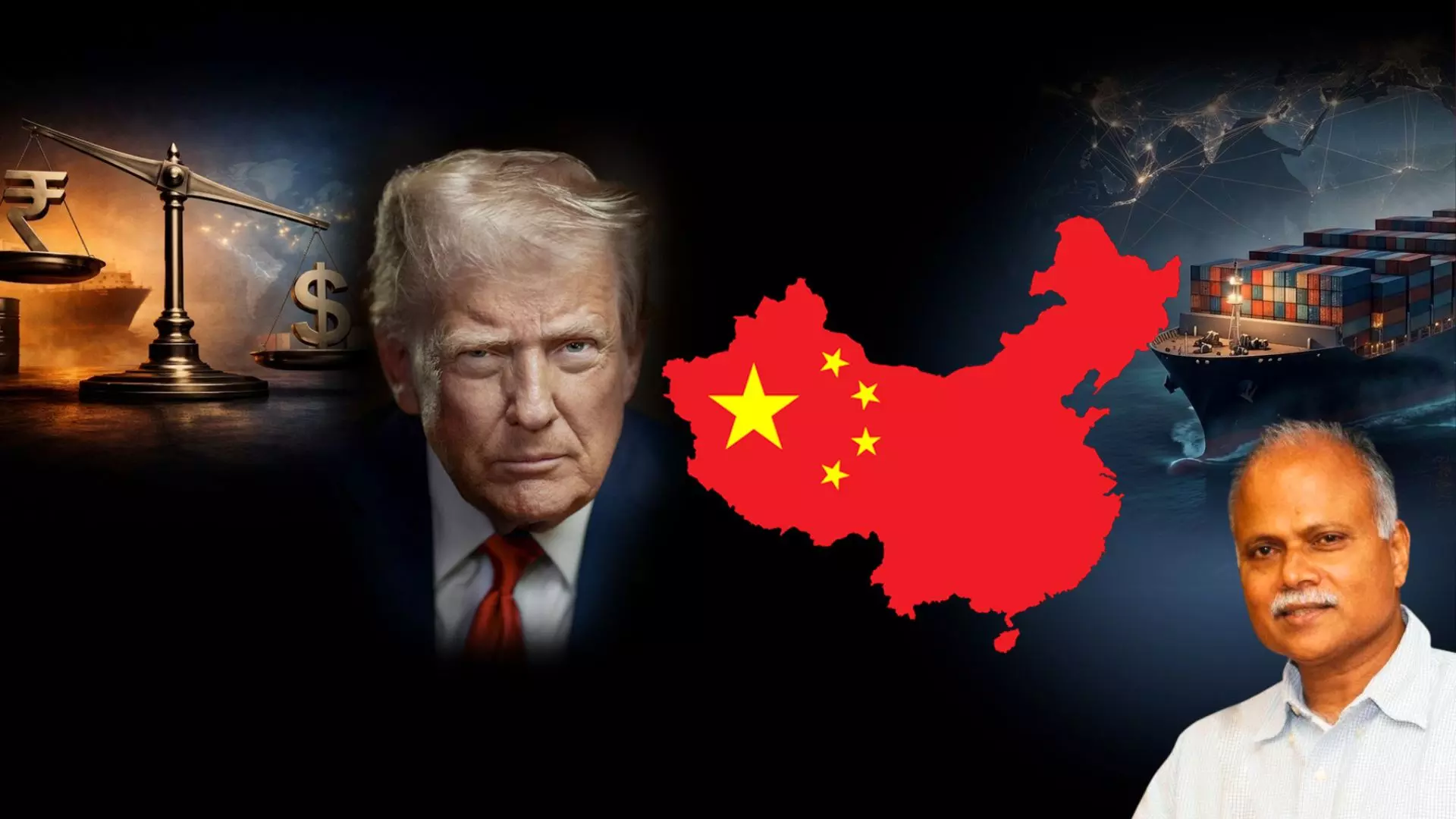
Iran war: 'Trump might end up helping China and boosting electric ecosystem globally'
S Srinivasan, Editor-in-Chief, The Federal, spoke to TK Arun, senior journalist and columnist, on how the West Asia conflict is reshaping currencies, energy choices, and global power equations

US President Donald Trump’s war against Iran may end up strengthening China’s global position—an outcome starkly at odds with Washington’s strategic goals. As countries rethink energy security and accelerate the shift to electricity, China’s dominance in batteries and power systems could make it indispensable.
S Srinivasan, Editor-in-Chief, The Federal, spoke to TK Arun, senior journalist and columnist, on how the West Asia conflict is reshaping currencies, energy choices, and global power equations.
How do you see the rupee moving after the war, especially after its recent sharp fall?
I think the fall is sort of temporary. While the rupee might not recover the full extent of its loss, a considerable extent will be made up.
When the war began, there was a flight of capital towards the US. The dollar strengthened as investors moved to safety, and most currencies depreciated. The rupee was part of that trend.
However, once the panic subsides, capital flows will reverse, and the rupee will strengthen again.
That said, inflationary pressures will persist because oil supplies are disrupted and prices are rising. The RBI may eventually have to raise rates, which could dampen growth but also support the rupee.
Also read: Iranian Navy guided Indian LPG tanker through Strait of Hormuz: Report
Could the rupee still slide further, even if the war ends?
I don’t think it will go to 95 and beyond. It should strengthen once the war ends.
There is also scope for RBI intervention because India’s trade and current account deficits are not alarming.
So, businesses will likely operate within a band between pre-war and current levels rather than expecting a sustained sharp decline.
Also read: Iran denies surplus oil supply after US eases sanctions on stranded crude
What lessons does this crisis hold for India’s heavy dependence on crude imports?
Two actions are needed. One is to reduce dependence on crude. The second is to increase domestic exploration.
India’s geography suggests there should be hydrocarbons, but we may not have explored enough. Discoveries like Cairn’s Rajasthan find show potential.
However, the most sensible strategy is to reduce reliance on crude altogether and move towards electricity as the primary energy source.
Is renewable energy the solution to this dependence?
Renewables are important, but they are not a full substitute for fossil fuels yet. While over 50 per cent of our installed capacity is non-fossil, nearly 70 per cent of actual power generation still comes from coal.
India’s per capita energy consumption is far below global levels, and it will rise as the country develops. That means we cannot avoid thermal power in the short term.
So coal remains unavoidable?
Yes. India has large coal reserves but struggles with efficient mining. We should expand coal usage, but in cleaner ways like gasification. Gasified coal can also serve as feedstock for fertilisers and plastics. There is significant scope for investment and R&D here.
If the world shifts to electric energy, does that create new dependencies?
Yes, and this is critical. We are currently dependent on China for battery storage systems and power electronics. These are essential for managing renewable energy grids. This creates a major national security vulnerability because disruptions or sabotage in these systems can affect the entire economy and defence infrastructure.
Is nuclear energy a better long-term alternative?
Yes, especially for India. We have thorium reserves and a three-stage nuclear programme designed for long-term energy security. But progress has been slow.
India should prioritise developing indigenous nuclear capabilities instead of relying on imported technologies.
Globally, who benefits most from this energy shift triggered by the war?
China. It is a one-stop source for everything electric—battery storage systems and advanced power electronics. As countries move away from hydrocarbons, they will depend more on China. Europe, for instance, may start seeing China not as a rival but as a stabilising partner in energy transition.
Does this mean Trump has indirectly helped China?
Yes. Trump might actually end up helping China and boosting the electric ecosystem globally. The war accelerates the shift to electricity, which plays directly into China’s strengths.
What happens to Trump’s push for oil dominance?
In the short term, higher oil prices benefit US oil companies. But the US lacks sufficient LNG capacity to replace disrupted supplies from regions like Qatar. Building that capacity takes years.
Meanwhile, countries will look elsewhere, including Russia, for gas supplies.
Has Trump’s policy approach affected the US dollar as well?
Yes. His tariff policies, instability, and global economic disruptions have eroded trust in the US dollar. This weakens its role as the anchor currency of global finance and benefits rival economies.
How will the global geopolitical order change after the war?
One major consequence is nuclear proliferation. Countries will conclude that having nuclear weapons is the only real deterrent. Nations like Japan, Germany, and South Korea may reconsider their stance.
In the Middle East, Israel will emerge as the dominant regional power, while Iran is likely to eventually develop nuclear capability.
What about Gulf economies and their global ambitions?
This war has damaged their ambitions significantly. Disruptions to hubs like Dubai raise questions about their long-term reliability as financial and aviation centres. Their plans to diversify away from oil may face setbacks.
Is the world moving towards a more unstable multipolar order?
Yes, and in an unregulated way. Countries will spend more on defence, which is good for arms manufacturers but bad for social sectors like health and education, especially in developing nations.
Where does India stand in this changing world order?
India must invest heavily in R&D. Currently, we spend just 0.65 per cent of GDP on R&D—far too low. Even smaller economies spend more proportionally. Without building domestic technological capability, especially in defence and electronics, India cannot achieve strategic autonomy.
What is the biggest risk if India does not act?
We will remain dependent. Even our drones rely on Chinese components. That is unacceptable for a country aiming to be a major power. We must invest massively in science, technology, and innovation to secure our future.
(The content above has been transcribed from video using a fine-tuned AI model. To ensure accuracy, quality, and editorial integrity, we employ a Human-In-The-Loop (HITL) process. While AI assists in creating the initial draft, our experienced editorial team carefully reviews, edits, and refines the content before publication. At The Federal, we combine the efficiency of AI with the expertise of human editors to deliver reliable and insightful journalism.)