



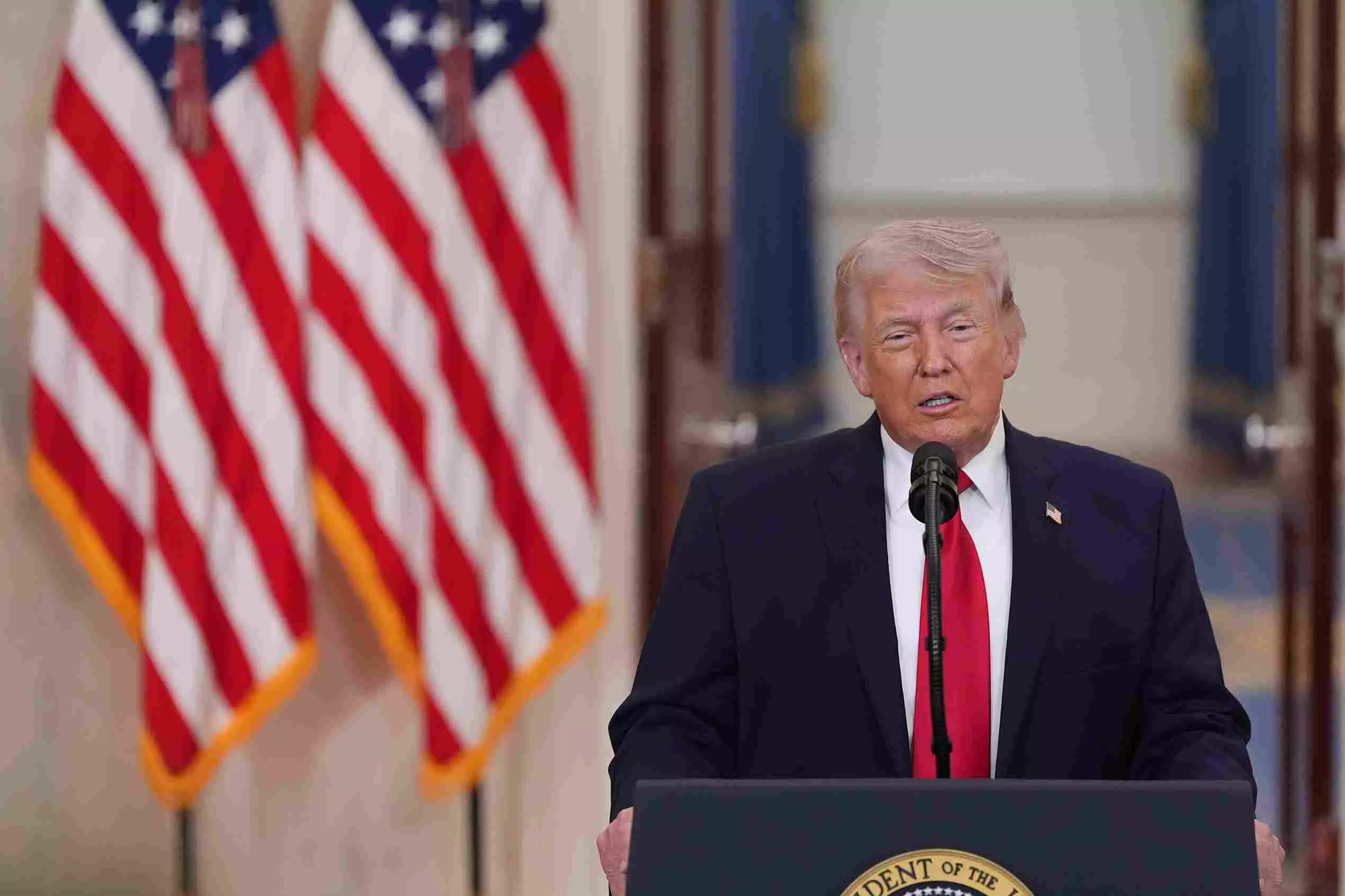
'Thousands of savages' were hunting for the missing US airman in Iran, said President Donald Trump referring to Iran's bounty on the American airman, later in an interview. Photo: PTI
How US F-15 airman's cryptic radio message nearly thwarted his audacious rescue
How the US airman was rescued from deep inside Iran in a massive Special Ops task force is nothing short of a plot from a Top Gun movie. Here is what happened

The high-stakes, dramatic rescue of a downed US F-15 pilot from deep within hostile territory wasn’t just a military operation; it was a real-life thriller that could have been part of a plot from a Top Gun movie.
Here is what happened. On April 3, the unthinkable happened when a US F-15E Strike Eagle, a twin-engine, two-seat interdiction fighter jet, was shot down over south-western Iran.
As the dual-engine jet shattered against the horizon, the US recovery teams managed to rescue the pilot, pulling him out before the dust of the crash had even settled. However, the backseater, a weapons systems officer, was not so lucky and he vanished into the rugged Iranian landscape, becoming a "ghost" behind enemy lines.
Most hunted man
Then began a frantic search and a race against time to bring home the weapons systems officer home. The world watched with bated breath as the rescue operations went on for two days.
Meanwhile, the Iranian government turned the hunt into a televised spectacle. Desperate to seize a high-value asset, they issued a $60,000 bounty for any information leading to his capture and urged civilians to participate in the search operation.
Also read: Live! Trump threatens to blow up ‘entire’ Iran; Iran minister calls him ‘unstable’
For 48 hours, the WSO, a Colonel, was the most hunted man in the Middle East.
Battle for survival
While Iranian patrols combed the valley floors and the US scrambled every available aircraft in the sky, the airman was battling a solitary war against the terrain and the clock.
First, he hid in a mountain crevice, and then kept moving and at one point hiked up a 7,000-foot ridgeline to stay ahead of the forces closing in around him. Armed with a handgun and his training, his location remained unknown even to the United States for more than 24 hours.
The airman also had a communication device and a tracking beacon. However, he went off the grid to survive.
In an interview later to Axios, US President Donald Trump said, "This brave warrior was behind enemy lines in the treacherous mountains of Iran, being hunted down by our enemies, who were getting closer and closer by the hour."
CIA's unique capabilities
According a report in The New York Times, the CIA deployed "unique capabilities" to detect the airman’s location the mountains, as he outmaneuvered local search parties and stayed one step ahead of the bounty hunters.
Once the airman's coordinates were locked, the CIA informed the White House, and on Saturday night, under the cover of total darkness, a Navy SEAL team 6 special operations troops was dropped in the middle of the Iranian mountains to rescue the missing US F-15 airman.
Also read: Lost jet, destroyed planes, daring rescue: How US airman was pulled out of Iran
They moved with the lethal silence of professionals. Despite the injuries, the officer had sustained during his two-day ordeal, the team secured him and left without a single casualty or injury to the rescue force, said US media reports.
Trump described the mission as "the first time in military memory that two US pilots have been rescued, separately, deep in enemy territory."
'Power be to God'
According to US officials, the airman relied on his mandatory Survival, Evasion, Resistance, and Escape training, known as SERE, to avoid capture for a day and a half. However, the airman nearly missed being rescued due to a cryptic message he had sent through his radio.
It wasn't a standard distress code or a set of coordinates. Instead, the stranded weapons systems officer sent a four-word declaration: "Power be to God."
The unusual nature of the message sent alarm bells ringing through the highest levels of American intelligence. They suspected the airman had already been captured by Iranian forces. Officials worried that his captors were forcing him at gunpoint—or using his equipment—to broadcast "false signals". To move in meant risking more American lives on a potential Iranian ruse; to stay back meant abandoning a man who might actually be calling for help. s
Trump told Axios after confirming the rescue, "What he said on the radio sounded like something a Muslim would say." He also added that people who knew the officer later explained he was a religious person, and that it made sense for him to say that.
How US airman survived
The airman relied on his mandatory Survival, Evasion, Resistance, and Escape training. The airman's training teaches pilots to endure harsh conditions, avoid enemy forces, resist capture and navigate towards rescue teams. Pilots are equipped with a survival kit attached beneath the ejection seat and a survival vest worn on their person, carrying items including radios, helmets and weapons.
Also read: US readies to deploy its most lethal long-range missiles as Iran holds its ground: Report
Even as Trump put it, "thousands of these savages were hunting him down", around 200 soldiers from special operations units were deployed to rescue him.
Pure fiction, says Iran
While Washington celebrated a historic recovery, the Iranian military dismissed the story as pure fiction, claiming the US didn't pull off a rescue, but instead walked into a trap.
Ebrahim Zolfaghari, spokesman for the military's central command, Khatam Al-Anbiya, said the operation had been "completely foiled". According to Zolfaghari, the U.S. attempted a multi-aircraft insertion at a desolate, decommissioned airfield in southern Isfahan. He characterized the mission not as a surgical extraction, but as a "deception and escape" attempt that was crushed before it could begin.
Zolfaghari didn't stop at tactical claims; he took direct aim at the Oval Office, accusing President Trump of peddling "empty rhetoric and diversion".
"The reality on the ground," Zolfaghari stated firmly, "demonstrates the superior position of Iran's powerful armed forces."