



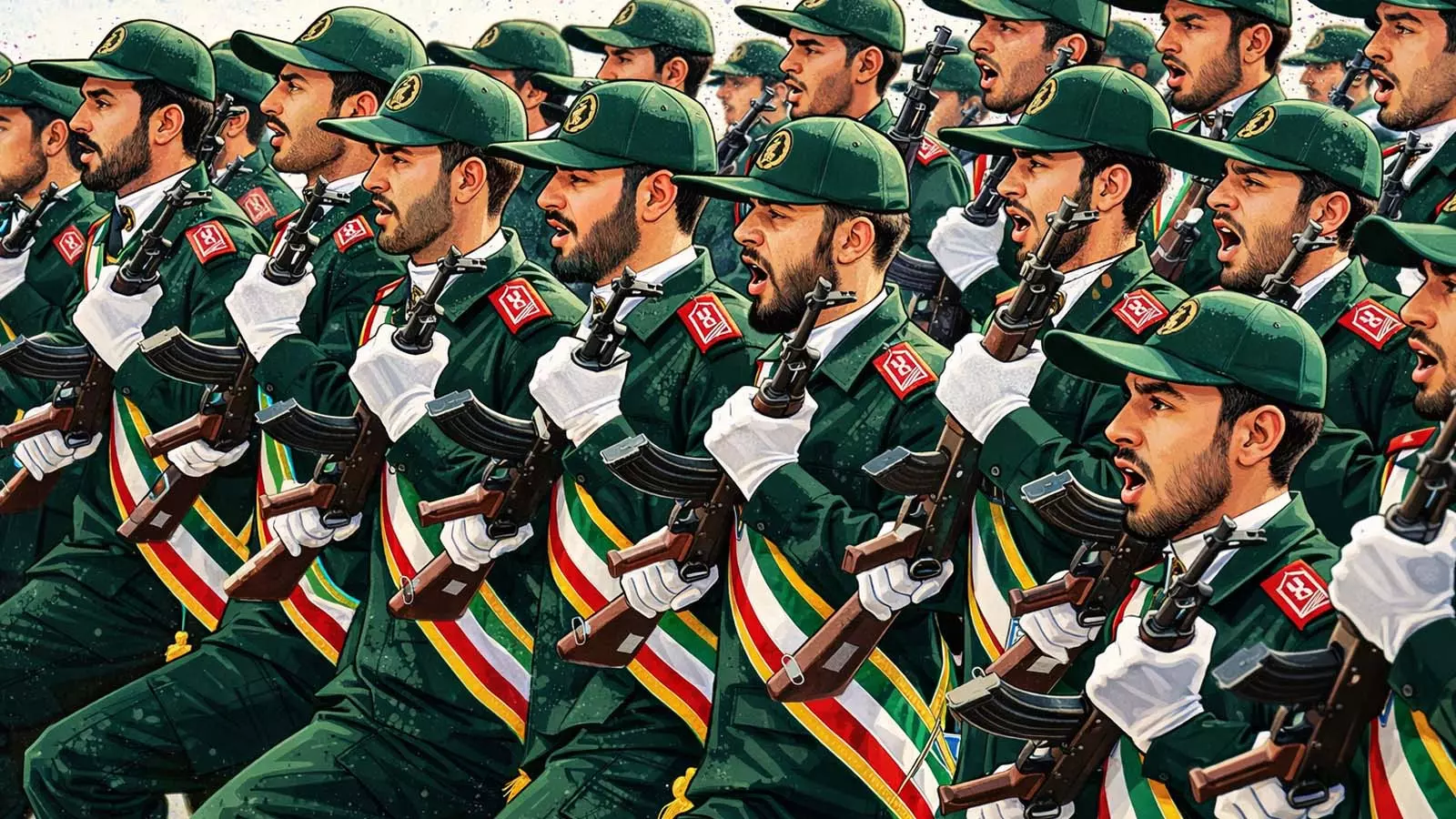
Has IRGC tightened grip over Iran power reins amid war?
The growing external hostility and the depletion of leadership has reportedly put the Revolutionary Guards in a position to dictate terms in administration

While the ongoing conflict in West Asia has seen damage both in the territory of Iran, its regional rival Israel and also other nations as collateral damage, it has also signalled a shift in the power equations in Tehran.
Also read: Iran war: IRGC threatens 18 US tech, infra companies; fully prepared, says US
In an exclusive report, Iran International, based in the UK, has claimed that tensions have also been on the rise between Iranian President Masoud Pezeshkian and the influential Islamic Revolutionary Guard Corps (IRGC), which is part of the Iranian Armed Forces, with the latter taking control of important state functions, pushing the former into a “complete political deadlock”.
What is IRGC?
♦ The Islamic Revolutionary Guard Corps (IRGC) was founded in 1979 after the Islamic revolution
♦ It was founded by the clerical leaders who did not trust the traditional armed forces much
♦ IRGC personnel were conceived as a “people’s army”, helping consolidate the revolution as the founding supreme leader, Ruhollah Khomeini formed a state on the concept of velayat-e faqih (guardianship of the jurist).
♦ Today, the IRGC reports directly to Iran's supreme leader
♦ The Iran-Iraq War (1980–88) saw the IRGC transforming into more of a conventional fighting force
♦ The IRGC includes, among others, ground forces in Iran’s 31 provinces and Tehran, numbering over 150,000
♦ The IRGC plays a key role in Iran’s politics, with many of its veterans becoming senior government officials
The report also claimed that the IRGC has barred presidential appointments and intervened in decisions while setting up a security apparatus around the saddle of power, restricting the government from exercising executive control.
IRGC blocked president's efforts
Giving an example of Pezeshkian’s reduced authority, the Iran International report also cited sources to claim that efforts made by the president to install a new intelligence minister after the incumbent Esmaeil Khatib was eliminated in an Israeli airstrike in March could not succeed under pressure from Ahmad Vahidi, the chief of the IRGC. Vahidi himself assumed the position on March 1 after his predecessor, Mohammed Pakpour, was also killed in the attacks.
If the report is to be believed, Vahidi even asserted that decisions on filling up critical and sensitive leadership positions would be made by the IRGC in such wartime situations.
The IRGC’s assertions consolidate speculations that Iran is seeing a serious power vacuum. In the country’s political system, presidents are generally second in command after the supreme leader, who enjoys authority over important portfolios. But with the long-time supreme leader in Ali Khamenei killed and the whereabouts of his successor, Mojtaba, not confirmed, the IRGC perhaps has found a golden opportunity to consolidate its grip over statecraft.
Also read: If US plans Iran ground war, where does it launch it from?
Such a turn of events and a consequent power struggle, if at all going on in Iran in the alleged absence of the supreme authority, is not surprising.
President, IRGC speak in contrasting voices
A week after the attacks began on Iran on February 28, and it retaliated with a strategy of targeting Gulf nations hosting American bases, President Pezeshkian issued an apology to Iran’s neighbours and stated that his country had no intention to violate them and cited that attacks took place against its forces first.
But the IRGC was not impressed and came up with its own statement soon after, warning Iran’s neighbours that the attacks would continue if the US and Israel used their territories to target Iran. Going by Iran’s hard response that has taken place over the last month or so, one would not doubt that it’s the IRGC’s stance which is more at play.
Last week, Iran International said in another report that Pezeshkian and Vahidi were not on the same page on how to manage the ongoing conflict and the adverse repercussions it has left on the Iranians’ lives and the nation’s economy. The president did not approve of the IRGC’s approach that saw escalation of tensions, cautioning what economic consequences it could result in.
But the IRGC also had its counterpoint ready. It blamed the government for the current state of affairs, alleging that it was a failure on the latter’s behalf to implement structural reforms that saw the beginning of such a conflict, Iran International reported, citing sources.
It also rejected the president’s urge to allow the administration to run the executive and managerial functions.
Israeli media also speculates 'cracks'
Besides the Iranian media, reports emerging from Israel also speculated about “signs of cracks” developing within the Iranian political system. The Times of Israel wrote, citing a senior Israeli official recently, that there are signs of cracks in the regime in Tehran, and while Israel was creating conditions to see it toppled, it all depends ultimately on the people of Iran. It cited even Israeli Prime Minister Benjamin Netanyahu speaking about visible cracks in the Iranian establishment.
Also read: What’s behind Trump’s flip-flops on Iran war?
Israeli outlet ynet Global also carried an analytical report on March 23 titled ‘Bombs will not break Iran — but its elites might’ in which it made a forecast about Iran’s likely fate following the war.
It said, “The possibility of regime collapse in the Islamic Republic of Iran following the Iran-Israel-U.S. war is best understood not through battlefield dynamics or protest intensity alone, but through the stability of the ruling elite coalition. Authoritarian regimes rarely fall simply because they are challenged from below; rather, they collapse when internal coordination among elites breaks down.
“External military pressure can act as a catalyst. However, its decisive effect depends on whether it alters the expectations and incentives of key regime insiders, most notably the Islamic Revolutionary Guard Corps (IRGC), clerical institutions and regime-linked economic actors.”
Top Iranian official warned against Mojataba elevation
Iranian media reports have also cited an “unprecedented internal crisis” which is suspected to be unfolding within Mojtaba’s inner circle. It said efforts were being made to remove Ali Ashgar Hejazi, a powerful leader in the office of the supreme leader. This episode is also being held to be closely linked with the IRGC’s alleged dominance in matters of governance since Hejazi is against Mojtaba’s elevation and reportedly cautioned that under him as the supreme leader, the IRGC would take control of Iran and eclipse the civilian institutions permanently.
Regional experts have also indicated that the IRGC’s clout is indeed strong at the moment.
Senior Al Jazeera journalist Resul Serdar was cited by the news outlet as saying that while political leaders in Iran are responsible for state and non-strategic affairs, in matters of strategic — foreign and security policies — they don’t have much of a say. Even the president doesn’t. The office of the supreme leader and the IRGC enjoy real powers, even when there is no war.
Also read: US burns $10,300 a second in Iran war, says SIPRI study
Al Jazeera also spoke with Ali Vaez, director of the Iran project at the International Crisis Group, who said Pezeshkian’s occasional off-key remarks have shown his limitations in seeing through critical moments. Soft words during conflicts are seen more as “rhetorical missteps” and the civilian leaders remain sidelined, and it’s the IRGC that eventually prevails, he said.
IRGC leaders have been appointed to posts
What makes the IRGC’s growing influence in Iran more evident is the fact that several of its leaders from the Iran-Iraq war (1980-88) era have been appointed to high-profile positions in the power structure in the midst of the elimination of its leaders.
Mohammad Baqr Qalibaf, speaker of the Iranian parliament (Majlis), appears to have been put in de facto charge of Iran, particularly after the killing of the secretary of the Supreme National Security Council, Ali Larijani, on March 17. Qalibaf is a career IRGC figure and now appears to be playing a major role in spearheading the war effort.
However, it would be wrong to say that the IRGC’s influence has grown in Iran’s domestic affairs only now.
IRGC a powerful keeper of post-1979 Iran
Founded soon after the country’s watershed moment in 1979, when the revolution happened, the IRGC has remained directly answerable to the supreme leader and defends the republic against both external and domestic threats. It also acts as a counterweight to the regular Iranian forces as the country's clerical leaders formed it since they little trusted the traditional armed services.
Reuters reported that the IRGC has emerged as a “state-within-a-state”, combining military might, an intelligence network and economic power — all of which focused on maintaining the survival of the country’s Islamic system of power.
Also read: Iran war: Forex reserves fall by USD 30 bn; will it increase India’s challenges?
With Iran facing the international community’s wrath (the UAE has squeezed the IRGC’s monetary networks and Argentina has designated it as a terrorist outfit, for example) amid the war and its leadership facing a serious depletion, the powerful IRGC’s urgency to steer the country doesn’t defy logic. The war has simply accelerated what was already a dominant position.
Whether this becomes a permanent structural shift or reverts once the conflict stabilises remains to be seen.