



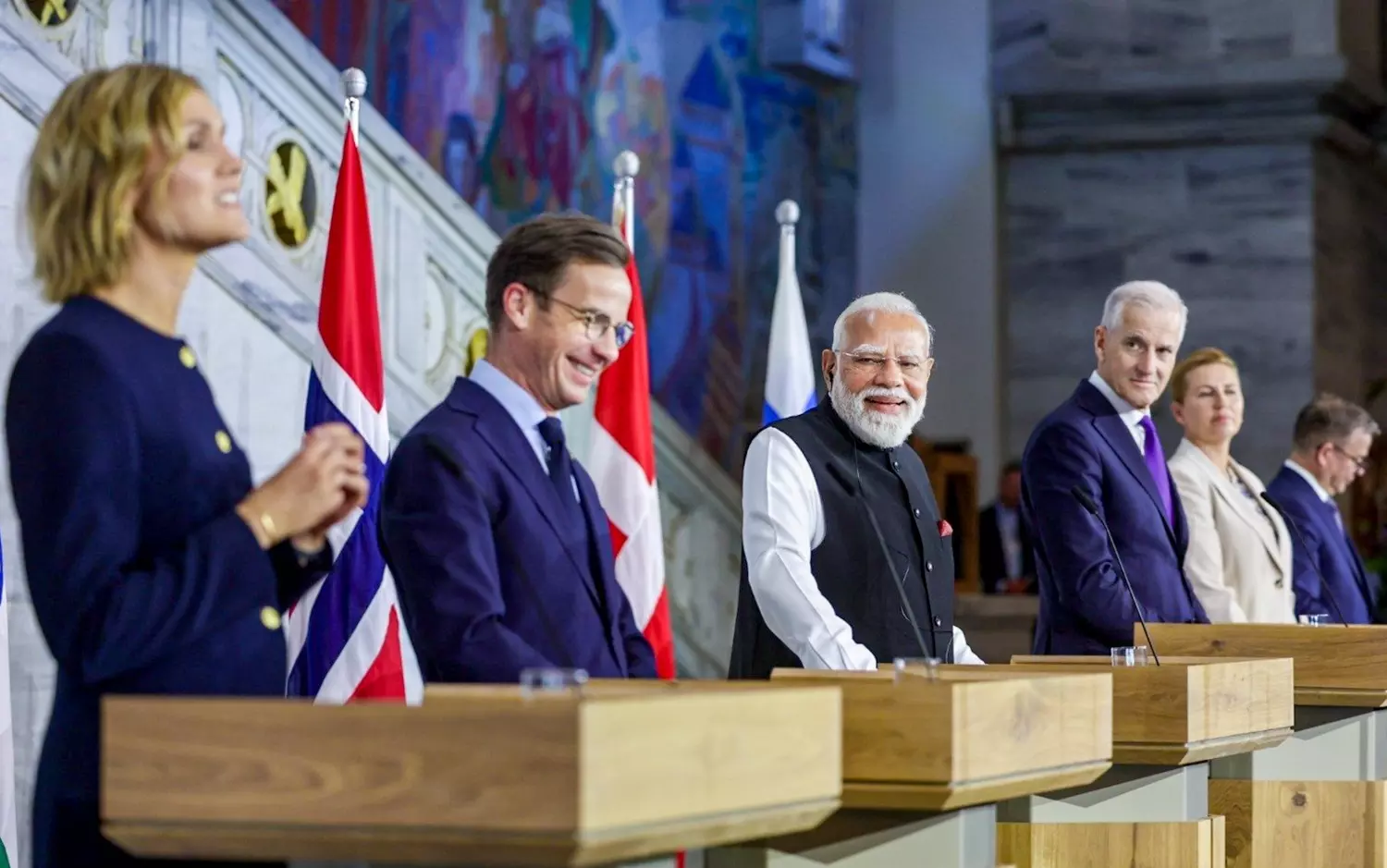
In this image posted on May 19, 2026, Prime Minister Narendra Modi speaks during a joint press meet with Nordic leaders, prime ministers of Norway, Finland, Sweden, Iceland, and Denmark, at the Nordic-India Summit, in Oslo, Norway. Photo: @narendramodi/X via PTI
Modi’s Nordic outreach: Reactive foreign policy than bold strategy? | Interview
India’s outreach to Nordic countries becomes important because it signals a need to diversify international relationships and trade partnerships

A world unsettled by wars and shifting alliances is forcing India to rethink parts of its foreign policy, says geopolitical analyst and The Federal's Consulting Editor K S Dakshina Murthy. According to him, Prime Minister Narendra Modi’s latest outreach to some of the Nordic countries is more a response to mounting global uncertainty and economic vulnerabilities than a bold strategic pivot.
Also read: Now, Trump looks at rival Xi to bail him out of Iran mess
As India expands ties with countries such as Sweden, Norway, Finland and Denmark, questions are emerging over whether New Delhi is gradually reshaping its diplomatic priorities. In a conversation with The Federal, Murthy spoke about Modi’s recent visit to Europe, China’s rising influence, renewable energy, and India’s evolving foreign policy calculations.
Here are some excerpts from the interview:
Why did Modi visit the Nordic countries now, and what does India gain from the outreach?
The visit to the Nordic countries was, in many ways, a routine and planned engagement because it was linked to the third India-Nordic summit. The earlier summits were held in 2018 and 2022, in Copenhagen and Stockholm, respectively.
Modi also combined the trip with visits to Italy and the UAE, making it a broader diplomatic tour. However, the current global context has given the visit an added significance.
The world is facing uncertainty because of the Russia-Ukraine war and the ongoing tensions involving Iran, Israel and the United States. There is widespread anxiety about where these conflicts are heading and how they could affect the global economy.
Also read: Trump, other US officials enter China under ‘digital lockdown’; why so?
In this context, India’s outreach to Nordic countries becomes important because it signals a need to diversify international relationships and trade partnerships. India’s economic ties with Nordic countries have historically been limited, with trade volumes hovering around or below one per cent.
At the same time, these countries are highly advanced in sustainable and green technologies. India can benefit significantly from deeper engagement with them, especially since India’s European relationships traditionally focused more on countries such as the UK, France and Germany.
Do Modi’s Nordic visits coinciding with trips by Trump and Putin to Beijing suggest a shift in global alignments?
The timing is largely coincidental because such visits are planned much earlier. But it is still significant that global leaders are increasingly converging on Beijing during a period of international instability.
China is emerging as a major diplomatic player, particularly in efforts to ease tensions between Iran and the US, as well as Russia and Ukraine.
Also read: Xi, Putin condemn US-Israeli strikes on Iran as 'illegal' at Beijing talks
India is watching these developments closely. While India and China maintain strong trade ties, China’s close relationship with Pakistan remains a concern for New Delhi.
Against this backdrop, Modi’s Europe visit reflects pressure on India to rethink aspects of its foreign policy. India risks appearing marginalised on the global stage if it does not actively recalibrate its strategies amid these changing geopolitical equations.
How important are Nordic countries for India’s long-term economic and technological goals?
The most important area right now is renewable energy. India needs to reduce its dependence on crude oil, especially given the instability in West Asia.
Countries like Sweden, Norway and Finland possess advanced technologies in solar, wind and sustainable energy systems. India needs such partnerships to better prepare for future global disruptions.
There are already concerns about possible shortages of LPG and crude oil because of tensions in and around the Strait of Hormuz. While India has managed the situation so far, there are limits to how long such management can continue.
Also read: Strategic balancing: How India is navigating the Iran crisis
China, for example, is better prepared because it has large crude reserves and meets around 50 per cent of its energy requirements through renewable sources.
India’s dependence on oil imports from the Middle East makes diversification essential. Closer ties with Nordic countries could help India build long-term resilience through technology and clean energy cooperation.
Does Modi’s Nordic outreach mark a long-term shift in Indian foreign policy, and how much is aimed at domestic political audiences?
When Modi first came to power in 2014, his extensive foreign travel generated both praise and criticism. Over time, however, those optics have become less politically significant domestically.
The larger question now is whether India is consciously reshaping its foreign policy or simply reacting to external developments.
India traditionally prefers not to take hard positions that might antagonise one country or another. But subtle shifts are visible. For example, India historically supported the Palestinian cause, yet under Modi it has moved closer to Israel and participated in broader strategic groupings involving the UAE and the US.
These changes are happening gradually rather than dramatically.
At the same time, India continues maintaining relations with countries like Iran and Russia, which have helped during the current energy crisis. Iran has periodically facilitated shipments carrying LPG and oil, while Russia became a key supplier of discounted crude.
Also read: Iran war: Why have peace efforts not clicked yet?
But maintaining close ties with multiple sides can also create paralysis in moments of crisis. India now finds itself unable to decisively respond to tensions between the US and Iran because it shares strong relations with both.
India’s current foreign policy approach appears more reactive than proactive. Even the push towards Europe and the Nordic countries is largely a response to global instability rather than a fully thought-out strategic transformation.
Whether this evolves into a more concrete long-term shift remains to be seen.
The content above has been transcribed from video using a fine-tuned AI model. To ensure accuracy, quality, and editorial integrity, we employ a Human-In-The-Loop (HITL) process. While AI assists in creating the initial draft, our experienced editorial team carefully reviews, edits, and refines the content before publication. At The Federal, we combine the efficiency of AI with the expertise of human editors to deliver reliable and insightful journalism.


