



Trump, other US officials enter China under ‘digital lockdown’; why so?
It's based on a longstanding belief in the US government that anything brought into China should be treated as unsafe or “potentially compromised”

As US President Donald Trump travelled to China for a high-stakes summit with President Xi JinPing, all members of his delegation were put under what officials call a ‘digital lockdown’. According to a Fox News report, all officials, including hundreds of aides, personnel, and major CEOs, entered China only after leaving behind their personal phones and laptops, instead carrying temporary “clean devices” with limited access.
This is based on a longstanding belief in the US government that anything brought into China should be treated as unsafe or “potentially compromised”. US officials operate under a rule that any device or network in China — including phones, laptops, Wi-Fi networks — are either compromised or under State surveillance.
Bill Gage, a former Secret Service Agent, told Fox News: “China is a mass surveillance state. Briefings for US officials begin well before the President arrives, and they make clear that everything is monitored.”
Burner devices, golden image phones
Most members of the delegation left their personal electronics at home, instead using temporary ‘burner’ or ‘golden image’ devices. These were stripped down to the basics and would be inspected before and after the trip to check for tampering.
Also read | Taiwan, Iran, trade: Key highlights of Trump-Xi meet in China amid global turmoil
These are devices that security teams specifically prepare with a known setup, so they can be checked against the original ‘golden images’ after the trip to detect surveillance.
“We always tell people to assume everything you say and do, both in person and digitally, could be monitored, and to act accordingly,” Theresa Payton, former White House Chief Information Officer, told media houses. This restricted access is not only for phones or laptops; it includes unknown networks.
The US government also warned the delegates against using unknown charging stations or USB cables, due to risks of ‘juice jacking’ where malicious hardware could steal data or install malware.
Analogue environment
These precautions create an analogue environment for a modern presidential delegation. Paper documents are more common, digital access is restricted, and aides accustomed to constant communication operate through tightly controlled government channels.
To facilitate secure in-person conversations, temporary ‘Sensitive Compartmented Information Facilities’ (SCIFs) are set up which block electronic bugging and eavesdropping.
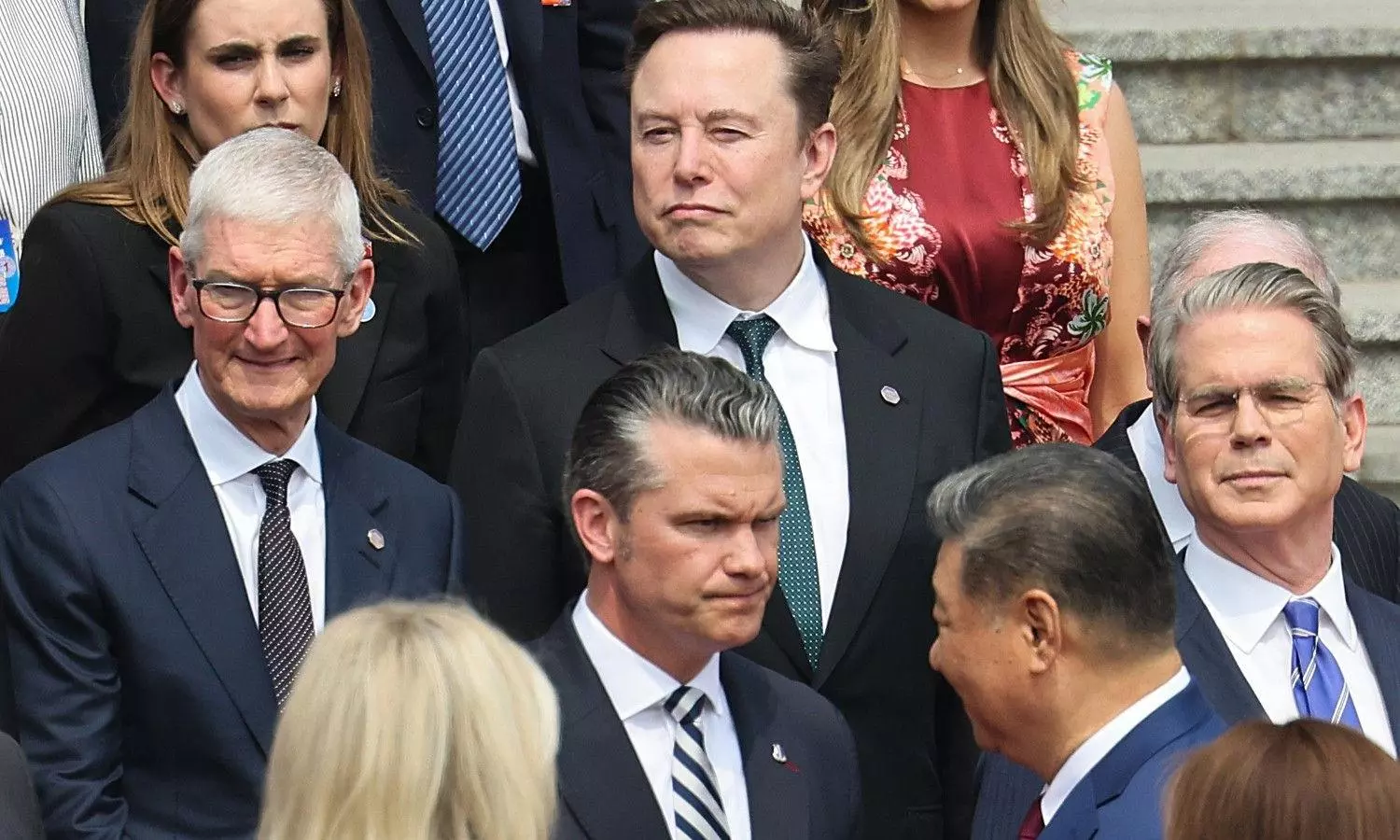
This is only a part of the security measures taken to protect the high-profile delegation, which consists of corporate titans like Tim Cook (Apple), Jensen Huang (Nvidia), Larry Fink (BlackRock), etc. However, despite these strict protocols, a viral video showed Tesla’s CEO Elon Musk recording the welcome ceremony with what seemed to be a personal mobile, sparking conversations online.
Chinese cyber laws
The Chinese government has constantly rejected claims that it engages in improper surveillance. In an interview with Fox News, Chinese Embassy spokesperson Liu Pengyu claimed: “The Chinese government places a high priority on protecting data privacy and security in accordance with the law. It has never required—and will never require—enterprises or individuals to collect or store data in violation of the law."
Watch/Read | Trump’s China visit: Will it help resolve Iran conflict?
China’s strict digital laws are said to enforce deep state control over cyberspace and information flow. These laws mandate intense surveillance and severe penalties for non-compliance or unapproved online speech, media reports say.
These extreme measures highlight the underlying tensions between the two countries regarding cyber espionage and technological competition. Despite diplomatic solutions such as the Obama-Xi Agreement where both nations pledged not to conduct any cybersecurity violations, the issue worsened in 2023, when a suspected Chinese surveillance balloon crossed the continental United States before being shot down by the US military after traversing sensitive military sites.