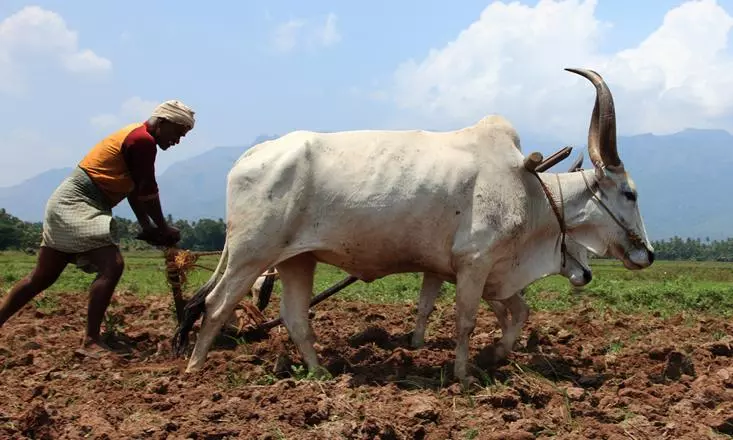
Budget 2026-27 works on continuity, not course correction, for agriculture
Govt pitches high-value agriculture, livestock, AI-led solutions; farm activists warn stagnant incomes, tenant farming and climate risks remain unaddressed

Experts, farm activists and farmer leaders have expressed disappointment over the Union Budget 2026–27, arguing that it reflects policy continuity without meaningful course correction and does little to address deep-rooted agrarian distress and stagnating farm incomes.
Speaking to The Federal, Dr GV Ramanjaneyulu, Executive Director of the Centre for Sustainable Agriculture (CSA), said the budget largely focused on continuing existing programmes, with no major policy shifts. “They have essentially tried to continue what they are already doing. No major changes are visible in this budget,” he said.
Focus on crop diversification
Presenting the Union Budget 2026–27, Finance Minister Nirmala Sitharaman announced a series of initiatives aimed at boosting high-value agriculture and allied sectors to diversify rural incomes beyond traditional farming.
Highlighting the role of livestock, which contributes nearly 16 per cent of farm income, she proposed credit- and loan-linked capital subsidy schemes to modernise livestock, dairy and poultry enterprises, strengthen integrated value chains, and expand veterinary infrastructure through private participation.
Also read | Budget 2026 | The same old grouse: Kerala feels Left out
The budget also outlined targeted interventions for high-value crops and coastal and hilly economies. Sitharaman announced a coconut promotion scheme to replace ageing plantations in major producing states, alongside dedicated programmes for cashew and cocoa to achieve self-reliance, enhance processing capacity and build export-oriented premium brands by 2030. Additional measures include promoting sandalwood cultivation and post-harvest processing, and supporting rejuvenation of old orchards and high-density cultivation of walnuts, almonds and pine nuts in hilly regions, with a focus on value addition and youth participation.
The Finance Minister also announced Bharat Vistar, a multilingual AI tool that will integrate the Agristack portal and the ICAR package on agricultural practices with AI systems. The minister said the platform would help enhance productivity, enable better decision-making and reduce risk.
Deep agrarian issues ignored
Dr Ramanjaneyulu pointed out that the Economic Survey itself highlighted fundamental challenges such as stagnant farm incomes and deteriorating soil health, but the budget failed to respond meaningfully to these concerns. “The government has repeatedly spoken about doubling farmers’ income, but we are nowhere close to that target. This requires proper investment in agriculture — through grants, schemes, better access to credit, and direct income support,” he said.
Dr Ramanjaneyulu also flagged structural changes in landholding patterns, with shrinking farm sizes and a growing number of tenant farmers. “More farmers are cultivating leased land, and tenancy is increasing. Yet, there is no policy framework to extend income support or subsidies to tenant farmers. The first step should be identifying who is actually cultivating the land and then building a support system around them.”
On sustainability, he warned that the budget remained silent on climate risks and soil degradation, despite both being acknowledged in the Economic Survey. “We are clearly seeing the impact of climate change and soil deterioration, but the budget does not address these issues. Fertiliser subsidy needs rationalisation, and support for natural farming should have been significantly expanded. What we see instead is only an inflationary adjustment, not a strategic shift.”
High-value crops, higher risks
He also expressed concern over the push for high-value crops, cautioning that diversification without adequate safety nets could increase risks for farmers. “High-value crops come with higher risks, especially when linked to international markets or specific buyers. Diversification is not just about value, it is about sustainability. Without sufficient investment and support systems, this approach may increase risk for farmers.”
Also read | Budget 2026–27 offers continuity, misses new push for North East
Describing the budget as underwhelming, Ramanjaneyulu said: “It’s like telling a patient that you will continue supplying oxygen and saline, but not ensuring that they recover and leave the hospital.”
He was also sceptical of the emphasis on AI-driven agricultural tools. “Technology like AI is only as good as the knowledge and data that go into it. Technology alone will not help if basic systems are not strengthened.”
MSP realisation remains elusive
Nagpur-based farm activist Vijay Jawandhiya told The Federal that the budget offered little for farmers and the rural economy. “The Union Budget is quite disappointing. There is nothing promising for farmers or for rural India. There is no concrete plan to support agriculture, dairy farming, or allied activities,” he said.
Jawandhiya highlighted the absence of measures to ensure Minimum Support Price (MSP) realisation. “Farmers are not getting MSP, and the government has no plan to compensate for their losses. Soybean and cotton farmers sold their produce at ₹1,000 below MSP, while tur farmers sold at ₹1,500 below MSP.” He stressed that MSP is meant to be a safety net, not a profitable price. “MSP is the minimum support price, it offers protection, not profit. If that protection is missing in the market, how are farmers supposed to survive?”
Punjab-based farmer leader Rattan Singh Randhawa told The Federal that the Union Budget offered little for the state’s farming community, with key issues like MSP left unaddressed. He highlighted the urgent need for crop diversification, noting that more than 100 out of 135 blocks in Punjab are classified as dark zones due to alarming depletion of the water table. “The government has done nothing to encourage farmers to move away from water-intensive crops like paddy. Even when MSP is announced for alternative crops, farmers do not receive the promised prices,” he said.
High output, low incomes
Questioning the emphasis on higher production, Jawandhiya added: “Farmers are already producing more, which is why we have record agricultural output. The real question is why incomes are not increasing.” He contrasted India’s approach with that of other countries, noting that the United States had provided $12 billion in additional subsidies to its farmers to offset losses from global trade disruptions. “Here, the government talks about ‘Sab ka Saath, Sab ka Vikas’, but offers nothing substantial to farmers and labourers.”
Also read | Operation Sindoor effect: Major hike in defence spending
Jawandhiya also criticised what he described as election-driven announcements. “High-value crop diversification was announced with an eye on the Kerala Assembly elections, just as makhana was highlighted ahead of the Bihar elections. These moves are about winning elections, not supporting farmers.”
He criticised the stagnation of PM-Kisan assistance, noting that the direct income support has remained at ₹6,000 annually for nearly seven years, without being indexed to inflation. “PM-Kisan support should be better targeted at needy farmers and linked to inflation. Keeping it stagnant for so long defeats its purpose,” he said.