How government school mergers have triggered varied fallout across states
From legal challenges to local resistance to safety risks for children, state governments have to reckon with vastly different issues. Part 2 of a 3-part series

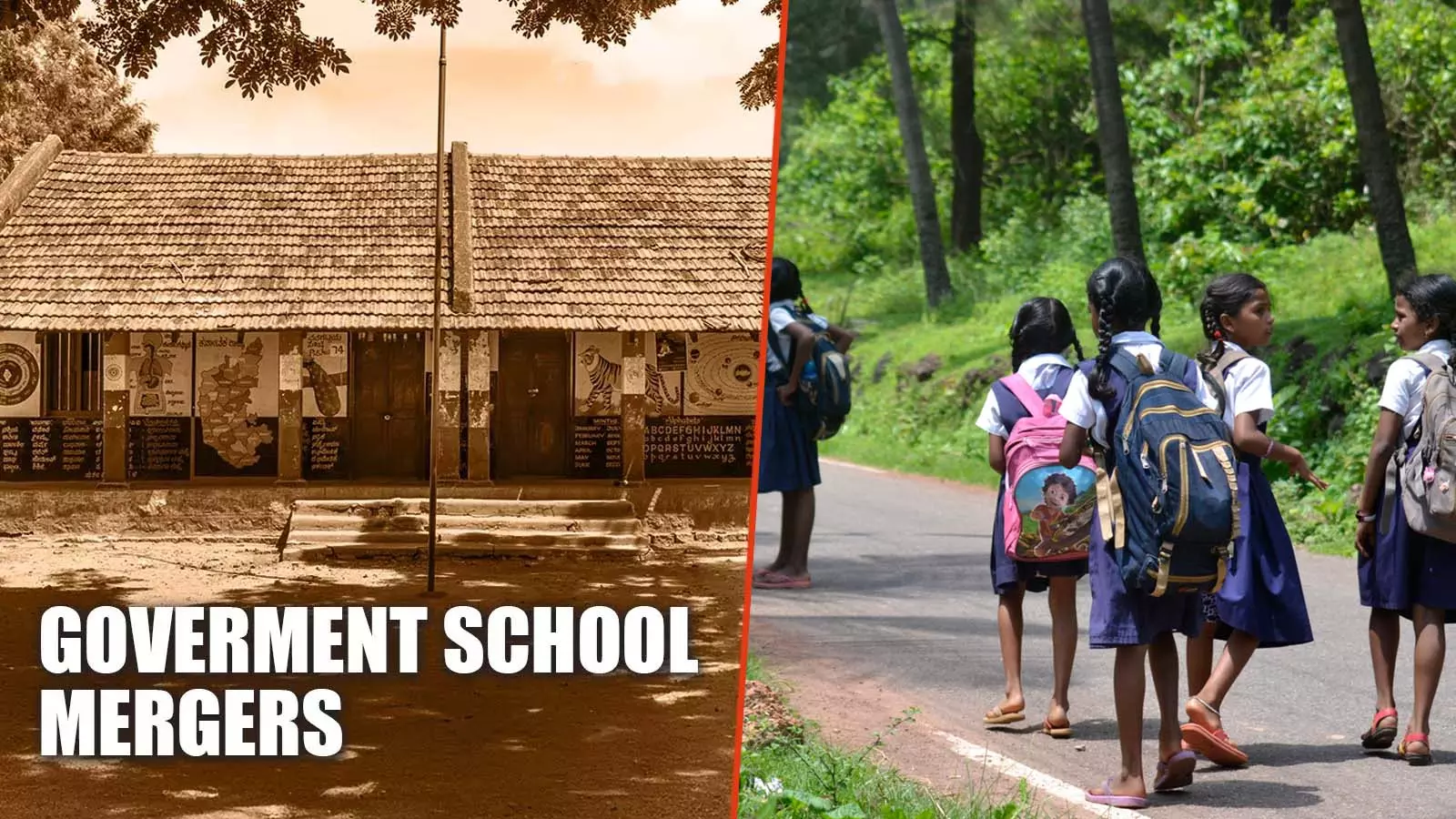
India is consolidating its sprawling network of neighbourhood government schools. Between 2019 and 2024, government data reveals, nearly 15,000 public schools have 'disappeared' — merged into or subsumed by larger schools for better operational efficiency.
However, as governments across the country move ahead with the school consolidation exercise, the reality on the ground suggests that the consequences are far more uneven and contested than policy frameworks indicate, as we read in Part 1 of this series.
Read Part 1 | Why students and parents bear the brunt of govt schools' consolidation
Read Part 3 | How government school mergers hit Dalit, Adivasi, girl students hardest
The trend cuts across states, from Madhya Pradesh and Odisha to Assam, Karnataka, Uttar Pradesh and Himachal. While policy frameworks promise "magnet schools" and "integrated campuses," the reality across states reveals consequences that are hitting children hard. But how this shift varies sharply by region.
UP: A legal flashpoint
In Uttar Pradesh, the attempt to merge schools quickly turned into a political and legal flashpoint. The Basic Education Department had proposed “pairing” primary schools within a 1-km radius and upper primary schools within 3 km, targeting institutions with fewer than 50 students.
Part 1: Why students and parents bear the brunt of govt schools' consolidation
The move triggered protests and a legal challenge from parents, forcing the High Court to stay the order. Although the department later halted the process, officials say over 6,000 schools had already been merged, while teachers’ unions estimate the number to be far higher. The court has since allowed mergers of schools with fewer than 50 students, leaving the policy partially in place.
“The order was issued to ensure the optimum use of resources…However, in many places, this was implemented hastily at the local level without proper execution, after which the matter went to court. Meanwhile, the RTE Act itself talks about providing ‘quality education’ to every child, and the department was following that. But the department has now cancelled the old order by issuing a new one,” a UP education department official told The Federal.
A 2020 NCERT study on school reorganisation in Jharkhand found that mergers did not necessarily resolve core gaps in infrastructure or staffing.
Low enrolment is the main reason cited for merging schools, but parents point out that it's a crisis created by the government itself. Dheeraj Maurya, who is educating his child in a government primary school in Sitapur, said, “If the number of students in a school is low, it is the fault of the government and the education department. How can it be the fault of the student who took admission in that school? Now my two young children have to travel quite far from home. This has increased the problems.”
Teachers and educationists argue that consolidation addresses the symptom, not the cause. “Instead of improving government schools, reducing their number will not solve the problem,” Sudhanshu Mohan of the Primary Teachers’ Union in UP told The Federal.
Karnataka: Locals up in arms
A similar debate is unfolding in Karnataka, where the proposed KPS Magnet School model has triggered resistance. The state plans to set up one such school per gram panchayat by merging 8-10 nearby institutions within a 5–10 km radius, backed by a ₹2,000 crore loan from the Asian Development Bank (ADB).
While the state government argues that this will improve quality by providing integrated schooling under one roof, critics warn that it could lead to the closure of tens of thousands of government schools. In places like Honganur in Channapatna taluk, attempts at merger have already met with local opposition.
Also read: Protest in Bengaluru over 'magnet' school plan; activists warn 40k govt schools at risk
“The KPS Magnet scheme that the government intends to launch is aimed at closing down more than 40,000 government schools…It is being said that in the future, KPS schools will be run by private parties. The intention is to privatise the education sector in a phased manner. That is why we are opposing it,” Subhash Bettadakoppa of the All India Democratic Students’ Organisation told The Federal.
These concerns are unfolding alongside a steady shift in enrolment. In Karnataka, government school enrolment has declined significantly over the past decade, while private school enrolment has risen. The number of low-enrolment government schools has also increased, strengthening the state’s case for consolidation.
Rajasthan: Poor implementation
Yet, evidence from other states suggests that merging schools often creates new barriers rather than resolving existing ones.
In a chapter titled ‘Problems of equity and access in education: A case of school-merging policy’, part of a book titled Contextualising Educational Studies in India, published by Routledge India in 2021, Aysha Malik of the National Institute of Educational Planning and Administration (NIEPA), wrote that 17,479 schools were merged in Rajasthan at both the primary and upper primary levels in 2015-16.
Also read: Is English native or foreign? CBSE third-language rule sparks confusion in schools
Based on her fieldwork, Malik found that community consultations were largely absent and access became more difficult, especially for younger children. In some cases, anganwadi centres linked to schools were also shut. Within a year, around 4,000 schools had to be reopened.
“These schools are completely violating the RTE (Right to Education) norms, which is something we need to keep in mind. Even with the data we have had, which does not point towards the rosy picture the government wants to portray, there are plans to close another 7,500 schools in Rajasthan,” said education activist Komal Srivastava.
Jharkhand: Policy pushback
Jharkhand presents a similar story of policy and pushback. The state merged over 4,000 schools and downgraded more than 500, citing low enrolment and resource optimisation.
“They actually wanted to shut down around 10,000 schools. But there was a major pushback from activists, and they could not go ahead with their plans. In fact, some schools have even reopened. One of the schools they were shutting had been open since 1947. After building pressure through media and other means, we were able to prevent that,” Kashi Nath Chatterji from the Jharkhand chapter of the Bharat Gyan Vigyan Samiti (BGVS) told The Federal.
As children move out of government schools, they also lose associated benefits such as mid-day meals, uniforms and other support systems.
A 2020 NCERT study on school reorganisation in Jharkhand found that mergers did not necessarily resolve core gaps in infrastructure or staffing. Most merged schools lacked teachers for all classes, and only 4.16 per cent had a regular head teacher. Around 55 per cent of upper primary schools had no subject teachers for key subjects such as science, mathematics and languages, while basic infrastructure like furniture remained inadequate.
The study also noted that schools were often located more than 1 km from children’s habitations, and student performance remained below 50 per cent across subjects, raising concerns about both access and learning outcomes.
Bihar, MP: Safety concerns
In Bihar, around 1,773 schools have already been closed, with nearly 8,500 more identified for phased closure as per directives from the state’s education department.
Also read | Why NEP’s three-language formula has sparked a Centre-TN clash
Across multiple states, field studies point to a common set of issues: longer travel distances, safety concerns, and irregular attendance, particularly for younger children. While transport provisions exist on paper in some states, implementation remains inconsistent.
In Madhya Pradesh, activists say mergers within a 15-km ilometre radius have reduced access to schooling, especially for rural and marginalised communities. Reports indicate rising dropout rates, with girls disproportionately affected due to safety concerns and long commutes. The policy, they argue, has deepened existing inequalities.
HP: Increased imbalance
In Himachal Pradesh, geography adds another layer to the problem. With a scattered, hilly terrain, access to schools is already difficult. Nearly 1,500 low-enrolment schools have been identified for closure. Experts warn that such moves could further restrict access for those who depend most on neighbourhood schools.
“Privatisation has had a significant impact. In Himachal, many private schools operate with very limited teaching staff. For instance, in the Tumba district, near the Ladakh border, there is a school called St. Hanuman School. It has around 40 students but only two teachers. Right next to it is a government school where enrolment is low, but teachers are available. This contrast reflects the kind of imbalance that exists on the ground,” said activist OP Bhuraita.
Haryana: Move to private schools
In Haryana, the government has actively encouraged moving to private schools, say activists. Around 5,400 schools have been identified in the rationalisation process.
Watch/Read | Should school textbooks be allowed to critically examine institutions like the judiciary?
“After COVID, the government introduced the Chirag scheme, under which ₹1,100 per year was given per child studying in government schools, with the option to move to a private school. In effect, it incentivised a shift towards private education. Many families took this opportunity, especially given the severe shortage of teachers in government schools, where more than 50 per cent of posts are vacant. Parents saw this as a chance for better schooling, and the impact of the scheme continues to be visible even today,” said Pramod Gouri of the Haryana wing of the BGVS.
A key concern is the absence of basic support systems. Despite consolidation, transport arrangements have not been put in place, making access difficult. As children move out of government schools, they also lose associated benefits such as mid-day meals, uniforms and other support systems.
Logic behind it all
A 2017 study of Rajasthan, Odisha and Telangana by Jawaharlal Nehru University (JNU) professor S Srinavasa Rao and his team found that only Odisha had a definite policy of transport allowance (TA) for students who were travelling more than 5 km to reach school.
This, however, was also only on paper. “The field investigations revealed that none of the children affected by the closure has received any TA,” the study found. It also raised a bigger question – “whether disbursement of transport allowance will be of any use to communities located in such difficult, inaccessible terrains”.
As more states move in the direction of consolidation and rationalisation, the question, therefore, is no longer about the logic of merging schools, but about the consequences. When neighbourhood schools disappear, can anything compensate for the loss of access?
And, in this push for “efficiency”, who is most likely to be left behind?
(With inputs from Chandrappa M in Bengaluru and Shilpi Sen in Lucknow.)
Read Part 1 | Why students and parents bear the brunt of govt schools' consolidation
Read Part 3 | How government school mergers hit Dalit, Adivasi, girl students hardest