Should school textbooks be allowed to critically examine institutions like the judiciary?
The textbook row has triggered a debate about whether teachers will be more cautious in discussing sensitive topics in classrooms, and how to inculcate critical thinking in our children

The recent controversy over an NCERT social sciences textbook that was withdrawn after Supreme Court remarks about a chapter on the judiciary has triggered a debate about the effect of this incident on academic freedom and also the need to inculcate critical thinking in our children.
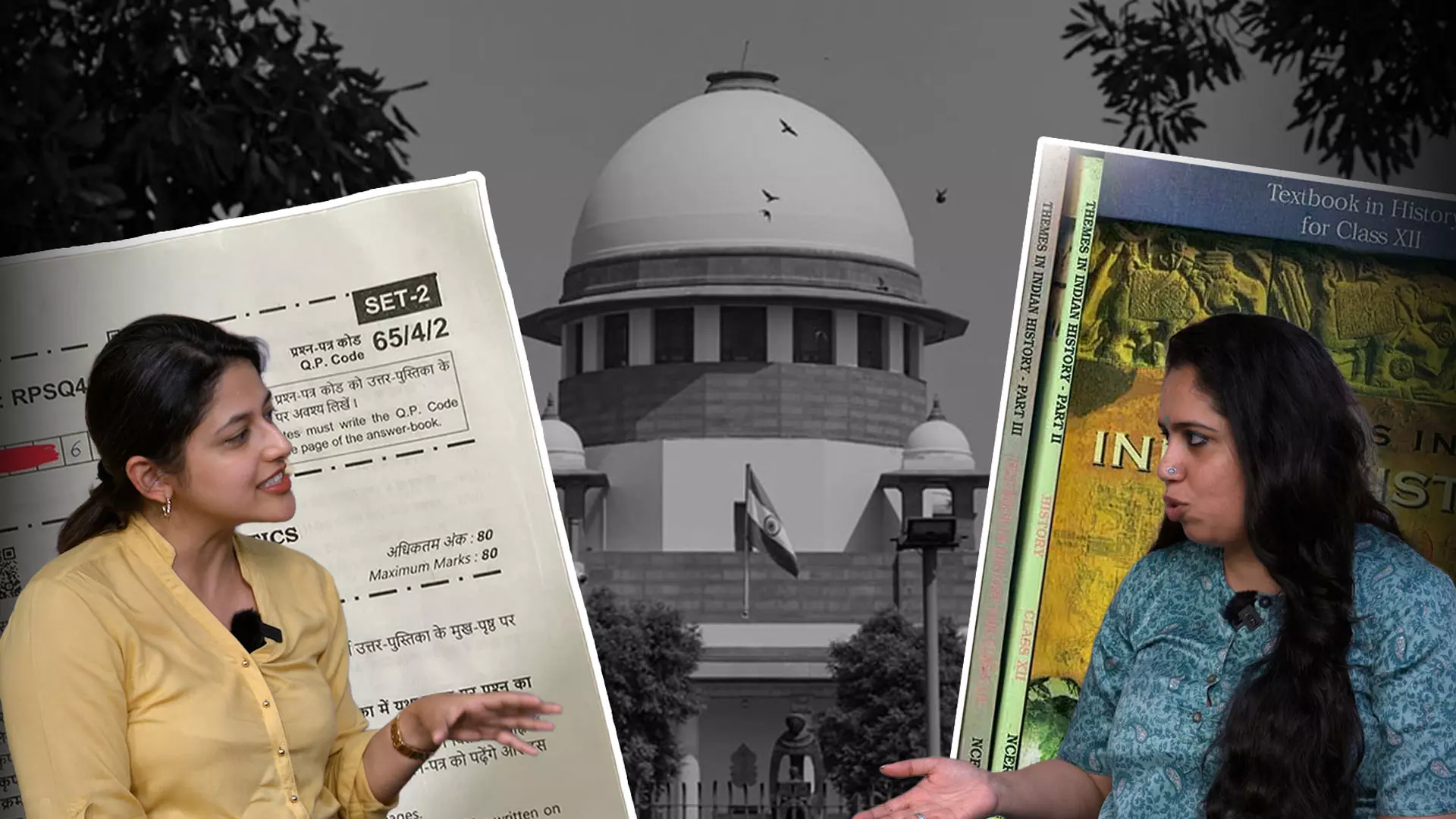
The debate comes alongside another controversy — a QR code printed on a CBSE board exam paper that led to a YouTube video and triggered questions about oversight. Our Special Correspondent Aranya Shankar shared her observations about what these incidents reveal about oversight, curriculum processes, and academic freedom in India’s school education system.
In the span of a few days, we saw a textbook withdrawn after Supreme Court remarks and a controversy over a QR code in a CBSE board exam paper. What do these incidents tell us about the state of oversight in India’s school education system?
I would look at both these incidents slightly differently. The CBSE thing, yes, it is a matter of oversight definitely because this QR code leads to a YouTube video, and it became a major social media spectacle. So there are questions to be raised as to how that YouTube video found its place through the QR code.
Also Read: NCERT issues ‘unconditional apology’ for chapter on judicial corruption
But the NCERT textbook issue involving the judiciary should not be seen as a question of oversight. Instead, it is about what can or cannot be part of the textbook curriculum. I would see it as a question of something that was not checked on time.
Why exactly was there a QR code in the CBSE board exam paper?
Actually, the QR code is not meant for students. It is purely an administrative thing and, ironically, it was introduced after the massive paper leaks in the 2018 board examinations.
So CBSE had introduced this as a system where the QR code is used to check and trace the paper. It helps verify whether the paper is coming from an authentic source and confirms the authenticity of the paper itself.
Also Read: NCERT textbook ban: Judiciary moves fastest when it's the one being judged
It is essentially a way of ensuring that the source of the paper is correct. So it is purely administrative in that sense. It is unfortunate or even funny that this happened, but it does not automatically mean that the paper was compromised.
This was introduced as a means of surveillance and authenticity check.
Should school textbooks be allowed to critically examine institutions like the judiciary?
I would say absolutely yes.
The way the National Education Policy claims to reform education is by moving away from a system of rote learning that has been part of our education system for decades. The policy talks about promoting critical thinking, interdisciplinarity, and deeper engagement with subjects.
Also Read: Who writes NCERT textbooks, and who really controls what goes in them?
But how can you inculcate critical thinking or make children thinking beings if you are not going to include material that is slightly critical of our institutions as well?
As long as what is included is factual and has been checked by multiple sources and multiple bodies, an objective and critical explanation of how the judiciary works is something that should very much be there in textbooks. Why not?
How are NCERT textbooks usually reviewed before publication?
This also brings me back to why I said earlier that I do not see this as a matter of oversight.
It is not as though one or two people sit in a room and decide what will go into a textbook and then it gets published. The process is much more elaborate than that.
First, it is important to understand the relationship between CBSE and NCERT. CBSE mandates which textbooks are used in schools, but the body that actually prepares those textbooks is NCERT.
Within NCERT, there are multiple bodies involved in the process. There is a textbook development committee which includes academic experts and subject experts. For example, if it is a social science book, there will be experts from civics, history, geography, and other relevant disciplines working together on the drafting.
Also Read: NCERT textbook row: Has SC overreacted? | AI With Sanket
There are also internal peer review committees. These include school teachers and other experts who go through the material carefully.
Apart from that, there are external committees that review the content. After the National Education Policy, there is also a National Steering Committee that determines whether the curriculum and textbooks are aligned with the National Curriculum Framework.
So there are multiple levels at which the content of a textbook is checked. In fact, people say that there are also consultants who ensure that everything going into the textbook is ideologically sound.
Because of all these levels of scrutiny, I do not think it is correct to see this as a case where something was simply overlooked.
Could incidents like this make textbook writers and academics more cautious about discussing sensitive topics in classrooms?
The simple answer is yes.
If there is going to be such a reaction to a textbook simply stating that there is a backlog of cases in courts, that case files are piling up, or that there have been instances of corruption — even though the book does not argue that the entire judiciary is corrupt — then it will definitely affect academic freedom.
If there is such backlash that an entire textbook is withdrawn, it will automatically make academics more cautious.
Also Read: Congress backs SC ban on NCERT textbook, alleges RSS-driven revisions
The larger issue then becomes that the responsibility shifts to individual teachers. It will depend on whether a teacher wants to go beyond the textbook and try to inculcate critical thinking in students.
Instead of textbooks encouraging this kind of engagement, it becomes the individual teacher’s prerogative to decide how they want to teach a subject.
(The content above has been transcribed from video using a fine-tuned AI model. To ensure accuracy, quality, and editorial integrity, we employ a Human-In-The-Loop (HITL) process. While AI assists in creating the initial draft, our experienced editorial team carefully reviews, edits, and refines the content before publication. At The Federal, we combine the efficiency of AI with the expertise of human editors to deliver reliable and insightful journalism.)