

Why students and parents bear the brunt of govt schools' consolidation

School mergers are said to address low student enrolment, rationalise teacher deployment and manage infra costs better, but at what cost? Part 1 of a 3-part series

Why students and parents bear the brunt of govt schools consolidation
x
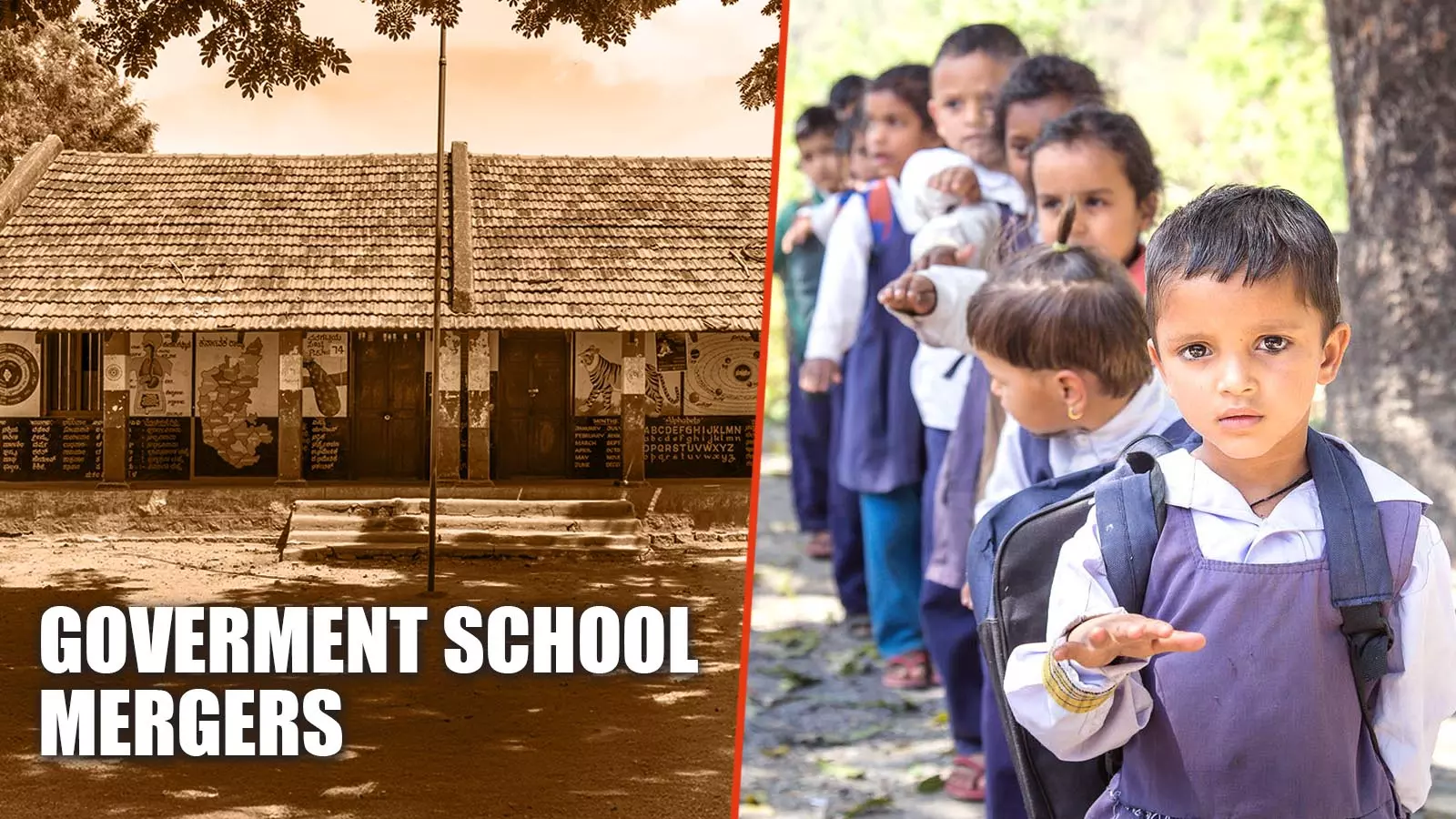
When schools are shut, children are just given a TC and asked to join a nearby school. The parents are not guided on the fresh admission process. Image: iStock
Click the Play button to hear this message in audio format

Karnataka has sparked a high-stakes conversation with its new "KPS Magnet Schools" initiative. By consolidating small, scattered government schools into robust, centralised hubs, the state has reignited a decade-long national debate: Is bigger truly better when it comes to school education?

The Karnataka plan envisions establishing one school in every gram panchayat by merging 8 to 10 nearby schools, within a radius of up to 10 km. It has faced resistance from teachers’ groups, activists and student organisations.

Even as the debate intensifies in Karnataka, the issue reflects a worrying broader national trend: the steady consolidation of government schools in response to falling enrollment and a growing number of under-utilised institutions.

Drop in enrolment

Data from the Unified District Information System for Education (UDISE+) shows that enrolment in government schools has been declining sharply in recent years. Total enrolment has fallen from around 13.62 crore in 2022-23 to about 12.15 crore in 2024-25, a drop of over 10 per cent in three years. This is part of a longer-term shift.
Even as India’s school-age population has not contracted at the same pace, a smaller proportion of children are attending government institutions. At the same time, private schools have expanded steadily, with enrolment rising from 7.92 crore in 2014-15 to 9.58 crore in 2024-25.

The decline in enrolment has not been matched by a proportional reduction in the number of schools. India had about 11.07 lakh functional government schools in 2014-15. Since then, nearly 93,779 schools have been merged or “rationalised”, but a large number of institutions continue to operate with very low student strength.

The number of low-enrollment schools has increased by over 24 per cent in recent years, indicating a widening gap between infrastructure and actual student demand.

In 2024-25, more than 65,000 government schools reported 10 or fewer students, and 5,149 had zero enrolment, despite collectively employing around 1.44 lakh teachers. The number of low-enrollment schools has increased by over 24 per cent in recent years, indicating a widening gap between infrastructure and actual student demand.

Call for consolidation

It is this imbalance that has driven states to reorganise their school systems. But the policy direction has been shaped not just by state-level decisions but by national frameworks.
The beginnings were made in 2017, when the Ministry of Human Resource Development (now renamed Ministry of Education, or MoE) issued the ‘Guidelines for Rationalisation of Small Schools across States for Better Efficiency’.

Unintended consequences and widening gaps

Increased student dropouts after school closures

Longer travel distances for rural children

Disruption to teaching and learning continuity

Greater burden placed on parents for enrolment

Lack of community consultation in school closures

Loss of access to welfare support systems

It called for “a nationwide consolidation of schools” to “improve functioning of schools and better use of the assets”, arguing that “if children and resources spread in two or more small schools are combined together within the habitation, it will not only provide a better teaching learning environment but will also make schools RTE (Right to Education) compliant”.

The guidelines stated, “The need for rationalisation of schools arises due to the fact that schools established more than a decade ago or even before may have undergone a change in terms of demand and supply. It is a process of working with Parents, Teachers, Children and Communities to improve functioning of schools and better use of the assets in the present context. It is a collective effort undertaken to promote access to schools, to expedite the resourcing of schools, to improve the quality of education, and to ensure the retention of children in schools."

Myriad problems

Even earlier, since 2014, states have independently been carrying out school mergers. At least 15 states have undertaken rationalisation exercises, fuelled further by a push by National Education Policy (NEP) 2020. Experts, however, say that contrary to what was mentioned in the guidelines, the implementation of the exercise has brought with it myriad problems.
As per the National Right to Education forum, one lakh schools shut down from 2011-15 across states, and that has brought with it many issues.

“The reasons the government states for merging schools are low enrolment, infrastructure utilisation, better quality of education. However, these are all for narrative building," Asha Mishra from the voluntary organisation Bharatiya Gyan Vigyan Samiti (BGVS) told The Federal. "We know that these claims are not supported by facts. Data from the states tells a different story." The BGVS works at the intersection of science and education.

Rise of dropouts

While the data clearly indicates the problem – declining enrolment and a proliferation of small schools as a result of the Sarva Shiksha Abhiyan– the outcomes of consolidation are less certain.
In a study conducted in five states – Andhra Pradesh, Assam, Haryana, Madhya Pradesh and Odisha – Nikhitha Mary Mathew from the National University of Singapore found that school closures led to dropouts.
“… the closure of a school due the implementation of school consolidation policy results in a decrease in the total school enrolment within the village by about 4.45 per cent. Looking across public and private schools, I find that while public school enrolments fall by about 6.62 per cent, there is no proportionate increase in private school enrolments. These results suggest a potential increase in dropouts as a result of consolidation,” she wrote in her paper titled ‘Closing Schools, Widening Gaps: The Unintended Consequences of School Consolidation Policies in India’ in September 2025.

Disruptions, onus on parents

Other studies point to procedural gaps. A 2017 study of Telangana, Odisha and Rajasthan, by Jawaharlal Nehru University (JNU) professor S Srinavasa Rao and his team, found that “contrary to what was expected", “mergers have only disrupted teaching-learning activities and perhaps further degraded the quality of education”.
“In Telangana as well as Odisha, the team found that once the schools were closed the onus of finding the nearest school and getting enroled was on the child and his/her parents… in all states, schools were closed without any consultation with the community or the parents or statutory bodies like SMCs or even the Panchayat bodies,” the study found.

“There was also no effort on the part of the teacher/s or any other cluster/block/mandal level officials to guide the parents or facilitate the entire process of so-called mergers. In Odisha, parents shared that, when the schools were closed, the children were just given a “transfer certificate” and were expected to go and join a nearby school,” it added.

What needs to be done?

Despite the emphasis on efficiency, there is limited publicly available evidence on the financial savings generated by school mergers. Experts say that while budget allocations for school education have grown modestly, there is little indication of systematic reinvestment into transport, safety, or support systems that become necessary when schools are consolidated.
As Karnataka moves to consolidation plans, there are pertinent questions now waiting to be answered.
When neighbourhood schools are merged into larger institutions, how far are children now travelling to attend classes? Are transport arrangements working as intended, or are families bearing the burden? Are students continuing in school, or are there signs of irregular attendance and dropouts?
In places where government schools become less accessible, are families turning to nearby low-cost private schools instead? If government schools are the main channel for PM POSHAN, free textbooks, uniforms and other support, what happens when children move out of them? Do poorer households risk losing not just free education, but also the support systems that sustain attendance and learning?
These are questions that cannot be answered through national data alone, but only by looking closely at how the policy is playing out on the ground.
(With inputs from Chandrappa M in Bengaluru and Shilpi Sen in Lucknow.)
Coming soon | Part 2: What has been the merger experience across different states?
Next Story