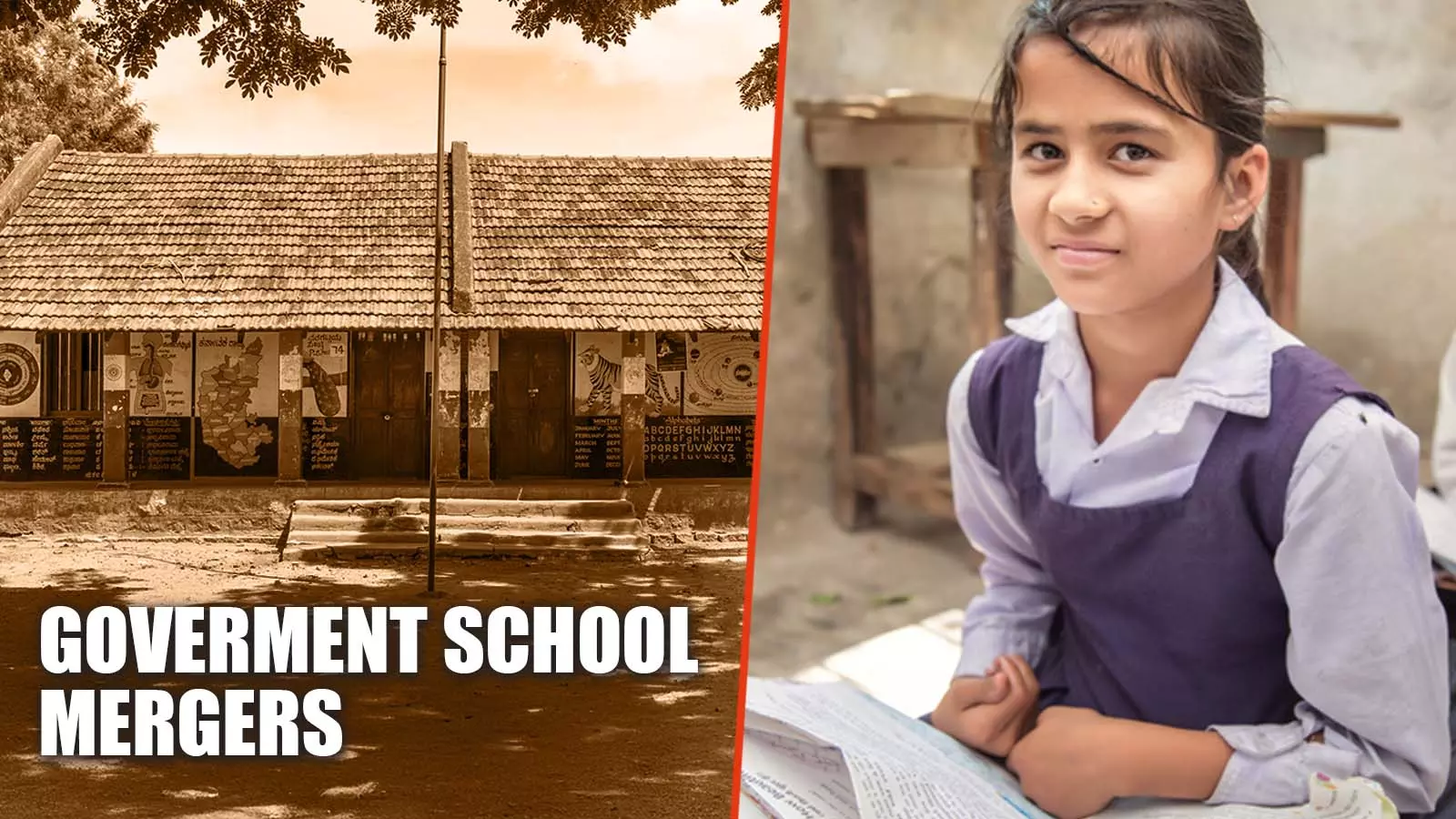
“These consolidation decisions were made based solely on enrolment thresholds, without considering the social composition of affected communities. In India’s context of caste-based residential segregation, this is particularly problematic: sparsely populated habitations are often home to marginalised caste groups,” she noted.
The result is a measurable and uneven decline. Across five states – Andhra Pradesh, Assam, Haryana, Madhya Pradesh and Odisha – public school enrolment fell by 6.62 per cent following closures. But among Scheduled Castes, the decline was sharper at nearly 11.8 per cent. In villages with fewer basic amenities, enrolment dropped by over 10 per cent, while in better-off areas it remained largely unchanged.
Infra, geography widen gaps
Infrastructure and geography further deepen these gaps. In villages without public bus services, enrolment declined by more than 8 per cent, with sharper drops among SC, OBC and ST students. Mathew also found that in areas marked by high caste segregation, there was a “negative” effect on enrolment. For example, the decline in enrolment of SC and OBC students in such areas was as high as 30 per cent.
“Schools with a higher share of marginalised students are more likely to face closures under consolidation policies. That is, even within a village, schools that cater to a higher share of marginalised students are more likely to close, given the current enrolment-based criteria. This result shows that relying solely on a quantitative threshold to determine school closures may result in unintended and disproportionate targeting of marginalised social groups,” Mathew wrote in her paper.
On the ground, these numbers translate into everyday barriers. In tribal and hilly regions, where settlements are scattered and transport is limited, the closure of neighbourhood schools often makes education physically inaccessible. Younger children struggle to travel long distances, while parents, particularly of girls, are reluctant to send them across isolated terrain.
“Areas like Rayagada are among the worst affected, with the highest number of school closures and mergers. Most children here live in hilly, remote regions, making it difficult for them to travel to other schools. In just two blocks, over 500 children have dropped out. Those most affected are from tribal communities,” Blorin Mohanty, Odisha RTE (Right to Education) Forum told The Federal.
Caste factor
In many states, caste plays a defining role since government schools remain the primary site of education for marginalised communities, making them particularly vulnerable to closures.
Schools serving marginalised communities are more likely to be shut, and the consequences of that loss are borne unevenly.
“About 62 per cent of girls in Himachal Pradesh are enrolled in government schools. The dependence is even higher among Scheduled Castes – around 72 per cent of SC students study in government institutions. Any closure of these schools will disproportionately impact the rural poor, especially girls and Dalit students,” pointed out educationist OP Bhuraita.
In Haryana, similar concerns have emerged. “More than 1,400 government schools have already been merged. The impact is being felt most by girls and Dalit children, who form the overwhelming majority of students in these schools,” said Pramod Gouri, Bharatiya Gyan Vigyan Samiti (BGVS).
Girls bear the brunt of it all
Gender and class add further layers to the inequality. A multi-state study in 2017 done by Jawaharlal Nehru University professor S Srinivasa Rao found that “discontinuation of their (girls') education often leads to early marriage”.
“The study found that the girls from Ranginiguda (in Odisha) did not continue after primary education as the high schools are located in Jeypore, 5 km away or in Tankua, at a distance of 1.5 km. Parents also hesitate to send their daughters alone and would allow them to go only in groups,” it noted.
“In Rajasthan, when the only girl schools were callously merged with co-educational schools it led to many drop outs. As such the girl child confronts a very hostile and insensitive patriarchal attitude even when she is at school. She has to face everyday sexism and struggle her way to complete education, besides her everyday struggles to negotiate with the structures of differentiation at home and in the community which continues to see her as a ‘burden’ and a ‘liability’. Investment on a girl child is seen as a waste and this perception has been found to be rampant in the field sites as well,” the study further noted.
Long way to go
In a chapter in ‘Contextualising Educational Studies in India’ (Routledge India, 2021), Aysha Malik of the National Institute of Educational Planning and Administration (NIEPA) noted that girls were among the most affected.
“Female students were most affected under this policy, as they had to travel farther from their respective homes to the newly-created schools. The school environment is an issue for children in these newly-created schools because of cultural differences. Language is another issue faced by students in newly- merged schools. The study found that 15 per cent of the students from closed schools joined low-fee private schools because of the long distance of the newly-created school from their home, which is a burden for poor families. Most of the students who moved to private schools belonged to families whose monthly income was Rs 5,000 to Rs 10,000,” she wrote.
The uneven loss
For some, the outcome is even more severe. In regions where child labour is prevalent, the absence of a nearby school reduces the likelihood of continued education altogether, according to the 2017 study by professor Rao.
“The impact of school closures is high in regions where child labourers are more such as Mahbubnagar in Telangana, Banswara in Rajasthan and Koraput in Odisha…In such regions, where children are engaged as labourers, the presence of a school and keeping them in classrooms becomes all the more necessary. The absence of a neighbourhood school in sight means that parents may not make the extra effort to send a child to a faraway merged school,” it noted.
The risks are even higher for children with disabilities. In one case documented in Odisha, a child with speech impairment dropped out after his neighbourhood school was closed, as travelling to a distant school was not a feasible option for his family.
Clear structural pattern
What ties these experiences together is a clear structural pattern. Schools serving marginalised communities are more likely to be shut, and the consequences of that loss are borne unevenly.
It is this pattern that worries activists in Karnataka, where the proposed rollout of KPS magnet schools has revived concerns around access and exclusion.
“The magnet schools will deprive wage labourers, children of farmers and especially girls from remote areas of their right to education,” said Subhash Bettadakoppa of the All India Democratic Students’ Organisation.
Whether Karnataka becomes the norm or the exception remains to be seen.
(With inputs from Chandrappa M in Bengaluru.)