



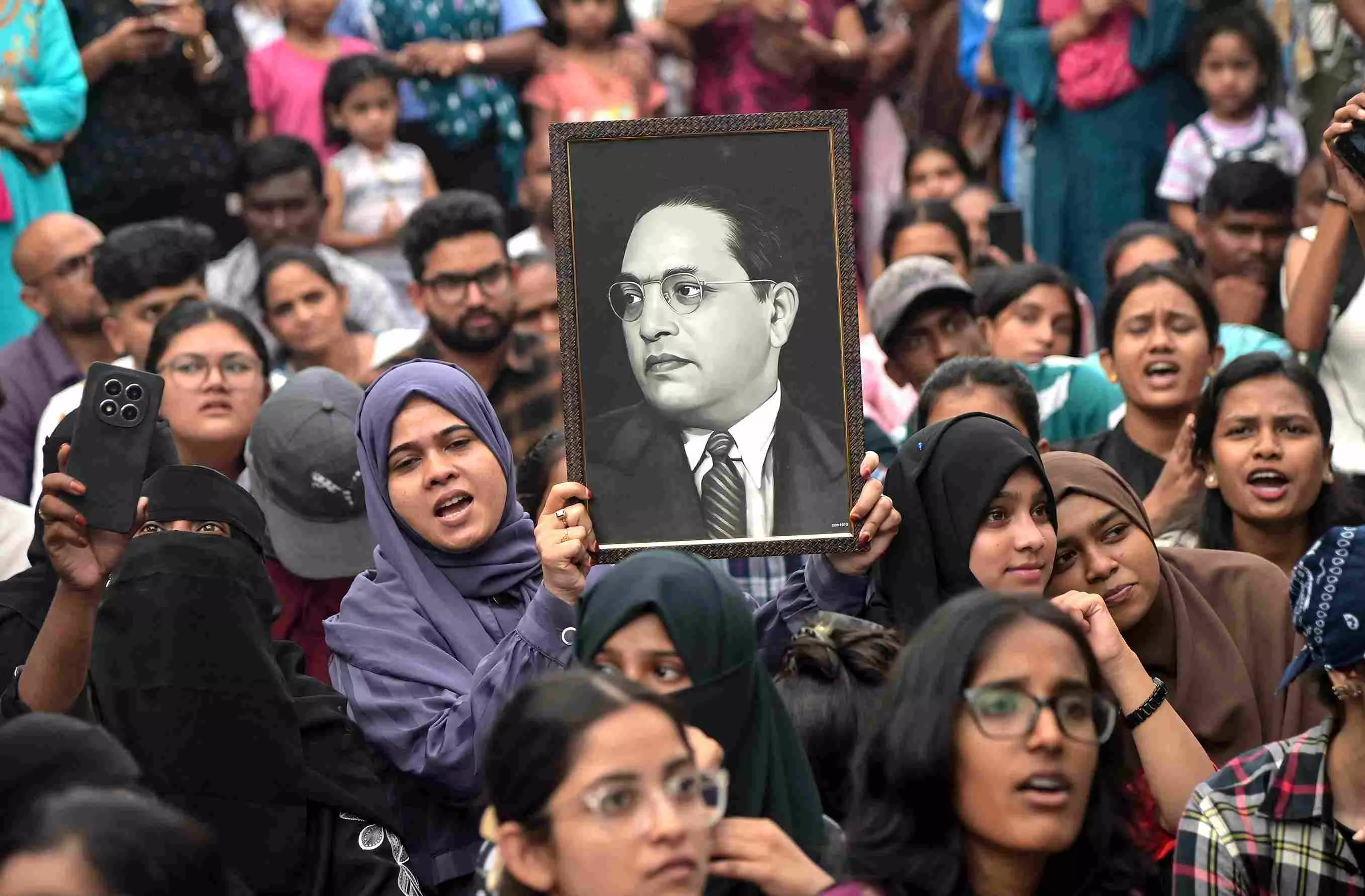
A Cockroach Janata Party (CJP) supporter holds a portrait of Dr. BR Ambedkar during a celebration after the resignation of Union Education Minister Dharmendra Pradhan over the NEET paper leak row, in Nagpur, Maharashtra. PTI file photo
NEET solution: Online, offline, or scrapped? Experts split on exam future
From a money-making coaching industry to a seat crunch and an exam that tests recall, not reasoning, educationists say NEET's problems run deeper than paper leaks

The irregularities in the National Eligibility cum Entrance Test (NEET)-UG, including a paper leak scandal, have seriously eroded the credibility of India's education system, with youth anger spilling onto the streets. For over a week, protests demanding accountability for alleged malpractices rocked the country, leading to the resignation of Union Education Minister Dharmendra Pradhan.
NEET has been dogged by security breaches almost every cycle since it became the sole gateway to medical education years ago. Besides paper leaks, it has spawned a coaching industry that has effectively privatised exam preparation, and a seat crunch that guarantees mass failure by design.
These are some of the systemic flaws the Nandan Nilekani task force, set up by the Centre, will need to address if NEET is to regain public trust.
The Federal talks to educationists and experts to understand how NEET can be made credible, professional, and stress-free for students.
Go online!
One way to make NEET credible is to make it online, affirmed EP Sivakumar, general manager of Brilliant Study Centre, Pala, Kerala. Pala is a quiet town in Kottayam district, which has emerged as an unlikely coaching hub, drawing thousands of NEET aspirants from across the state and beyond each year.
Calling for a more "student-friendly and credible exam", he said that can be achieved if it is “completely conducted online with multiple attempts to reduce stress and ensure fairness for students”.
Credibility in an exam is essential, and NEET has come under serious scrutiny on that front, said experts. Referring to the controversies surrounding the recent NEET examination, Sivakumar said the credibility of NEET as an exam has come under serious scrutiny, with even the Supreme Court raising concerns. "When students and parents spend one or two years preparing for an examination, they must have complete confidence in both the examination and the system," he said.
Also read: Why Karnataka is pushing to replace NEET with its own CET
The Indian government has announced plans to conduct the undergraduate medical entrance exam, NEET-UG, in a fully online, computer-based test format starting in 2027.
Welcoming this proposal, Sivakumar said such a move would significantly reduce students' anxiety if implemented effectively. "We support any reform that genuinely benefits hardworking students," he added.
Not solvable by technology
However, Prof A Narayana, a member of the Karnataka State Policy and Planning Commission, does not believe making NEET online is the answer to the problem.
“The intention to conduct the NEET exam online from 2017 is welcome, but this is not the solution. Because, there is no technology that cannot be misused by humans. Since everything is done by humans, errors can occur at any stage. No one should have the illusion that technology alone can prevent irregularities. Such irregularities cannot be curbed unless those in authority in our society are made morally responsible. Those involved in the examination system should give up greed. Otherwise, no technology will work,” the Professor pointed out.
Prof Narayana blames it on the 'exam culture' currently prevailing in the country. "The irregularities are not taking place because the exam is conducted at the all-India level. This too cannot be said reliably. Earlier, UPSC was conducted very honestly. No one was arguing about its examination method. Now, I do not have the courage to say that the UPSC has maintained the same transparency."
“Examination is a culture. The Kerala Public Service Commission is functioning more transparently in comparison. Lakhs of people are waiting for government posts there. However, there is no such culture in the Public Service Commissions of most states, including Karnataka. It cannot be said that this happened due to the lack of technology.''
Further, he pointed out that in Punjab, the alleged irregularities of the state Public Service Commission created such a stir that in the end, a military general had to be made the chairman of the Punjab Public Service Commission.
In his view, "the country has such a history". And, he appeared to be frankly skeptical about the extent to which irregularities will be contained by using technology.
Also read: NEET re-exam 2026: Leak crisis exposes deeper flaws in India’s exam system
''Exams should be conducted with due moral responsibility and without causing injustice to anyone. Otherwise, it can lead to irregularities at any stage. Self-interest should be put aside. In some cases, if excessive technology is used, the irregularities will not even be detected," Narayana stressed.
Further, he gave the example of how Common Entrance Test (CET) in Karnataka had gained a good name in the early stages since the CET cell appointed efficient and honest officers. "Earlier, officers like Nagalambika Devi, Harish Gowda, Rashmi Mahesh built the institution with credibility and transparency. They were personally and morally strong," pointed out Narayana.
Priji Kurian, professor at Marthoma Institute of Information, Ayur, Kerala, also felt that taking NEET online, with tech-upgraded software, is the best option.
''NEET should be conducted online; that would resolve most of the current problems. We should use credible agencies like Tata Consultancy Service (TCS) to run the exam, since their software is up to date and would make the process far more efficient and foolproof,'' said Priji Kurian, who was earlier in-charge of conducting competitive exams at his college.
Beyond MBBS
Meanwhile, Chennai-based educationist D Nedunchezhiyan addressed one of the major issues facing NEET.
“I believe students are rarely given a clear understanding of the diverse career opportunities within the medical field. Instead, many are pushed into preparing for NEET without a clear sense of purpose or awareness of the other multiple options available to them,” he observed.
"The number of students appearing for NEET compared to the number of medical seats available itself explains the enormous stress surrounding the examination," Nedunchezhiyan added.
"Every year, around 22 to 24 lakh students take NEET, competing for only about 1.3 lakh MBBS seats across the country. One way is that the government must help students understand the diverse disciplines within the medical stream, the courses available, and the career prospects each offers. At present, many students prepare for NEET believing that MBBS is the only goal,” he said.
'Structural changes needed'
Further, he said that the challenge does not end with admission to a medical college.
The educationist felt that even after completing their degrees, many young people face unemployment or underemployment. "These structural issues remain largely unaddressed," he said.
Nedunchezhiyan argued that the public debate on unemployment has gradually faded even though the crisis persists. According to him, the Indian economy has failed to generate sufficient employment because growth has not been broad-based or employment-intensive. He also criticised the government's handling of economic data, arguing that unemployment and inflation cannot be addressed by merely presenting favourable statistics.
"Economic realities cannot be hidden forever. International indicators reveal the true state of the economy. You cannot solve unemployment by changing the numbers. What India needs are policies that generate investment, stimulate demand and create jobs," he told The Federal.
Two attempts
On reforms to the examination pattern, Sivakumar suggested either introducing two attempts every year, similar to the Joint Entrance Examination (JEE), or adopting a two-stagesystem with a preliminary test followed by a final examination for qualified candidates.
Also read: Beyond NEET: Why NEP rollout is creating anxiety in Bengal’s classrooms
He observed that before 2012, medical aspirants had multiple entrance examinations, including the All India Medical Entrance Examination, the Kerala Medical Entrance and AIIMS entrance test, allowing students more than one opportunity to secure admission.
"The problem arose when everything was merged into a single examination," he stated.
Memorising vs reasoning
According to experts, NEET, as it stands, tests speed and recall, the ability to retrieve memorised facts from a fixed syllabus and pick the right option under time pressure. Medicine demands a different set of capacities: reasoning under clinical uncertainty, communicating with distressed patients, ethical judgment in grey areas, empathy that holds up under sustained exposure to suffering, and the humility to admit "I don't know."
None of this is assessed by NEET, or cultivated by the coaching-driven preparation it rewards.
Other countries test for it explicitly. The UK's UCAT includes a situational judgment section that scores how candidates navigate ethically complex clinical scenarios; Australia uses a comparable instrument.
The US MCAT devotes an entire section to the psychological, social, and biological foundations of behaviour, alongside the sciences. These systems reflect a conclusion NEET has yet to absorb: the traits that make someone a fast, accurate memoriser aren't the same ones that make them a good doctor.
Preliminary exam
However, Sivakumar expressed reservations about introducing descriptive questions, saying that manual evaluation could introduce subjectivity and would be difficult to implement for such a large-scale examination.
He instead proposed a two-stage filtering system: with nearly 20 lakh students appearing for NEET annually, a preliminary exam could first shortlist 5-10 lakh candidates. A more refined final round would then let premier institutions like AIIMS and IISc identify the most deserving students, he argued.
A federal issue
Mohan Rao, former professor at Centre of Social Medicine and Community Health, JNU in Delhi, and a medical doctor specialised in public health, argued that NEET should be abolished.
"It is deeply anti-democratic, keeping marginalised populations away from medicine. It also violates the principles of federalism," he said.
Further, he cited the example of the Tamil Nadu government, which never had problems posting doctors in remote areas, now facing massive challenges because affluent urban students are less likely to serve in rural areas. This disrupts the state's prior system, which relied on pre-university marks for admission to medicine, admitted caste-diverse candidates, and produced locally rooted doctors who readily filled primary health centres (PHCs).
"NEET has made it more upper caste. And, TN has shown the gaps they are facing in remote areas with data," asserted Professor Mohan.
Educationists like Narayana too felt that the NEET exam should not be held at the national level.
(Inputs from Rajeev Ramachandran, Chandrappa M and Pramila Krishnan)
While at it, have you read our special stories on NEET and the escalating job situation from across the country?
• Beyond NEET: Why NEP rollout is creating anxiety in Bengal’s classrooms
• Why Andhra’s govt job crisis is escalating despite CM Naidu's push
• Why Karnataka is pushing to replace NEET with its own CET
• NEET dreams break families, while GST revenues shoot up
• Navodaya was never just about language, it's a Constitutional issue, says TN educationist