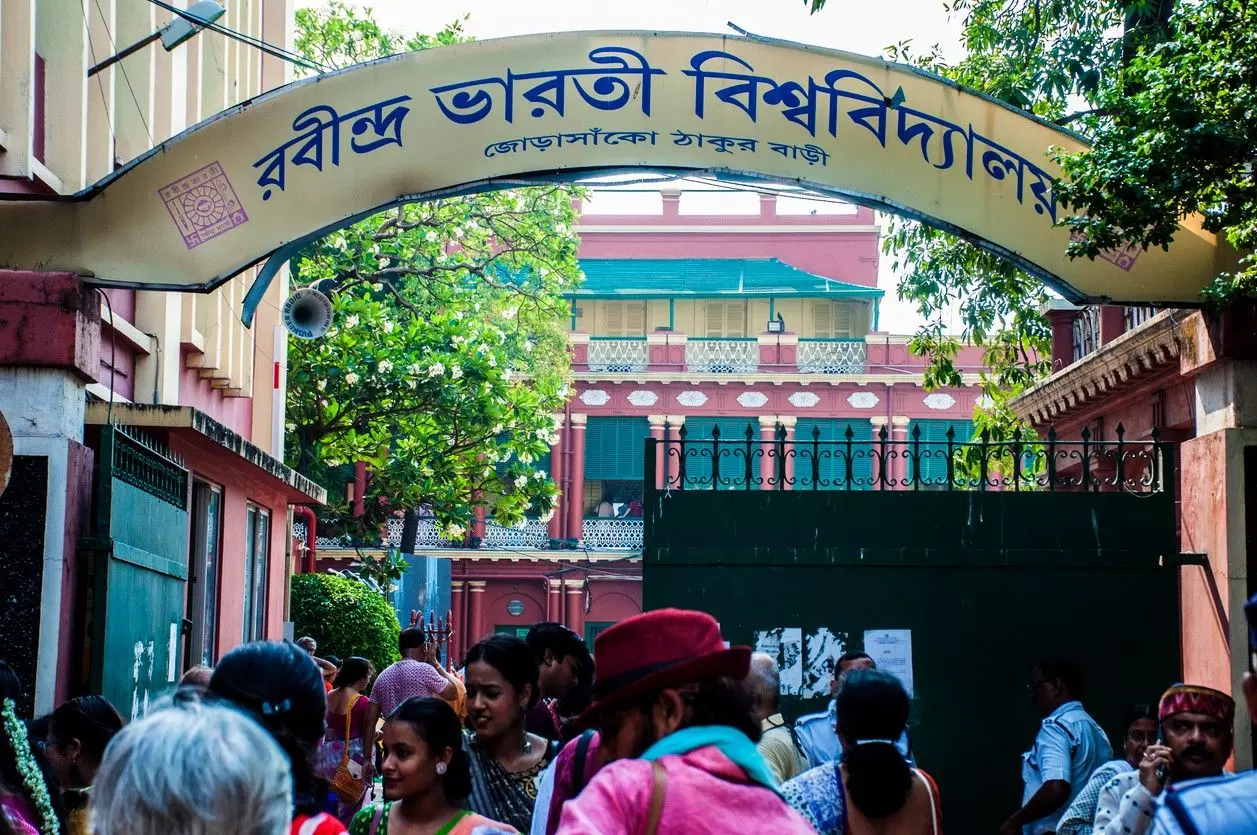
Students at the gate of Rabindra Bharati University, a public university in Kolkata, West Bengal. Photo: iStock
Beyond NEET: Why NEP rollout is creating anxiety in Bengal’s classrooms
Delayed exams, rising fees, and shifting curricula leave Gen-Z students caught between policy transitions, faculty shortages, and political shifts

Just as the NEET paper leak protests forced Dharmendra Pradhan to resign as the Union education minister and thrust India's education system into the national spotlight, a quieter but equally alarming crisis is brewing in West Bengal's classrooms and colleges. Here, the anxiety isn't over an exam scandal, but over the state's uneven, unpredictable rollout of the National Education Policy (NEP) — leaving Generation Z students rattled between shifting deadlines, rising expenses, and a curriculum seeing constant changes.
Also read: Why Andhra’s govt job crisis is escalating despite CM Naidu's push
Take the case of Saurav Ganguly, who enrolled himself in Kolkata's Ashutosh College last year. At that time, he expected his first year would be devoted solely to studying psychology.
But, to his utter dismay, he found himself navigating delayed examinations, additional courses, rising fees and a new four-year undergraduate structure whose implementation, according to him, remains anything but predictable.
Ganguly's experience may soon become increasingly common.
Reforms causing more uncertainty?
As the Bharatiya Janata Party (BJP) government in Bengal reviews school textbooks and moves to align the state's education system with the NEP, students across schools and colleges are once again preparing to adapt to changing curricula and academic rules.
For Gen Z learners, the reforms have become less about what is being taught and more about the uncertainty surrounding how and when the changes will be implemented.
Interviews with students, teachers and education experts suggest that while few dispute the need to modernise India's education system, the staggered rollout of the NEP, faculty shortages, funding constraints and recurring curriculum changes are leaving many students anxious at a time when competition for board examinations, entrance tests and jobs has become more intense.
For Ganguly, the uncertainty is not theoretical but part of everyday college life.
His classes for Psychology Honours began in September 2025. Under the semester system, his first examination should have been held around February this year but eventually started only on May 13. His second semester examination is now scheduled barely three months later.
"The academic cycle has become completely irregular," he said. "Instead of getting enough time to prepare, we are constantly adjusting to revised schedules," he told The Federal.
The four-year undergraduate programme has also increased the financial burden on students, Ganguly said. Besides semester admission fees, students pay examination fees for every semester.
Also read: Why NEP’s three-language formula has sparked a Centre-TN clash
"A four-year course means one additional year of expenses. For many families, that is not a small amount."
He also believes the semester system has reduced classroom teaching.
"Teachers are almost always busy conducting examinations for one semester or another. That inevitably affects classes for students in other semesters," he said.
'NEET only one expression of students' anger'
Student activist Anik Dey of the All India Democratic Students' Organisation said Ganguly's experience reflects a broader frustration among young people.
"The NEET paper leak was only one expression of students' anger," he said. "The frustration has been building because there is uncertainty everywhere. There is no continuity even in what we study. Every government that comes to power wants to reshape education according to its own priorities."
His comments point to a larger challenge confronting the country’s education system.
Although the previous Trinamool Congress government refused to formally adopt the NEP 2020, its own state education policy, introduced in 2023, incorporated several of the Centre's key features, including the four-year undergraduate programme, multidisciplinary learning and the multiple entry and exit framework.
The BJP government is now seeking to formally align the state's education system with the NEP through curriculum revisions and other structural changes.
While the NEP promises greater flexibility through multidisciplinary learning, the four-year undergraduate programme (FYUP), the academic bank of credits and the multiple entry and exit system, the implementation has remained uneven across the country.
The first official assessment of NEP implementation, carried out through the education ministry's All India Survey on Higher Education (AISHE) 2023-24 and released earlier this month, found that only 56 per cent of universities had introduced the four-year undergraduate programme, while 49 per cent offered the multiple entry and exit option.
Many institutions are yet to fully integrate the academic bank of credits, leaving students uncertain about credit transfers, postgraduate admissions and mobility between universities.
'NEP says what's to be done but now how'
"The NEP has become a major source of uncertainty because it specifies what has to be done but provides little clarity on how it should be done," said educationist Om Prakash Mishra.
"Even states willing to implement the reforms have struggled because adequate institutional and financial support has not followed."
According to Mishra, one reason is that the institutional framework envisaged under the policy remains incomplete.
The proposed Viksit Bharat Shiksha Adhisthan (VBSA) Bill, 2025, which seeks to replace the UGC (University Grants Commission), AICTE (All India Council for Technical Education) and NCTE (National Council for Teacher Education) with a single higher education regulator, is yet to be enacted.
As a result, many NEP reforms continue to be introduced through regulations while universities still function under the older regulatory structure.
"The transition has affected the functioning of public universities," Mishra said. "Research and institutional development have suffered, weakening students' confidence in public institutions and pushing many towards expensive private universities. That inevitably widens inequality."
Funding remains another major concern.
Tarun Naskar, general secretary of the All India Save Education Committee (AISEC), argued that governments have announced ambitious reforms without making matching investments.
"The NEP promised public expenditure on education of six per cent of GDP, but that commitment has not been fulfilled," he said, adding that education's share in both the Union Budget and Bengal's expenditure has declined in recent years.
Also read: How Modi regime used central institutes to enforce NEP on state varsities
He pointed to the policy's emphasis on early childhood education as an example of the implementation gap.
The NEP integrates pre-primary education into the formal school structure from age three. Yet in much of the country, including Bengal, pre-primary education continues to rely primarily on Anganwadi and ICDS (Integrated Child Development Services) centres rather than dedicated government schools.
"The government had promised to train Anganwadi workers to implement the new curriculum. Years later, that process remains incomplete," the AISEC general secretary said.
He also highlighted what he described as a severe shortage of teachers in Bengal's government-aided colleges.
According to Naskar, the state's nearly 450 colleges currently have only around 5,500 teachers against an estimated sanctioned strength of about 15,000, forcing many institutions to depend on contractual state-aided college teachers paid substantially lower salaries.
The shortage, he said, limits colleges' ability to offer the multidisciplinary electives, vocational courses and research opportunities promised under the NEP.
Several implementation studies have similarly identified inadequate faculty, infrastructure deficits and limited institutional preparedness as major barriers to the policy's rollout.
Naskar also criticised recent curriculum revisions, alleging that they increasingly blur the distinction between scientific education and civilisational narratives.
'Mythology entering curriculum'
"In the name of the Indian knowledge system, mythology is entering the curriculum," he said, expressing concern over recent NCERT textbook revisions.
Citing the new NCERT Class VIII mathematics textbook, Naskar claimed it places greater emphasis on interactive stories and historical anecdotes than on mathematics, and criticised the introduction of Vedic Mathematics, which he described as "neither Vedic nor mathematics."
Supporters of the reforms, however, argue that introducing India's knowledge traditions complements rather than replaces modern scientific education.
Also read: Bengal heist: How BJP captured the state by hollowing out democracy
Critics, however, point to curriculum revisions such as the removal of Charles Darwin's theory of biological evolution from parts of the NCERT Class X science syllabus as another instance of what they describe as a deliberate weakening of scientific temper and the privileging of ideological narratives over established scientific concepts.
Beyond the ideological debate, educationists say the biggest challenge for students is the absence of uniform implementation.
Universities are adopting the NEP at different speeds, meaning students from different institutions, and sometimes even different batches within the same institution, are studying under different academic regulations.
Questions over degree duration, credit transfers, postgraduate eligibility and recognition of qualifications often receive different answers depending on where a student studies.
For students planning higher education or preparing for competitive examinations, that uncertainty can become an additional source of stress, pointed out Dey.
The BJP government has indicated that school textbooks prepared under the previous Trinamool Congress administration will be reviewed as part of a broader effort to align West Bengal's education system with the NEP and national academic standards.
The move has revived a familiar political debate over curriculum and textbook content, with rival parties accusing each other of attempting to shape education through ideology.
For students like Ganguly, however, the concern is more immediate.
Whether it is delayed examinations, changing syllabi, rising costs or uncertainty over academic rules, many say they are being asked to adapt repeatedly while simultaneously competing in one of the country's most demanding educational environments.
Campus politicisation
Ganguly also believes the changing academic environment is being accompanied by the growing politicisation of campuses.
Since the BJP came to power in the state, he said, colleges have increasingly made participation in seminars, blood donation camps, essay competitions and similar programmes compulsory, adding that these events are designed to familiarise students with the ruling party's ideology and leaders such as Syama Prasad Mookerjee and V D Savarkar.
Have you read our special stories on NEET, escalating unemployment situation and educational crisis from across the country?
• Why Andhra’s govt job crisis is escalating despite CM Naidu's push
• NEET dreams break families, while GST revenues shoot up
• Navodaya was never just about language, it's a Constitutional issue, says TN educationist