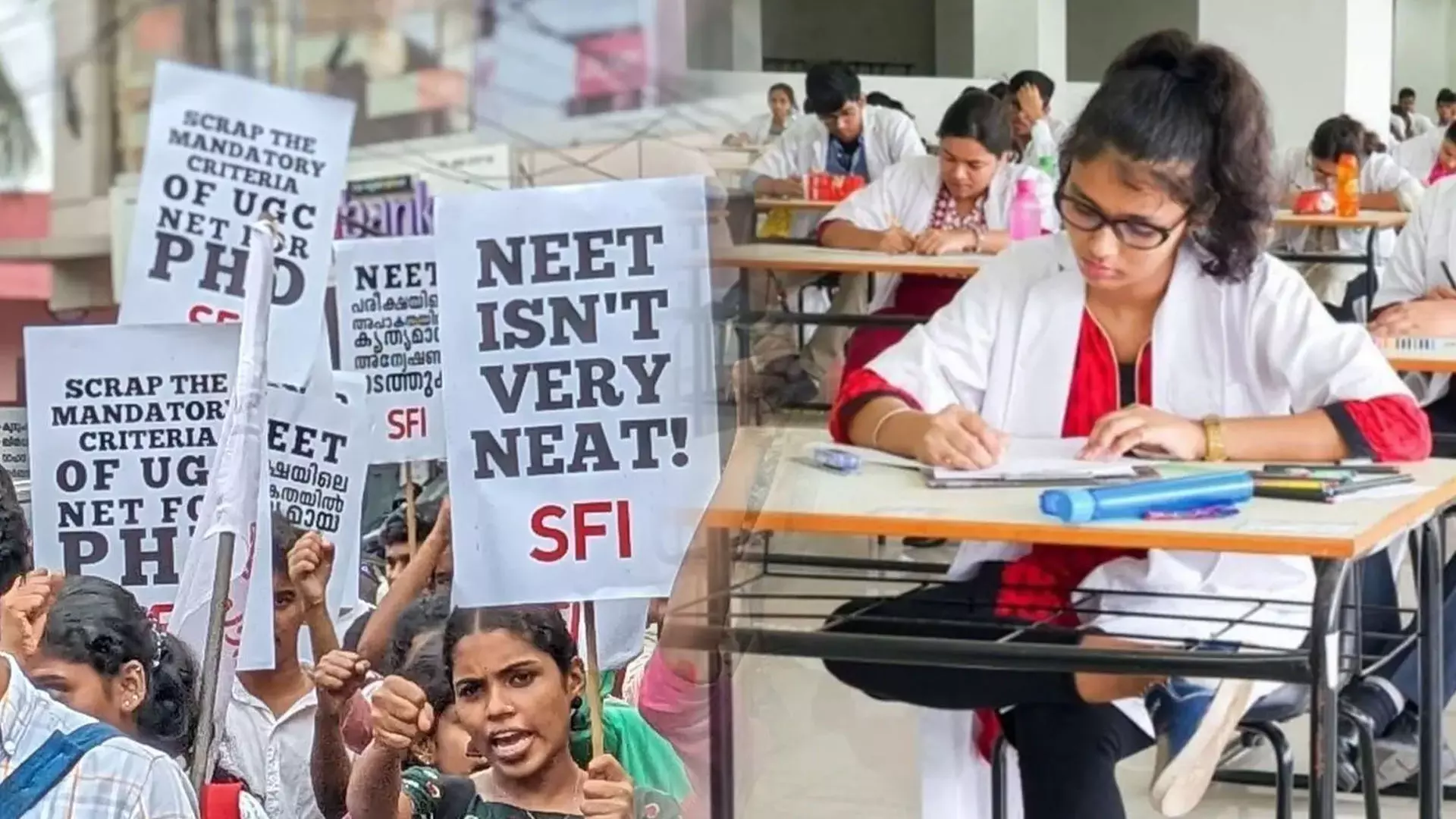
NEET re-exam 2026: Leak crisis exposes deeper flaws in India’s exam system
The NEET re-exam after the paper leak has renewed pressure on students, raising questions over whether India’s high-stakes admission system needs a rethink

More than 2 million students are set to appear for the NEET re-exam on Sunday (June 21) after the exam was cancelled following a question paper leak controversy. But even before the retest began, fake leak claims on social media prompted the government to temporarily block messaging app Telegram across India to prevent misinformation from spreading.
The National Testing Agency (NTA) had denied the leak claims and called them misinformation. However, the government took the additional step of restricting Telegram access until June 22, highlighting the growing anxiety around question paper security.
The move raised a larger question — has the fear of a leak itself become almost as disruptive as an actual breach?
Trust crisis
For students and parents, the issue is no longer limited to exam logistics. Questions around question paper printing, access control and secrecy have entered everyday conversations in homes across the country.
Also read | IAF to airlift NEET re-exam papers: 'India copying wrong things from China'
Many NEET aspirants have spent years preparing for the medical entrance exam. The cancellation of the earlier exam left several students struggling with uncertainty, anxiety and exhaustion.
One aspirant said it took her two years to complete the syllabus, only to see the exam cancelled overnight. A parent also highlighted that the pressure of NEET affects families as much as students.
The crisis has also renewed concerns over student mental health, with several reports of NEET aspirants dying by suicide in separate incidents across the country amid academic pressure and fear of failure.
The leak controversy
On May 3, over 2.27 million students appeared for NEET 2026. Nine days later, the examination was cancelled after investigators found similarities between a leaked question paper and the actual exam.
The matter led to investigations by agencies including the CBI and Rajasthan Police, resulting in arrests and a nationwide re-examination.
This time, the alleged breach was traced to the question bank level, affecting translation and printing processes. It was not seen as an isolated local incident but as a failure at the source of the examination system.
With concerns that undeserving candidates could gain medical seats, authorities decided to conduct a fresh exam for all candidates.
Student burden
An expert warned that repeated examinations can unsettle students at a crucial stage of their academic journey. "Repeated examinations create uncertainty at a stage when students need stability. It disrupts years of academic and psychological preparation," the expert said.
According to the expert, students often reach their peak mental preparation around the scheduled examination date. "Cancelling it forces them to sustain that peak for weeks longer under intense uncertainty, leading to anxiety, exhaustion, and loss of motivation," the expert added.
While a re-examination may be necessary to protect fairness, the burden falls most heavily on genuine candidates, especially those from rural and economically weaker backgrounds who may struggle with additional costs and disruptions.
Telegram debate
The government’s decision to temporarily block Telegram also became a point of debate.
The expert criticised such measures as reactive steps rather than solutions addressing the root cause. "These kind of actions are just knee jerk reactions. If that's the case, the entire internet will have to be shut down," the expert said.
According to him, blocking the transmission of leaked papers does not solve the original problem of how leaks happen.
"We are just solving the process of stopping the transmission of a leaked paper from one place to the other. But what is Telegram ban doing? It is not stopping the problem of paper leakage," he said.
The expert argued that stronger systems are needed to secure every stage of question paper creation, printing and distribution.
Bigger problem
The NEET controversy has also raised questions about India's wider entrance examination ecosystem.
The expert pointed out that similar vulnerabilities could exist in other competitive exams as well.
"We have a lot of evidence to say that this is happening in other examinations. NEET keeps coming in the news probably because of the prestige associated with becoming a doctor," he said.
According to him, as competition increases, the possibility of security breaches also grows. The deeper issue, he argued, is not only about preventing leaks but also about why millions of students are competing for a limited number of seats.
Beyond NEET
For many Indian families, career choices continue to revolve around a few traditional professions — medicine, engineering, law, civil services and chartered accountancy.
The expert said India needs to encourage students to explore wider career options. "We have to really, at a very core level, tell students that it's time to think beyond wanting to become a doctor. There are other professions available, even within health sciences and technological or information sciences," he said.
Also read | NTA defends Telegram curbs ahead of NEET UG 2026 re-exam, says 'move to stop fraud'
He also pointed out that countries with high-stakes entrance examinations cannot provide a simple model that India can copy. "There is no plug-and-play solution that India can really adopt from other countries," he said.
Instead, India needs to design an admission system that fits its own realities, including the growing number of first-generation learners entering higher education.
Need for reform
A secure admission system, according to experts, needs a combination of technology, transparency and accountability.
Every stage of question paper creation, transmission and printing must be traceable. Security cannot depend on a single safeguard but requires multiple layers, including biometric verification, secure digital channels, monitoring systems and independent oversight.
The ultimate goal, experts say, should not only be preventing leaks but rebuilding trust among students, parents and institutions.
Out of the 2.27 million students who appeared for NEET last month, only a fraction were directly linked to the alleged breach. Yet every candidate had to face the consequences through a nationwide re-examination.
Leaks can be investigated and rumours can be controlled, but the larger debate remains — should India rethink how it defines eligibility, allocates medical seats and conducts high-stakes entrance examinations?
The content above has been transcribed from video using a fine-tuned AI model. To ensure accuracy, quality, and editorial integrity, we employ a Human-In-The-Loop (HITL) process. While AI assists in creating the initial draft, our experienced editorial team carefully reviews, edits, and refines the content before publication. At The Federal, we combine the efficiency of AI with the expertise of human editors to deliver reliable and insightful journalism.