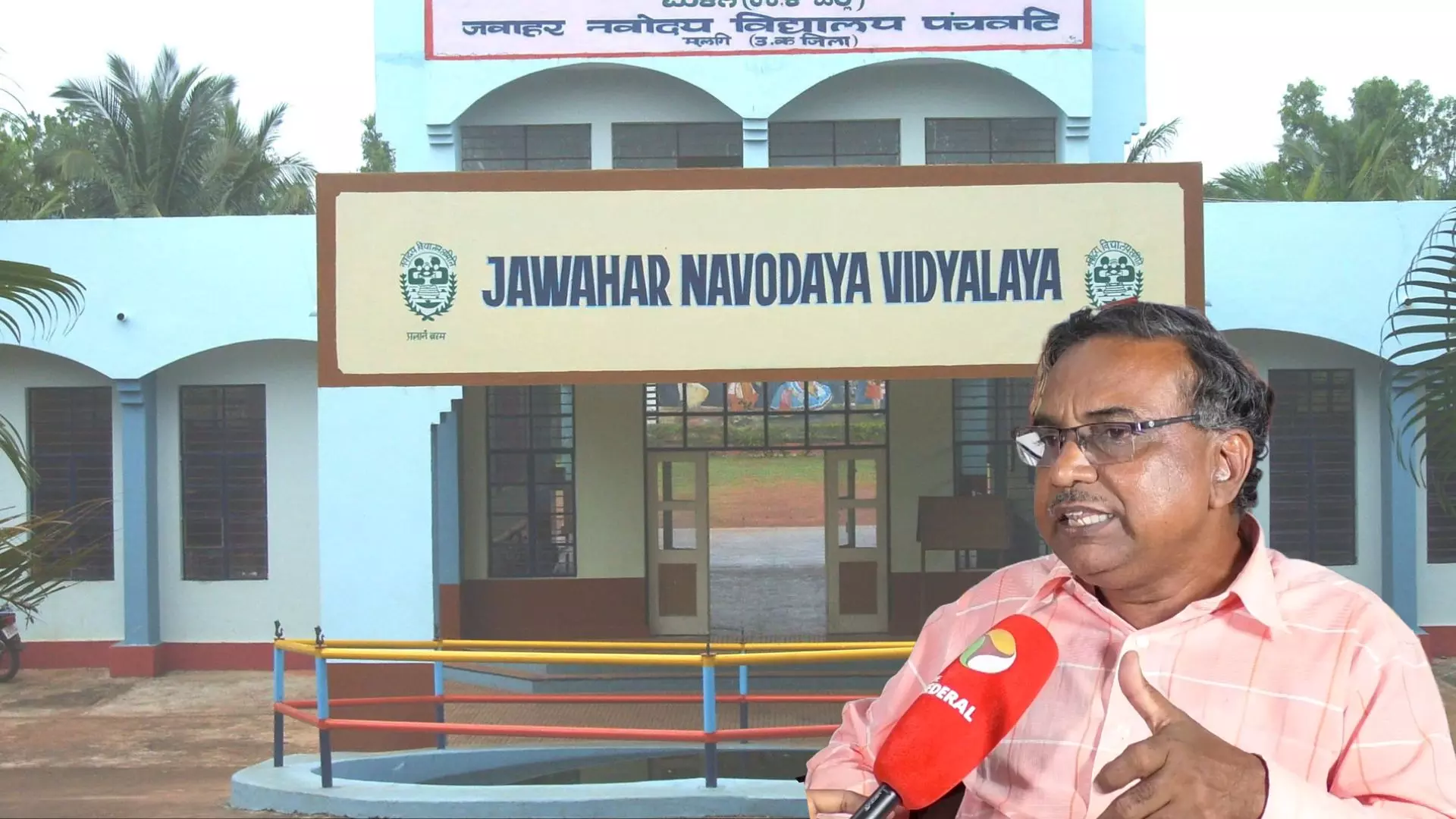
Educationist Prince Gajendra Babu argues that the Navodaya schools debate goes beyond language and should instead be viewed as a constitutional issue.
Navodaya was never just about language, it's a Constitutional issue, says TN educationist
As the Supreme Court asks Tamil Nadu to clarify its stand on Navodaya Vidyalayas, Prince Gajendra Babu argues the real objection lies in Articles 14 and 21

The Supreme Court has sought the Tamil Nadu government's stand on establishing Jawahar Navodaya Vidyalayas (JNVs) in the state, reviving the decades-old debate over the Centre's flagship residential school scheme.
The apex court's direction comes months after the TVK-led government assumed office, requiring it to clarify its position on setting up Navodaya schools in Tamil Nadu.
For over five decades, successive DMK and AIADMK governments have opposed the introduction of Jawahar Navodaya Vidyalayas, making Tamil Nadu the only state without a single JNV. The opposition has consistently argued that the scheme is incompatible with the state's long-standing two-language policy.
Also read: How government school mergers have triggered varied fallout across states
The Federal spoke to educationist Prince Gajendra Babu, who argues that the debate goes beyond language and should instead be viewed as a constitutional issue involving education policy, federalism and the rights of states.
Tamil Nadu has a new government, and the Supreme Court has asked it to clarify its stand on establishing Jawahar Navodaya Vidyalayas in the state. As an educationist, how do you view the issue at this juncture?
About Navodaya schools, for the past several decades, the Tamil Nadu government has upheld the Constitution of India. The challenge now is whether the present political leadership heading the government will continue to uphold the Constitution, or act against it — because Navodaya Vidyalaya, in my view, is against the spirit of the Constitution of India. This isn't really about the language policy anymore.
When Navodaya was introduced as part of the revised National Education Policy during Rajiv Gandhi's period, N.D. Sundaravadivelu, an eminent educationist, chaired a conference at Periyar Thidal, and his presidential address was later published as a small book. He pointed out that there are several thousand schools run by state governments.
Universalising education is the responsibility of state governments, which have established their own schools and colleges. The Union government has traditionally run specialised institutions such as Kendriya Vidyalayas, Sainik Schools and Jawahar Navodaya Vidyalayas.
When Navodaya was introduced, Article 45 was in force, which wanted the government to ensure free and compulsory education for all children under 14 — and that effort was taken only by state governments. Even today, Article 41 says that when the economic capacity of the state develops, the state has to provide education as a fundamental right — from primary school up to university.
Also read: Introduce third language in Class 5 or 6, not 9: SC on CBSE curriculum
Now you call Navodaya a model school for underprivileged children, fully funded by the Union government. You say you will establish one school per district with all facilities a school should have. Do you mean to say such facilities will not be available in other schools? Are you not bothered that other underprivileged children will develop an inferiority complex?
Navodaya and state schools are both taxpayer-funded, so why should one have better facilities than the other. So yes, Navodaya schools sustain inequality. They reflect a discriminatory social practice — the caste and class hierarchy being reflected in the classroom.
You've said CBSE schools have a higher pass percentage, an argument placed before the Supreme Court by some organisations. If that's true, CBSE schools would be considered homogeneous, while state-run schools in Tamil Nadu, Gujarat, Maharashtra are heterogeneous in character. How do you frame that distinction?
I already told you — except for Kendriya Vidyalaya, which is a special school, Sainik School, and Navodaya, which is again a special school for a special purpose.
Actually, Navodaya was meant for tribal people. It was not just for underprivileged children. Its primary aim was to address tribal needs, though it later accepted a certain percentage of Scheduled Caste and OBC students. You are deviating from the main purpose for which Navodaya was introduced and are trying to make it a political issue.
If Vikas means developed, and if Modi is speaking the truth about a developed India by 2047, then Article 45 should come into reality. You should provide the right to education, the right to work. In the National Education Policy 2020, you say the government will not fully spend on education. Without full spending on education, the Viksit Bharat Shiksha Adhishthan Bill, currently under consideration by a Joint Parliamentary Committee, doesn't talk about financial commitment at all. So without a financial commitment, without saying the government will fully fund it, how will you achieve equitable access? How will you fulfil Article 41 of the Constitution?
Also read: Zoho founder Sridhar Vembu responds to DMK with school corruption claims
So you are talking about Navodaya today, which is the brainchild of Rajiv Gandhi — not because you want to celebrate the former Prime Minister, but because you want to sustain inequality. The Tamil Nadu government must present before the Supreme Court that it has taken a policy decision that there will be equitable access to quality education for all — that is our Samacheer Kalvi policy. Whatever quality you talk about in Navodaya should be provided to every child. That is the mandate of the Constitution. That is what Article 14 says.
So you're saying the new Tamil Nadu government needs to reframe the argument against Navodaya schools altogether?
Political leaders framed the issue around the two-language policy because it was easier to communicate. But opposition to Navodaya has existed from the outset, particularly from Left parties such as the CPI and CPM.
I told you about N.D. Sundaravadivelu — he is a Dravidian educationist, and the Dravidian parties opposed it too. The basic opposition is that Navodaya sustains inequality. Even in language status, it doesn't give equitable opportunity. So the argument should be that Navodaya is against Article 14, Navodaya is against Article 21.
Even after 75 years of Independence, why have model schools not been developed for all? Public education should ensure equal opportunities, not limit quality facilities to one school per district.
The government can provide facilities in only one school over there — it cannot make all schools like that. So we are asking: give the same money to all schools. Why spend so much on one school and deny that fund allocation to others? This is injustice, and the Supreme Court of India should be told so.
We share the court's concern over forcing students to learn a third language. Children should be free to learn any language, but compulsion becomes cultural imposition—especially when limited language options effectively push them towards Hindi or Sanskrit.
The National Education Policy is less about language and more about promoting a particular cultural vision. He claimed it gives Sanskrit a privileged position by describing it as foundational to Indian culture and languages, saying this reflects an attempt to promote a single cultural identity despite India's linguistic diversity.
Also read: Karnataka govt school Hindi teachers fret as language gets 'graded down'
They want to dismantle the multicultural India that celebrates diversity. Hindi is the midway point toward that goal; Sanskrit is the ultimate goal. So it is not merely an additional language — it is cultural imposition, the imposition of Sanskrit culture on all the people living in India.
As an educationist, do you think Navodaya's very existence would breed discrimination in society — since a child who does well could still opt to move to such a school? Wouldn't that opportunity otherwise be denied to a child who studies well?
Navodaya, or the state's own model schools, are all forerunners to PM SHRI — the Prime Minister's Schools for Rising India. The harm in PM SHRI is not understood by many people, so they want to justify it by establishing Navodaya here too. Under the National Education Policy, certain Kendriya Vidyalayas will be designated PM SHRI schools; others will not be. Go to the PM SHRI website — it says children studying in these schools will be able to compete in any exam for higher education. What does that mean? That children in other Kendriya Vidyalayas — also Union government schools — will not be able to compete? So when a state gets a PM SHRI school, the Union government effectively takes control of that state school, while the rest of the schools remain outside that umbrella, without those advantages. Is that not inequality? Even in "Viksit Bharat," you are only sustaining inequality.
The Tamil Nadu government says it doesn't accept PM SHRI, but it has its own "Vetri" schools, its own schools of excellence — and that too is discriminatory, against its own Samacheer policy. Tamil Nadu should correct itself. Model schools are not the answer after 75 years of independence. As we approach the centenary of freedom, if we can't provide free education, we must at least provide equitable access — otherwise, won't the world laugh at us for not achieving even that after 100 years?
Tamil Nadu has a greater responsibility because it is Periyar's land. Babasaheb Ambedkar struggled a great deal for this cause. In Kerala, Left parties made every effort, even at cost to the government, to establish free education — government-run or government-aided — and that movement helped Tamil Nadu progress too. PM SHRI, like Navodaya, will only set the state back.
Also read: How government school mergers hit Dalit, Adivasi, girl students hardest
Tamil Nadu should be clear: we have several thousand schools, and we will provide equitable quality education for all children — we will not brand any particular school as a "model" school, whether that's a state model, PM SHRI, or Navodaya. This submission before the Supreme Court should be based purely on the Constitution of India, not on party lines, because the Constitution envisions a society of equals.