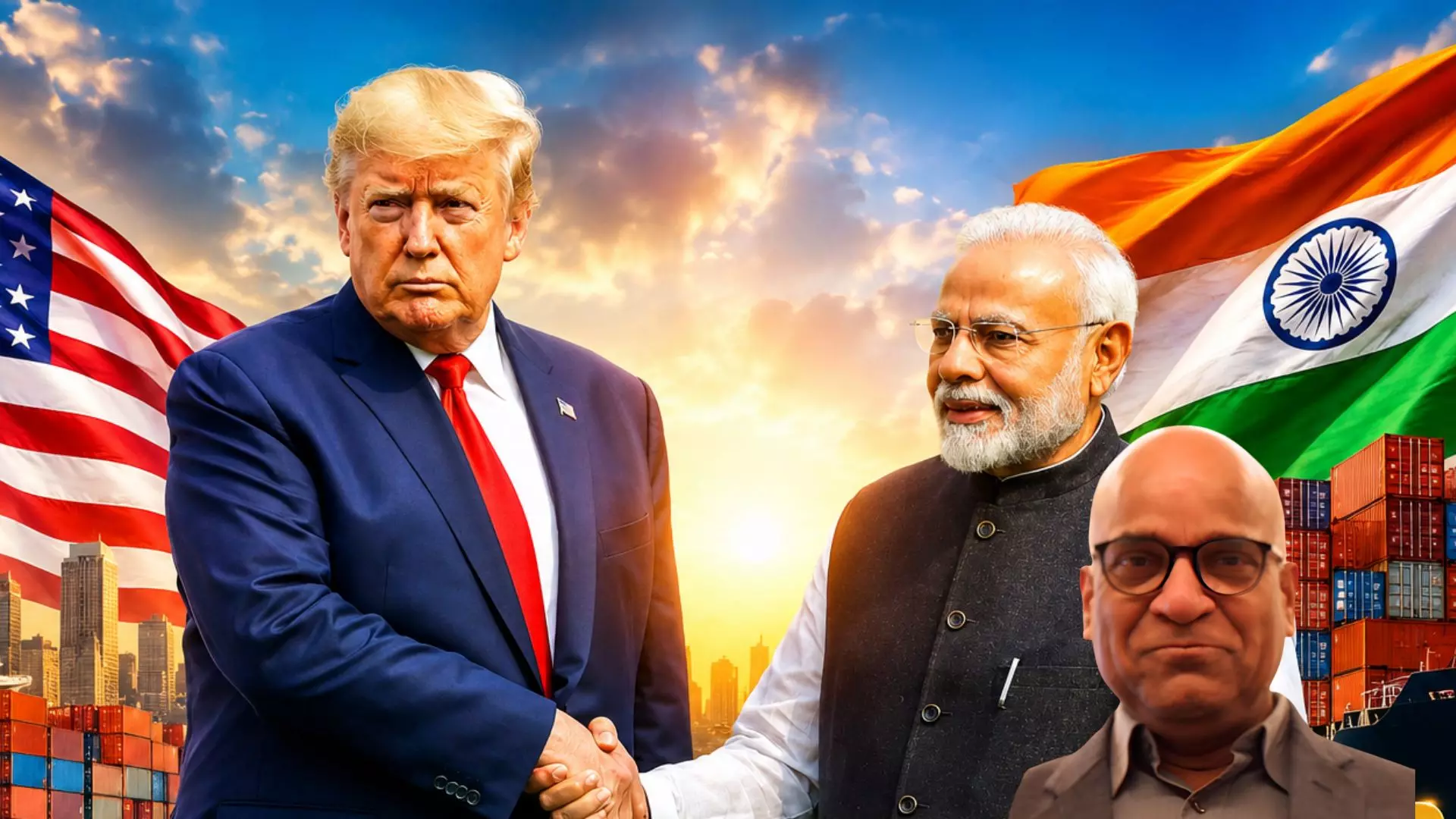
Trump doing whatever he pleases: Trade expert slams fresh tariffs on Indian imports | Interview
With the US imposing a 12.5 pc duty over alleged human rights violations, Ravi Kanth warns of severe impacts on labour-intensive sectors and questions India's bargaining power

As India and the US appear to be nearing a bilateral trade agreement, the latest move by the US Trade Representative to impose an additional 12.5 per cent duty over alleged forced labour violations has raised fresh concerns about exports, trade negotiations and the future of global trade rules.
Also read: India-US trade deal: Have farmers’ interests been traded away?
The Federal spoke with senior business journalist D Ravi Kanth about the move's economic implications for India, the impact on the trade deal, and the broader consequences for the global economy. Sharply criticising the US's proposed new tariffs, he said India is living in an "illegal world" where the US is doing whatever it pleases, irrespective of international norms.
Here are some excerpts from the interview:
What are the economic implications for India of these additional US tariffs?
There will certainly be significant economic implications. To begin with, India has already been hammered by US tariffs over the last year. First, tariffs were raised to 25 per cent, and then another 25 per cent was added, taking them to 50 per cent.
That completely affected India's exports across a range of labour-intensive products such as textiles, clothing and even marine products.
Given the current strategic dependence India has created for itself with the US, it remains to be seen how much protection India will offer to its own interests.
After that, the US Supreme Court ruled against those tariffs. They were imposed under the International Emergency Economic Powers Act (IEEPA), which the court said was illegal because such tariff impositions required congressional approval.
After losing that dispute, the US imposed what are known as Section 122 tariffs on February 26 this year. These tariffs are generally meant for balance-of-payments problems, but the US does not have such problems. Those Section 122 tariffs are due to end around July 22.
Also read: Explainer: India-US tariffs after Supreme Court verdict
Now, this latest tariff, imposed using forced labour conventions as justification, is completely illegal and will definitely affect India’s exports. According to a gazette notification, India falls under the 12.5 per cent category.
There are six to eight countries facing only a 10 per cent tariff, including Pakistan and Bangladesh, which are major competitors to India. Any tariff differential between what they face and what India faces will impact our exports.
Moreover, these tariffs are completely illegal. Section 301 tariffs have already been ruled against by a World Trade Organisation (WTO) panel. In fact, in 1999, the then Atal Bihari Vajpayee government strongly condemned these tariffs. India participated as a third party in that dispute and submitted a detailed statement accusing the US of reneging on its WTO commitments.
Today, however, we are living in a completely illegal world, particularly one in which the US does whatever it likes, regardless of established rules. It has almost destroyed international rule-of-law institutions.
The same thing is happening domestically in the US, where rules are being set aside, and arbitrary actions are being taken against those who question the Trump administration’s motives.
We are living in a very dangerous world. I would describe this tariff move as “extort baby extort”. Trump is known for saying “drill baby drill”. What we are witnessing instead is “extort baby extort”, imposed on countries by the Trump administration.
Many argue that labour rights violations are merely a pretext for protectionism. Given the US's own human rights record, what moral authority does Washington have to impose such tariffs?
That is a valid question.
There are eight core labour conventions, and the US is party to only two of them — one on forced labour and the other on child labour.
Tomorrow, it would not be surprising if the US takes action against India on the grounds that India is not fulfilling its child labour commitments.
Also read: Trade boost or strategic retreat? India-US deal beyond the rhetoric
These conventions are inconsistent with the WTO system and with the legal jurisprudence developed under the WTO rules. That was precisely the issue in the 1999 case brought by the European Union against the US.
Several countries filed third-party submissions, and India was among them. The Vajpayee government took a very strong position at that time. I am not sure the same would happen now. The current government may not take such a stance.
Trade and labour were never part of the WTO agenda. During the 1999 WTO ministerial meeting in Seattle, there were major protests. The then US President Bill Clinton wanted to bring labour issues into the WTO rules, but the developing countries strongly opposed the move.
So yes, this is an act of protectionism.
But what the US is doing goes beyond protectionism. It is replacing one trade action with another, depending on what is legally available within its rulebook.
Once the IEEPA tariffs were struck down by the US Supreme Court, Washington shifted to Section 122 tariffs. Those tariffs are valid only for 150 days and will expire around July 22.
Under those tariffs, India faced a 15 per cent duty. Now we are looking at a 12.5 per cent tariff under this new mechanism.
We still have no clarity about what is being negotiated under the bilateral free trade agreement.
Imagine a scenario where, in addition to the 12.5 per cent tariff that may be imposed in July, India also accepts an 18 per cent tariff under the trade agreement. Then India could end up facing nearly 30 per cent in total tariffs.
We simply do not know.
That scenario cannot be ruled out because negotiations are still ongoing. Will India receive any accommodation under the current tariff regime? That remains an open question. Will India face additional tariffs? That is another unanswered question.
The government is keeping these details completely under wraps. We will only know the answers when the agreement is finalised and signed.
How could these new tariffs affect the India-US trade negotiations? Are they a way to pressure India into opening sensitive sectors such as agriculture?
Agriculture is the first and most important area of concern. Will India resist what the US is doing? I am doubtful.
Given the current strategic dependence India has created for itself with the US, it remains to be seen how much protection India will offer to its own interests. So far, the indications are not positive. As for agriculture, the US is highly determined and will definitely exert pressure through tariffs.
Also read: Why India-US trade deal raises fears of one-sided concessions
In a column I wrote recently for The Federal, I explained how the American rice lobby and other farm lobbies are running a sustained campaign against India at the WTO and elsewhere.
Even the US Senate is strongly opposed to India’s agricultural policies, especially public stockholding programmes for food security, minimum support prices and related measures.
We still have no clear idea about what has been agreed upon regarding agriculture in the ongoing trade talks. However, the concerns being expressed are credible. The Indian government appears to be delaying the agreement on one issue or another.
I am told Prime Minister Narendra Modi will attend the G7 leaders’ meeting in Evian, France, later this month. I am not sure this government will stand up for the interests of farmers, workers and small- and medium-scale exporters at this stage.
What impact could these tariffs have on the broader global economy, which is already facing multiple geopolitical conflicts?
The global economy is currently in a difficult position, and India is one of the major victims of these challenges.
There is a growing expectation that the current tensions could lead to a prolonged period of stagnation combined with inflation. You can already see inflationary pressures in countries such as India and across many other economies. What we are witnessing is that the Americans are no longer concerned about rules.
This is what a Harvard political scientist once described as the behaviour of a “predatory hegemon”. The US is not concerned about established rules. Yet there are two areas where it is facing serious challenges.
One is China, where it cannot do everything it wants. The other is Iran.
Iran has demonstrated remarkable strategic endurance and an ability to leverage the limited assets available to it. It has shown a willingness to stand up to the US rather than surrender.
Also read: Thanks, but no thanks. India doesn’t really need US soybean, corn or milk
The Strait of Hormuz has become an important leverage point. Before the war, it was not a major issue. But because of the conflict, it has become a critical choke point for global trade, with around 25 per cent of petroleum and LNG shipments passing through that narrow waterway.
These are the two countries that have effectively stood up to the US, particularly Iran. The latter is a weak and vulnerable country facing many challenges. It has been under sanctions since 1979.
Yet it has demonstrated that if a country is determined and willing to defend its sovereignty and integrity, it can stand its ground. Even if it loses, it loses with honour and dignity. That has not been the case in several recent conflicts we have witnessed, whether in our region or elsewhere.
(The content above has been transcribed from video using a fine-tuned AI model. To ensure accuracy, quality, and editorial integrity, we employ a Human-In-The-Loop (HITL) process. While AI assists in creating the initial draft, our experienced editorial team carefully reviews, edits, and refines the content before publication. At The Federal, we combine the efficiency of AI with the expertise of human editors to deliver reliable and insightful journalism.)