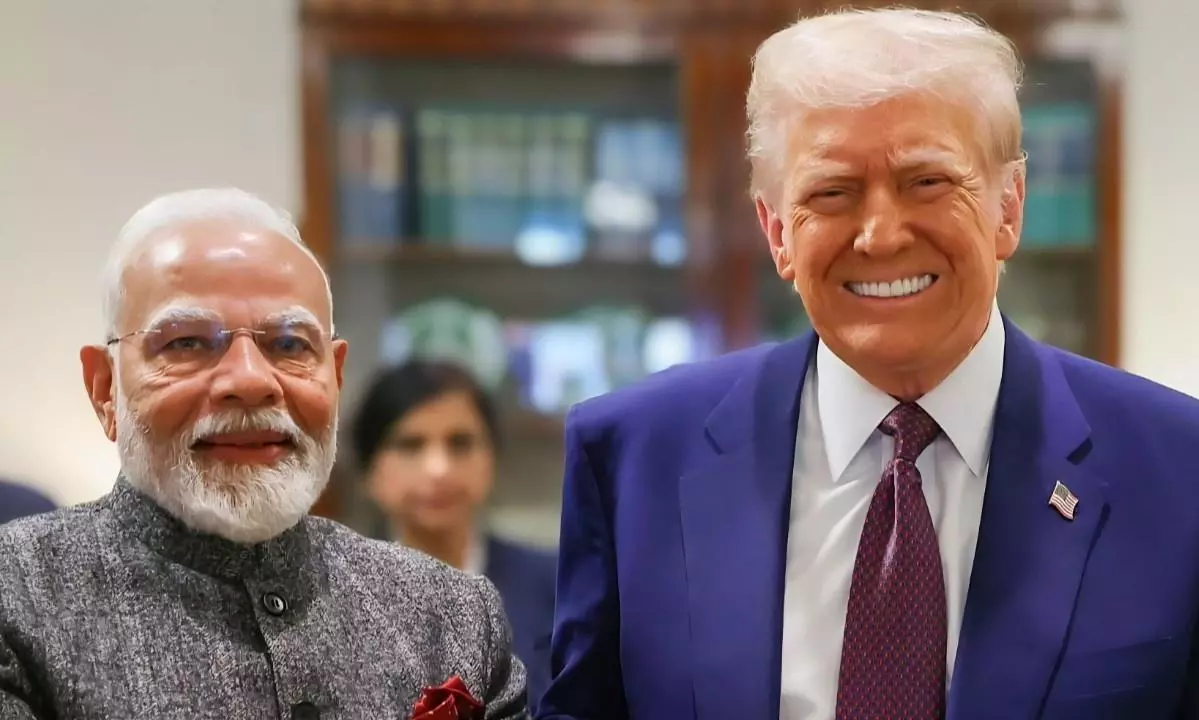
American farm lobbies have long pushed to dismantle India's MSP and public stockholding systems, key pillars of farmer protection and food security
Today, India and the United States are holding a crucial round of trade negotiations to finalise the first tranche of their much-publicised bilateral trade agreement. Officially, the talks are about technical and legal scrubbing. In reality, they may determine whether the interests of nearly 800 million vulnerable Indian farmers are quietly mortgaged at the altar of geopolitical expediency.
Against a backdrop of mounting American pressure and public criticism of India's subsidy regime, the central question remains unanswered: what substantive commitments has the Modi government already made under a combination of political, strategic, and economic pressure?
Pressure on Indian policies
Last week, Washington escalated what increasingly resembles a coordinated campaign against India’s agricultural policies. At the World Trade Organisation’s Committee on Agriculture, the United States—joined by the Cairns Group of agricultural exporting nations, including Pakistan—mounted an unprecedented naming-and-shaming exercise targeting India’s farm support programs.
Also read | India-US trade deal first tranche expected soon as key issues settled: Piyush Goyal
Notably, not a single country came to India’s defence. New Delhi found itself isolated and struggling to justify its policies.
Yet even as India faced criticism in Geneva, Union Commerce Minister Piyush Goyal was publicly celebrating progress in trade negotiations with Washington. According to reports, a US delegation is arriving for the final phase of discussions, with most substantive issues already resolved and only technical and legal matters left to conclude.
That assertion should concern every Indian citizen.
Opacity clouds trade talks
The Modi government has revealed almost nothing about the commitments it may have made in agriculture, services, pharmaceuticals, or digital trade. Beyond occasional leaks and selective briefings, negotiations have been conducted behind a wall of opacity. The public has been denied any meaningful understanding of the concessions being offered in sectors that affect livelihoods, food security, employment, and public health.
India’s 1.4 billion citizens—including roughly 800 million people dependent on agricultural support systems—remain largely unaware of what their government may have agreed to. This secrecy has only fuelled speculation that considerations extending beyond trade, including broader strategic and corporate interests, may be shaping the negotiations.
The concerns are not hypothetical.
Concerns over agriculture sector
For years, American farm lobbies and lawmakers have relentlessly targeted India’s public stockholding and minimum support price programs. Their objective is clear: dismantle policies that shield Indian farmers from market volatility and support domestic food security.
The principal charge against India is that it spends roughly $65 billion on agricultural support, including around $25 billion categorised as trade-distorting subsidies, with the remainder falling under development-related support measures.
India has rejected those claims. Yet at the WTO meeting, even members of the G33 coalition of developing countries—such as Indonesia and China—remained silent. New Delhi’s diplomatic isolation was impossible to ignore.
Coordinated US policy push
The campaign against India is no longer confined to government channels. It increasingly resembles a coordinated effort linking official US policy, congressional pressure, and private-sector lobbying.
The warning signs were evident in remarks by Senator John Boozman, chairman of the US Senate Committee on Agriculture, Nutrition, and Forestry: “American rice and wheat farmers continue to be targeted by India’s egregious over-subsidisation, and there are countless other examples. This legislation will give us the tools needed to address unfair practices and market manipulation by our trading partners to level the playing field and maintain a competitive advantage in the global marketplace.”
Also read | Why India-US trade deal raises fears of one-sided concessions
Such statements are not merely rhetorical. They signal a growing bipartisan determination in Washington to challenge India's agricultural policies through trade instruments, legislation, and potentially formal disputes.
Ironically, this comes from a country that itself lost a major WTO dispute over cotton subsidies.
Taking battle to WTO
The United States has also worked to construct a broader narrative portraying opposition to Indian subsidies as a global concern rather than a bilateral grievance. At the WTO, Washington brought representatives from the US Rice Association and, significantly, Pakistan to argue that Indian support programs harm competitors across both developed and developing countries, including agricultural exporters such as Paraguay.
A side event hosted by the US rice lobby became the focal point of the offensive. With US trade envoy Ambassador Joseph Barloon participating, speakers from Pakistan and the US Rice Association launched what observers described as a “very localised attack on India.” Their argument was straightforward: they can compete with anyone except the Indian government.
Agriculture, however, is only one front.
Expansion to services and tech
India faces growing challenges in services trade, particularly in information technology. The Trump administration's repeated attacks on H-1B visas suggest a continuing effort to reduce foreign participation in America’s technology sector, despite the substantial contributions Indian professionals make to the US economy and social welfare system.
On digital trade, India has already moved away from its long-standing support for policy flexibility on customs duties for electronic transmissions. Under continued pressure, New Delhi may eventually endorse a permanent moratorium that could deprive the country of tens of billions of dollars in future customs revenue.
The government’s aggressive promotion of tax incentives for AI-driven data centres also raises difficult questions. While presented as a modernisation strategy, such policies could simultaneously reduce tax revenues and accelerate job displacement among millions employed in India’s software services sector as artificial intelligence automates routine functions.
Pharma faces growing pressure
The pharmaceutical sector presents another area of vulnerability.
Prime Minister Narendra Modi frequently describes India as the “pharmacy of the world.” Yet that status could be undermined if trade negotiations impose more stringent intellectual property obligations, particularly on patents and pharmaceutical innovation.
The timing is notable. A Wall Street Journal report on May 31, titled “Trump Wants Minerals, Health Data for Aid. African Nations Are Pushing Back,” described how several African governments have resisted US demands tied to health assistance.
According to the report, “Zimbabwe, Ghana and Zambia have said no or dragged out negotiations over the Trump administration’s self-described America First foreign-assistance policies, which aim to tie health aid more directly to US diplomatic and security goals.”
The report further noted that governments were resisting demands involving access to private medical data and, in some cases, mineral resources.
Whether in agriculture, digital trade, pharmaceuticals, or development assistance, a common pattern emerges: maximalist bargaining backed by overwhelming economic leverage.
Questions over policy sovereignty
The uncomfortable possibility is that India has already diluted—or abandoned—many of its long-standing positions under similar pressure.
Also read | US wants to 'put itself first' in trade deal with India: 'Not here to do charity'
Trade agreements are often sold as instruments of growth and strategic partnership. But they can also become vehicles for asymmetrical concessions when one side negotiates from a position of overwhelming power and the other from a position of political urgency.
History offers a cautionary lesson. Siraj-ud-Daulah resisted the encroachment of the East India Company until the balance of power shifted irreversibly against him.
Today’s circumstances are vastly different, but the underlying question remains familiar: can India preserve policy sovereignty in the face of external pressure, or is it quietly yielding ground to the world's predatory hegemon?
The answer may emerge not from today’s public announcements, but from the commitments buried deep within the fine print of the agreement.
(The Federal seeks to present views and opinions from all sides of the spectrum. The information, ideas or opinions in the articles are of the author and do not necessarily reflect the views of The Federal.)