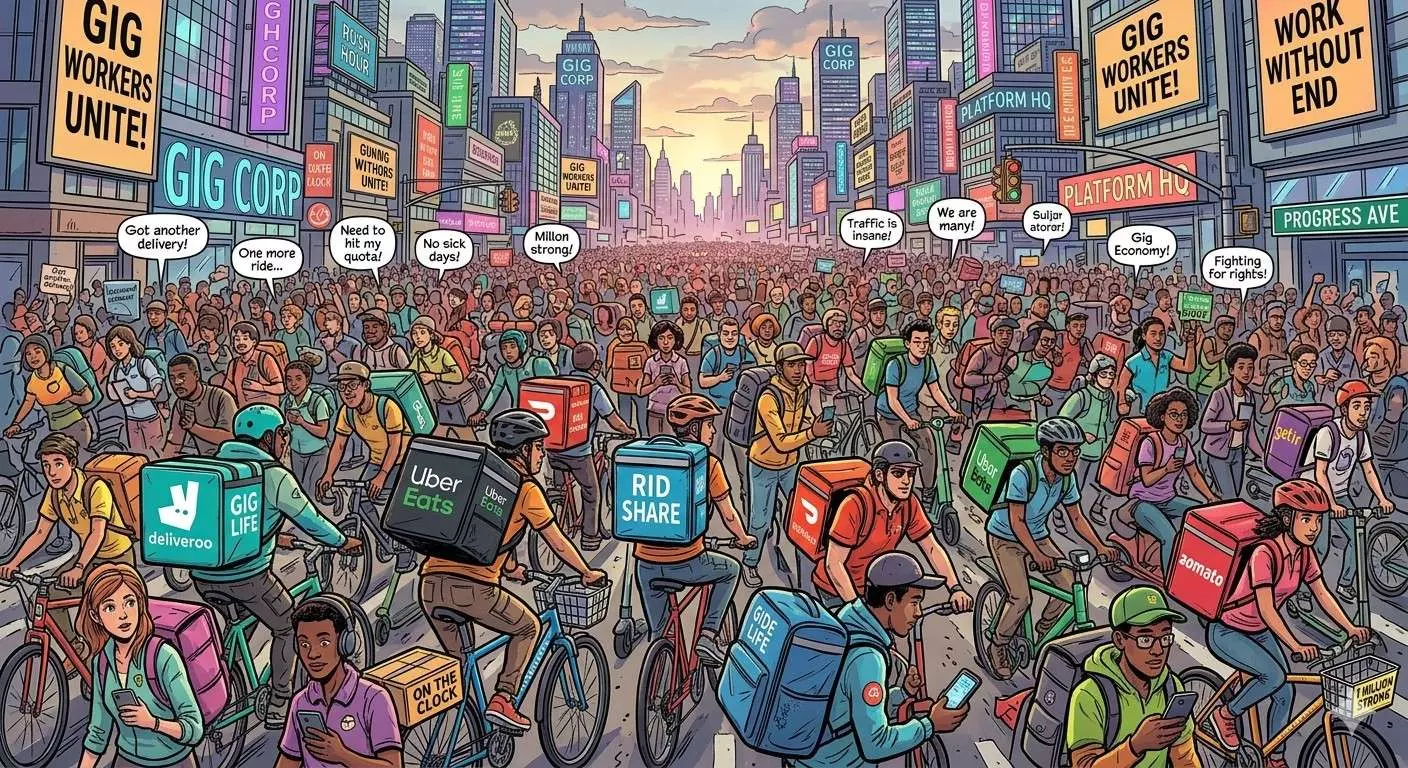
Despite legal recognition, social security remains elusive for millions of gig workers
Even though the Social Security Code has been implemented on paper, millions of gig workers remain without provident fund, pension, or effective insurance cover

India had 7.7 million gig workers in 2020. By 2030, that number is projected to reach 23.5 million, spanning 21 sectors — from food delivery and ride-hailing to online tutoring and data annotation for artificial intelligence — according to a Niti Aayog report.
Six years ago, India formally recognised gig workers as a distinct category entitled to social security benefits. The Code of Social Security was passed in 2020, proposing contributions from the central government, state governments, platform companies and the workers themselves.
But even today, millions of delivery partners, cab drivers and home service workers continue to operate without provident fund, pension or meaningful insurance coverage. The Code, even though implemented on paper in November last year, has not been operationalised on the ground.
Workers speak up
In Chennai, delivery workers from Swiggy, Zomato, Blinkit and BigBasket say they have few complaints about the platforms themselves. Many value the flexibility gig work offers.
"In my previous job, I wasn't a confirmed employee. The commute was long and the conditions were not comfortable. Here it is different. I work when I want to, rest when I need to, and manage my own time. No pressure, no force. I work on my own terms," said Sivakumar, a delivery partner with Instamart and Swiggy.
Also read: Centre proposes 90 days’ work for gig workers to qualify for social security
Mohammed, a Zomato delivery partner, echoed the sentiment about worker engagement at his platform. "Compared to other platforms, Zomato stands out. They don't treat us just as riders — there is a sense of belonging. Every month, they conduct meetings where even senior officials come and listen. We can report our problems directly to our team leader. That support makes a difference," he said.
A full-time delivery worker can earn around Rs 30,000 a month, with some aiming for Rs 60,000. Many others take up gig work in the evenings to supplement their primary income.
Insurance that doesn't pay
But not all workers share that positive experience. One part-time BigBasket delivery partner took up gig work because his regular salary was insufficient. When he met with an accident and was hospitalised, the insurance he had been promised failed to cover his expenses.
Suresh recounted his ordeal: "They have given us insurance. But to use it, I have to get admitted to a big hospital. We cannot manage that on our own. Two years ago, during a delivery, I fractured my leg. I was admitted to a hospital in my town, had an operation, and spent Rs 40,000. I tried to claim the insurance but could not. The company did not cover it. Later, I found out the insurance only works if you are admitted to a specific big hospital, with proper bills. Without that, there is no claim."
Also read: 14-hour workday in oppressive conditions: Expert shares dark truths of gig work
When workers were asked about PF, pension or the government's social security scheme, almost none had heard of it. Rajesh Kannan, a Zomato delivery partner, said: "There are some benefits — health insurance, and accident claim up to Rs 10 lakh. But pension or PF? I have never heard of receiving anything like that."
Ramarajan, a Blinkit delivery partner, was equally unaware. "There is no pension. The only deduction is TDS. No other benefits. I have no information about anything else," he said.
Legal gaps persist
Legal experts say that by stripping away the employer-employee relationship, the law has effectively left gig workers without meaningful protection.
Mayank Arora, partner at the Chambers of Bharat Chugh, explained the fundamental problem: "The legislature categorically wants gig workers and platform workers to stay outside the rim of an employer-employee setup. Now, so what? Actually speaking, you are on your own. And the moment this goes away, you are treated as an independent contractor vis-à-vis an organisation. Now imagine they are placing you on a par with a corporation which is vast and a worker who is a tiny cog in the wheel of how the entire system operates. I think which is what is most worrying."
Also read: Women gig workers protest in Delhi over pay, account blocks
The proposed scheme requires a gig worker to complete 90 days on a platform within a year to become eligible for benefits. But gig work is inherently irregular — workers log in when they can, not according to fixed schedules. Experts warn that if a worker is blocked or removed from a platform on day 89, they lose all eligibility. There is no warning, no explanation, and currently no system to challenge the decision.
The cost question
Arora also highlighted the stark contrast between what platforms are expected to contribute under the proposed scheme and what traditional employers pay.
"They are being only told to pay one to two per cent of their turnovers and it is capped at five per cent of the overall cost that they are spending on gig workers. Now, if you see a traditional employer-employee setup, these costs can go as high as 35 to 40 per cent of the total employee cost. So, imagine if you are able to take care of that ball park in five per cent capping, why would you resist? They would rather have a capping at this number rather than having an open-ended liability," he said.
The Labour Ministry is considering a multi-manager model, where the Employees' Provident Fund Organisation handles provident fund contributions and a separate fund manager oversees pensions. Platform companies are being asked to contribute 1–2 per cent of their turnover to a central fund. But key questions around the policy design remain unresolved.
Why the delay?
Policy experts argue the delay was structural, not accidental. The law was always a framework, with no clear implementation mechanism built in.
Also read: Exclusive | Gig workers not robots, exploitation should stop: MP Raghav Chadha
Nikhil Narendran, partner at Trilegal, said: "The law was always a framework without a clear implementation mechanism. The nature of gig workers from 2020 to 2026 has undergone a sea of change. It was just a framework that the government came about with. There was no real mechanism which was laid out. And it also required coordination amongst state governments and the central government to come out with the basic structure. That has naturally led to this sort of delay. We should now use this opportunity to come out with the best possible structure to regulate gig workers because it's now become a need — the majority of them depend on this as a primary source of income and it's one of the major employment generators in India."
Data and a unified ID
Looking ahead, experts say two changes could transform outcomes for gig workers: greater data transparency and a unified worker identity system.
Narendran pointed to rights gig workers already have under India's Digital Personal Data Protection Act — access to their own data, information on how it is processed, and disclosure of third-party sharing. He also called for a single worker ID that would follow an individual regardless of whether they are employed full-time, between jobs, or doing gig work.
"Why should I have multiple logins, multiple portals, multiple hoops to travel through? There are studies which say that it creates large amounts of delays because these funds sometimes get stuck and lie in accounts without these folks being able to use it properly. Give one unified design portal, one login ID for these employees to operate — whether they are a gig worker, whether they are a permanent employee, whether they belong to the unorganised sector — where they can access all social benefits," he said.
Also read: Zomato CEO Goyal defends gig model amid protests, safety concerns
Arora added that gig workers currently have no functional grievance redressal system. Workers can be removed from platforms for reasons as minor as slower-than-average delivery times, with no recourse. "Data is not being very transparently shared with gig and platform workers. Frankly, I don't think they have any redressal mechanism today. Although the act provides for a helpline and redressal mechanism, I don't think that's operational yet," he said.
Right protection for the right person
The government's scheme counts every gig worker — the full-time delivery partner who depends entirely on platform income, and the part-time rider earning supplementary money. But the law treats them the same. One needs protection urgently. The other may already have it through a primary job.
For the BigBasket worker who fractured his leg on a delivery and spent Rs 40,000 out of pocket, the question was simple: if the insurance he was promised didn't cover his hospital bill, what exactly was he covered for?
Until the system can tell the difference between those who need protection urgently and those who already have it elsewhere, the right benefits may never reach the right person.
(The content above has been transcribed from video using a fine-tuned AI model. To ensure accuracy, quality, and editorial integrity, we employ a Human-In-The-Loop (HITL) process. While AI assists in creating the initial draft, our experienced editorial team carefully reviews, edits, and refines the content before publication. At The Federal, we combine the efficiency of AI with the expertise of human editors to deliver reliable and insightful journalism.)