Navarro is wrong; India is giving more to ChatGPT than taking from it
Apart from subscription revenue, India offers an incredibly large platform for training and evolution of AI systems with its language and cultural diversity

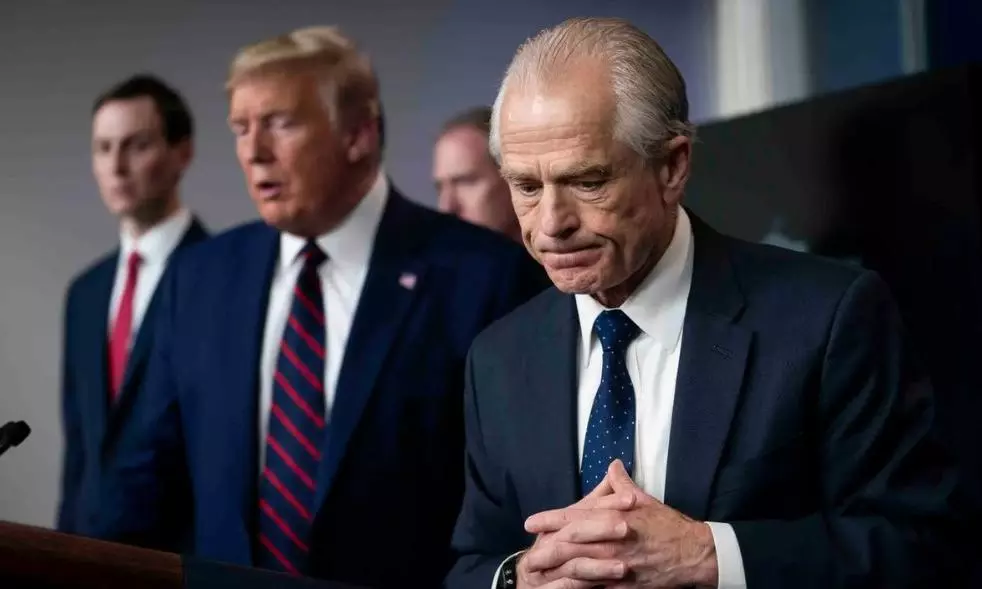
US President Donald Trump’s top trade advisor Peter Navarro, once again attacking India, asked earlier this week, "Why are Americans paying for AI use in India?" This comes after targeting India for buying Russian crude, "cozying up with China" and "erecting trade barriers".
In his latest attack, Navarro gave the example of ChatGPT being used in India, suggesting that it was being paid for by Americans, as ChatGPT is “operating on US soil, using American electricity” (also water). He threatened that the Trump administration is examining the matter and can be expected to take “strong action”.
His statement came after two Republican senators asked Trump about the “unfair” tariff imposed by India on US pulse imports.
Also read: Tariff war not one-sided; US senators complain about ‘unfair Indian tariffs’ on pulses
Weeks earlier, Trump himself had threatened higher tariffs on Indian basmati exports. The US has imposed 50 per cent tariffs on India since August 2025 – the highest, along with that on Brazil, with no sign of easing.
However, Navarro’s claim is quite misplaced for multiple reasons, indicating it could be part of Trump's “America First” campaign seeking US firms to pull investments abroad back to home ground to re-industrialise the US, so to say, and create more jobs.
Is India a ChatGPT freeloader?
Navarro doesn’t reckon that it isn’t American taxpayers’ money which is being deployed in the ChatGPT use in India. It is an AI platform owned and operated by commercial enterprises. US-based OpenAI Group, which operates it, owns a 26 per cent stake, its employees and other investors own another 47 per cent and Microsoft the balance 27 per cent.
Also read: OpenAI unveils new AI agent for ChatGPT
Sam Altman, an American entrepreneur, is the CEO and co-founder of OpenAI; Elon Musk was one of the co-founders but is not associated with it anymore.
According to analytics firms, India leads in ChatGPT usage at 13.5 per cent, surpassing US users last year and Indian subscribers paid $8 million on ChatGPT subscriptions between 2023 and early 2025.
Though US users pay more, at $330 million during the same period, India still dominates the market as the subscription rates are different. Indian subscribers are charged lower and given free subscriptions (Reliance Jio offers ChatGPT free to its own subscribers).
Also read: OpenAI offers ChatGPT Go free for one year in India
Last August, Altman said India “may well become our largest market”. It is no surprise that big US firms – Google, Microsoft and Amazon – are making huge investments in building AI infrastructure in India. Here are some:
a) Last October, Google announced a $15-billion investment to build an AI data hub in Andhra Pradesh.
b) Last December, Microsoft announced an $17.5 billion investment plan for cloud and AI infrastructure, in addition to $3 billion announced earlier.
c) Last December again, Amazon said it was “on track” to invest $12.7 billion in local cloud and AI infrastructure in India.
It isn’t only about subscription and revenue though. India offers an incredibly large platform for training and evolution of AI systems like ChatGPT, with its diversity in professions, languages, and interactions.
Use of resources
Navarro’s concerns over the use of soil, energy and water for AI infrastructure are, however, valid. AI does call for intensive use of resources – putting high stress on the environment and climate crisis mitigation.
During an interview, Altman said an average query on ChatGPT uses “about 0.34 Watt-hours, about what an oven would use in a little over one second, or a high-efficiency lightbulb would use in a couple of minutes” and “consumes approximately 0.000085 gallons of water, which is “roughly one-fifteenth of a teaspoon”.
Also read: Is the US paying for India’s ChatGPT use? Navarro’s claim explained
Considering several requests on ChatGPT globally, it amounts to a huge consumption of electricity and water (for cooling data centres).
Cornell study
A Cornell University paper published last September indicated that the baseline daily energy use of serving 1 billion queries works out to 0.8 GWh/day, and if 10 per cent are long queries, the energy demand could grow to 1.8 GWh/day.
As for water use, it has already spread panic in the US, drawing Navarro’s attention. An analysis by the Alliance for the Great Lakes in August 2025 stated: “Hyperscale data centers, the likes of which can support generative artificial intelligence, can use more than 365 million gallons of water a year, equivalent to what 12,000 Americans use in that time. Hyperscale data centers are projected to withdraw as much as 150.4 billion gallons of water over the next five years, as much as 4.6 million American households.”
In fact, Navarro could as well ask US firms to keep away from American soil. India surely needs their investments.
Americans paying more now
In any case, Navarro’s weird idea of imposing high tariffs on foreign exporters to check trade deficit has already backfired.
Germany-based think tank Kiel Institute for the World Economy published a study, “America's own goal: Americans pay almost entirely for Trump’s tariffs”, on January 19, which shows 96 per cent of US tariffs imposed on foreign countries are actually paid by Americans (the rest 4 per cent absorbed by foreign exporters).
Also read: India-US trade deal first tranche ‘very near’, says Commerce Secretary
It used shipment-level data covering over 25 million transactions, valued at $4 trillion, to say it was “near-complete pass-through of tariffs to US import prices.”