



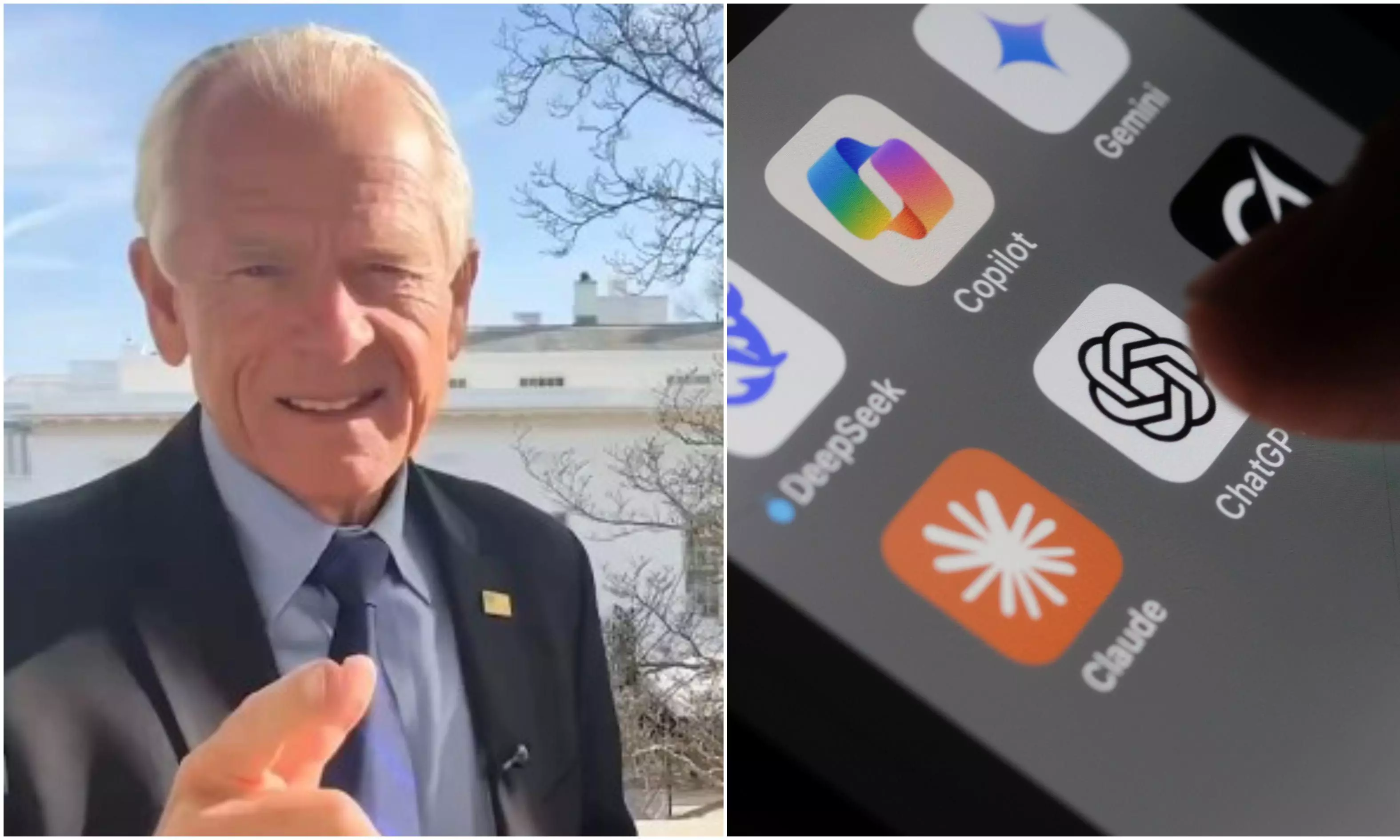
Is the US paying for India’s ChatGPT use? Navarro’s claim explained
White House adviser Peter Navarro claims Americans pay for AI used in India. Here’s what the data and business model actually show

Even as tensions between Washington and New Delhi over oil trade and tariffs continue, White House trade adviser Peter Navarro has raised another issue that could further complicate bilateral relations: the global use of US-based artificial intelligence platforms.
Speaking on Real America’s Voice on Saturday (January 17), Navarro questioned why American infrastructure should support AI services accessed overseas, particularly in India and China. He suggested that the Trump administration was examining the issue from the perspective of national and economic security.
Also Read: Trump’s raw power politics and what it means for India
"It’s like, why are Americans paying for AI in India? Chat GPT (is) operating on US soil, using American electricity, servicing large users of Chat GPT, for example, in India and China and elsewhere around the world. So that's another issue that's got to be dealt with," Navarro said in an interview with former White House chief strategist Steve Bannon.
Navarro added that the administration was closely studying the impact of AI data centres on domestic electricity costs and hinted at possible policy intervention.
Is the claim accurate?
While India is among the world’s largest user bases for ChatGPT, Navarro’s assertion that Americans are “paying” for AI usage abroad does not hold up to scrutiny.
According to data cited by Visual Capitalist, India accounts for one of the highest shares of daily ChatGPT usage globally, at around 36 per cent, well above the global average. Separately, surveys by Boston Consulting Group show that Indian respondents are more willing to integrate generative AI tools such as ChatGPT into workplace tasks compared to their US counterparts.
However, high usage does not translate into US taxpayer funding.
ChatGPT is operated by OpenAI, a US-based private company that finances its services through a mix of paid subscriptions, enterprise contracts, and API usage fees. Indian users and companies either pay directly for premium services or access free tiers that are subsidised as part of a standard freemium business model — a structure that applies equally to users within the United States.
Who bears the cost of AI services?
The operational costs of AI platforms — including data centres, electricity, and infrastructure — are borne by the companies themselves, not by the US government or American citizens.
Concerns raised by Navarro are better understood as part of a broader debate within the US over the energy intensity of AI data centres, many of which are located domestically and draw heavily on local power grids while serving a global user base.
US data centre power demand is projected to reach about 260 terawatt-hours (TWh) in 2026, up from roughly 183 TWh in 2024. While it is difficult to isolate AI-optimized servers from general cloud services, Wells Fargo projected AI-specific demand in the US would reach 52 TWh in 2026.
Data centres currently consume roughly 4 per cent of total US electricity. This is projected to rise to between 6.7 and 12 per cent by 2028.
Also Read: India refutes US claim on trade deal, says Modi spoke to Trump 8 times
This debate mirrors earlier discussions around cloud computing, streaming platforms, and global internet traffic, sectors where US-based infrastructure supports international demand without implying foreign subsidy.
Investments in India
Navarro’s remarks also come at a time when US technology companies are expanding their footprint in India. Microsoft CEO Satya Nadella has announced USD 17.5-billion investments in AI and cloud infrastructure in the country, while Amazon has committed to invest USD 35 billion in AI-driven initiatives across the country over the next five years. Google has pledged USD 15 billion for data centres through partnerships with Indian conglomerates Adani Group and Bharti Airtel.
These investments, however, are commercial decisions by private corporations, not transfers funded by American taxpayers. However, it has to be seen if Navarro's statement, "...that's got to be dealt with," will have an bearing on such plans of the tech giants.
A broader diplomatic backdrop
Navarro’s comments arrive amid strained US-India relations over multiple issues, including tariffs, energy trade, immigration policy, and former President Donald Trump’s claim of having brokered a ceasefire between India and Pakistan in May last year, a claim that is being consistently rejected by New Delhi.