Budget 2026
Budget 2026 bets on long-term growth, but is it politically ambitious? | Capital Beat
Panellists criticise the policy document for small-scale allocations and unfulfilled promises while questioning the federal vision for states

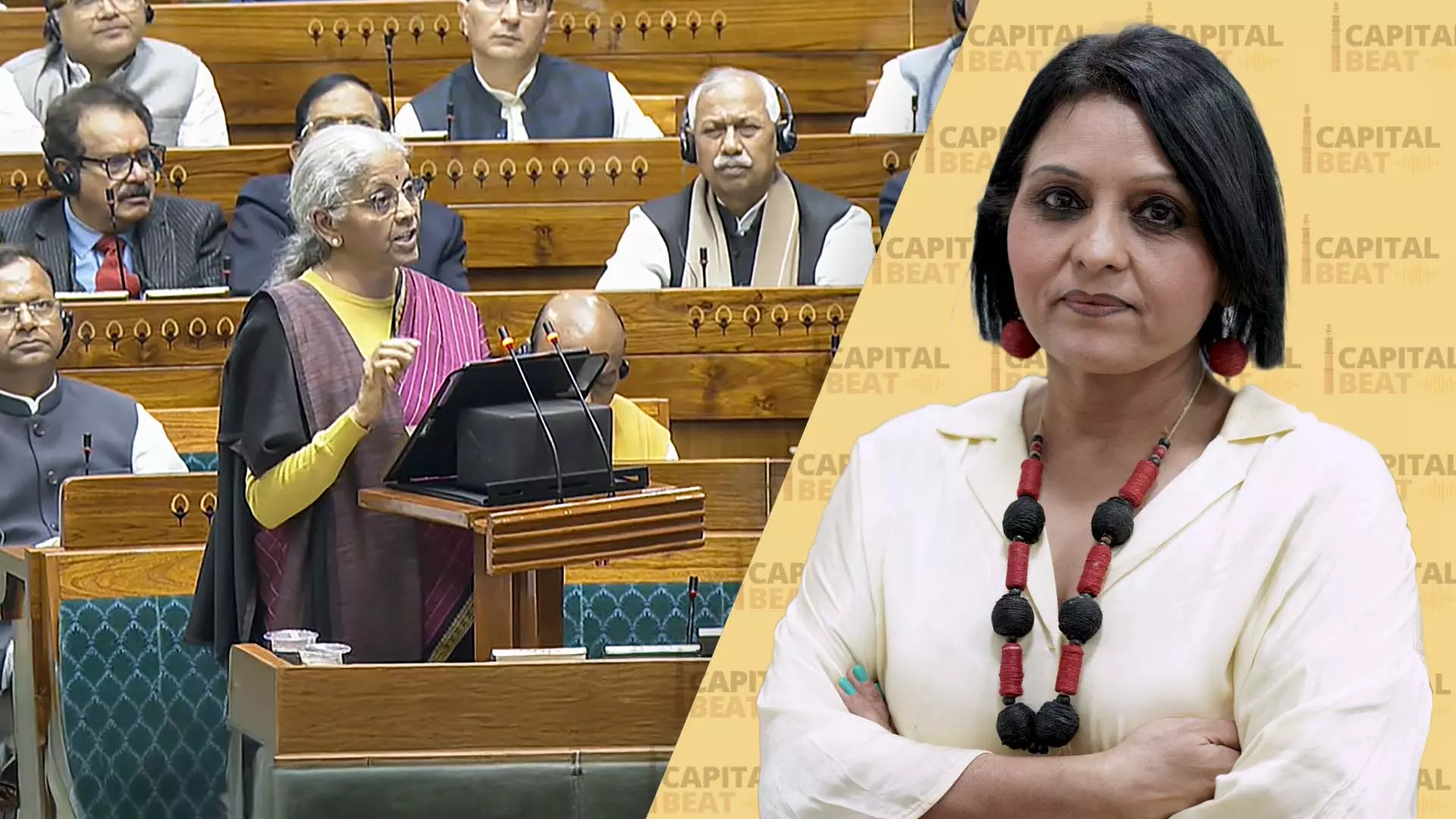
The Union Budget 2026 drew sharp political criticism on Capital Beat, with panellists questioning its lack of strategic clarity, weak demand signals and uneven federal vision even as the government projected infrastructure expansion and a long-term “Viksit Bharat” vision.
The Federal spoke to Congress leader and economic development expert Salman Soz; Samajwadi Party leader Sarvesh Tripathi of the Samajwadi Party; Professor Charan Singh, former Reserve Bank of India Chair Professor; and senior journalist Girish Joshi, in a Capital Beat episode examining the political and economic messaging of Union Finance Minister Nirmala Sitharaman’s ninth consecutive Budget.
Soz set the tone early, describing the Budget as a dispersion of “relatively small sums across sectors” rather than a document that signals India’s next economic frontier. He argued that after more than a decade in power, the government failed to articulate a credible growth narrative anchored in technology, demand revival or private investment.
'Sprinkling money, not strategy'
He criticised what he described as the absence of scale in flagship announcements. Referring to the proposed Biopharma Shakti mission, he said, “Rs 10,000 crore over five years works out to roughly USD 225 million a year. That is what Pfizer spends on R&D in two weeks.”
Also read: Budget 2026: Business as usual in a world that is not
He added that such allocations were inconsistent with claims of building global leadership in advanced sectors.
Soz also flagged weakening demand indicators, stating that falling tax collections point to stress in the economy. “If tax collections are down, it means there is a weakness in demand,” he said, warning that reductions in employment-linked spending could further deepen the slowdown.
'Budget for 3-4 pc of population'
Tripathi said that Budget 2026 offered little to ordinary citizens, calling it “a budget for three to four per cent of the population.” He said there was “nothing for the lower class, nothing for the youth, nothing for farmers,” and questioned claims of labour-intensive growth without an implementation roadmap.
The SP leader also linked the Budget’s political reception to market signals. “The market is self-explanatory,” he said, pointing to investor reactions as an indicator of dissatisfaction. He added that expectations of relief for the middle-class and poll-bound states were unmet.
Federal imbalance and devolution
Concerns over Centre–state finances emerged repeatedly during the discussion. Soz highlighted the expanding use of cesses and surcharges, arguing that this shrinks the divisible pool meant for states. “Actual devolution to states is not what it appears on paper,” he said, adding that state budgets are under increasing stress as responsibilities expand without matching transfers.
Also read: Budget 2026 focuses on AI, digital education but concerns over inequalities remain
He also warned that shifting funding burdens to states for employment and welfare programmes could weaken demand further, given constrained state finances.
Rare minerals and state revenues
Joshi focused on the political economy of minerals and infrastructure. He pointed to a Supreme Court verdict allowing states to collect lease rentals on mineral-bearing land, calling it a potentially major revenue source for mineral-rich states such as Maharashtra, Jharkhand, Odisha, Andhra Pradesh, West Bengal and Gujarat.
He said the Budget's references to rare-earth corridors and mining-research funding did not fully acknowledge the scale of fiscal change this ruling enables. He argued that projected employment gains were being framed as automatic outcomes without concrete delivery mechanisms.
Unfinished promises
Joshi also listed several past Budget announcements that, according to him, remain unfulfilled. These included plug-and-play industrial parks, urban vendor clustering under the Street Vendors Act, internship programmes, ITI upgrades and agricultural missions.
“There is no accounting of what failed and what succeeded,” he said, calling this a recurring problem in Budget-making.
Also read: What does each state get from Budget 2026-27?
He argued that repeated rebranding of initiatives without performance audits weakens policy credibility and blurs accountability.
No proper evaluation of Budgets
Professor Singh placed the debate in a longer institutional context, noting that he had analysed over four decades of Union Budgets. He said a structural weakness of India’s budgeting process is the absence of systematic evaluation. “There is no chart showing which schemes succeeded, which failed, and which were terminated,” he said, calling this a failure of public finance accountability.
Singh also pointed to India’s low tax-to-GDP ratio of around 18 per cent, describing it as a binding constraint on expenditure regardless of which party is in power. “Given this ratio, the fiscal space is limited. That reality cannot be wished away,” he said.
Vision 2047 and geopolitical questions
On the government’s long-term 'Viksit Bharat 2047' framing, Singh said India is not alone in setting centennial development goals, citing Indonesia’s 2045 vision. However, he acknowledged concerns that Budget 2026 did not sufficiently address immediate geopolitical and economic uncertainties.
Also read: Union Budget leaves poll-bound Assam empty-handed, yet again
He argued that fiscal and monetary policy are directional tools rather than accounting exercises. “A Budget is a policy document. It signals a strategy that unfolds over time,” he said, while conceding that the opening articulation of that strategy could have been clearer.
Green shoots or prolonged transition
Singh identified what he termed “green shoots” in areas such as medical tourism, high-speed rail corridors, MSME (Micro, Small, and Medium Enterprises) funding and the proposed high-level committee on banking. He said these indicated an acknowledgement of structural needs, particularly in financing growth amid technological disruption.
However, Soz challenged this framing, saying, “This is the twelfth year of this government. This is not the time for green shoots. We should be beyond the foundation stage by now.” He argued that repeated references to early recovery signals mask deeper stagnation.
Budget struggled to balance political and economic?
Across the discussion, panellists agreed that Budget 2026 struggled to balance political messaging with economic urgency. While infrastructure expansion, corridors and sectoral incentives were acknowledged, the absence of a clear demand revival strategy, evaluation of past schemes and coherent federal framework dominated the criticism.
Also read: 'Lacklustre', 'visionless', 'blind' to India’s 'real crises' — How Opposition sees Budget 2026-27
The debate underscored how Budget 2026 has become less about numbers and more about trust in execution, direction and credibility at a time of global uncertainty and domestic economic pressure.
The content above has been transcribed from video using a fine-tuned AI model. To ensure accuracy, quality, and editorial integrity, we employ a Human-In-The-Loop (HITL) process. While AI assists in creating the initial draft, our experienced editorial team carefully reviews, edits, and refines the content before publication. At The Federal, we combine the efficiency of AI with the expertise of human editors to deliver reliable and insightful journalism.