



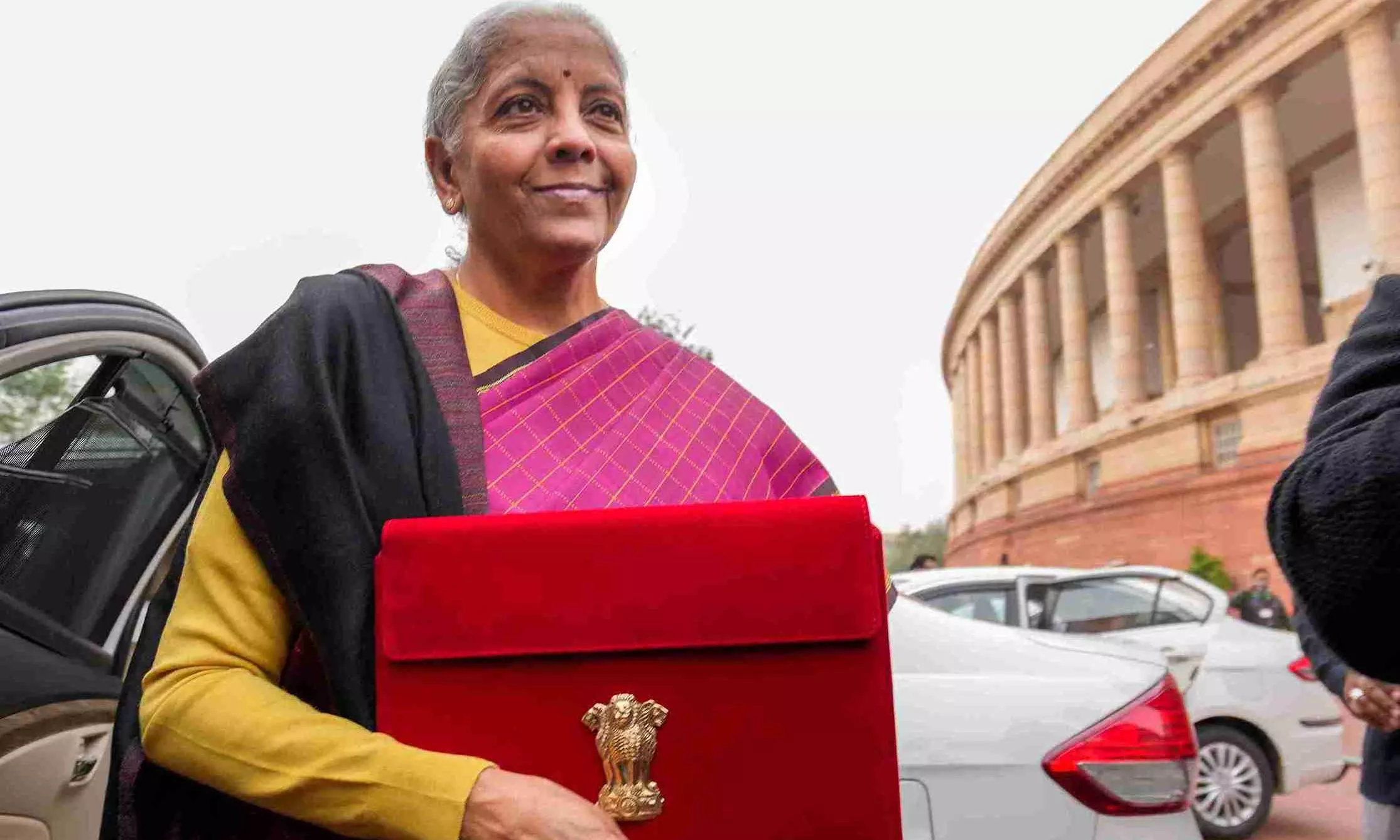
Coastal and eastern states won big in Nirmala Sitharaman's ninth Budget, with targeted industrial corridors, high-speed rail connectivity, and mineral-specific development plans | PTI Photo
What does each state get from Budget 2026-27?
Coastal, eastern states win big with Odisha emerging as the toast of Budget 2026-27; Punjab gets no big project while 3 southern states bag rare earth corridors

In the Union Budget 2026-27 presented on Sunday (February 1), Finance Minister Nirmala Sitharaman focused on structural growth through regional corridors and cluster-based development.
Coastal and eastern states won big, with targeted industrial corridors, high-speed rail connectivity, and mineral-specific development plans.
Here is a list of who got what from Sitharaman’s ninth Budget:
Odisha
- The BJP-ruled state is a major beneficiary of Purvodaya (strategic push for eastern development)
- One of four states selected for a dedicated Rare Earth Corridor.
- National Waterway-5 (NW-5) to connect mineral hubs like Talcher and Angul and industrial clusters like Kalinganagar to the ports of Paradip and Dhamra
- State to be integrated into the new East Coast Freight Corridor, which aims to lower logistics costs for core sectors like steel, aluminium, and mining.
- Training institutes to develop skilled manpower required for new waterways ecosystem.
- Development of turtle trails along Odisha’s Olive Ridley nesting sites, specifically at Gahirmatha Beach and the Rushikulya River mouth, to boost biodiversity-led tourism.
Andhra Pradesh
- Andhra will benefit directly from two of the seven newly announced High-Speed Rail (HSR) Corridors: Hyderabad-Chennai and Hyderabad-Bengaluru.
- Rs 3,752.09 crore allocated for Amaravati and Polavaram projects.
- As a designated Purvodaya state, Andhra is part of the integrated East Coast Industrial Corridor, which aims to enhance industrial productivity and logistics along India's eastern seaboard.
- Andhra is the second of four mineral-rich states selected for a dedicated Rare Earth Corridor.
- Andhra can compete via the challenge route for support in establishing one of three proposed dedicated Chemical Parks designed on a cluster-based plug-and-play model.
- The Budget proposed the development of birdwatching trails along Pulicat Lake, shared between Andhra Pradesh and Tamil Nadu, to enhance experiential tourism.
- As part of the Purvodaya focus, the state will benefit from the shared deployment of 4,000 new electric buses in the region.
Tamil Nadu
- Tamil Nadu, with its imminent assembly elections, is the third state selected for a dedicated Rare Earth Corridor.
- The state’s extensive textile clusters are expected to benefit from the Integrated Programme for the Textile Sector.
- The limit for duty-free imports of specified inputs for processing seafood has been increased from 1 per cent to 3 per cent, benefiting Tamil Nadu’s large marine export industry.
- Two of the seven newly proposed High-Speed Rail (HSR) corridors will directly connect Chennai with Hyderabad and Bengaluru.
- A proposed Inland Waterways project aims to link Talcher (Odisha) to Ambur (Tamil Nadu) to provide a cost-effective logistics route for bulk cargo.
- The Budget supports the expansion of Cuddalore Port, which will include a new shipbuilding and repair yard.
- A new scheme was announced to replace non-productive trees with improved varieties, directly targeting Tamil Nadu as a major coconut-producing state.
- The Budget proposed developing ecologically sustainable nature trails in the Western Ghats and birdwatching trails along Pulicat Lake (shared with Andhra Pradesh).
- The Pothigai Malai (Agasthyarkoodam) peak on the Kerala-Tamil Nadu border was highlighted for promotion as a sacred trekking destination.
- The state is eligible to participate in the Medical Value Tourism scheme to establish five Regional Medical Hubs aimed at attracting international patients.
Kerala
- Kerala, also headed for Assembly elections, is the fourth state selected for a dedicated Rare Earth Corridor.
- The Budget announced the development of ecologically sustainable “Turtle Trails” along key nesting sites in coastal Kerala to promote nature-based tourism.
- The duty-free import limit for specific inputs used in seafood processing was increased from 1 per cent to 3 per cent, benefiting Kerala’s large marine export sector.
- A new national scheme was introduced to replace aging coconut trees with more productive varieties.
- Specific programmes aim to transform Indian cashew and cocoa into global brands by 2030.
West Bengal
- Another assembly poll-bound state, West Bengal, was announced as a key node for the East Coast Industrial Corridor, specifically with a major development hub in Durgapur.
- A 1,850-km-long freight corridor proposed to connect Dankuni to Surat in Gujarat.
- One of the beneficiaries of seven newly announced high-speed rail corridors connecting Varanasi with Siliguri.
- As one of the five “Purvodaya” states, West Bengal will benefit from a scheme to create five new integrated tourism destinations.
- The state will share in the deployment of 4,000 new electric buses planned for the eastern region.
Telangana
- Telangana is a primary beneficiary of the seven new HSR corridors announced as “growth connectors”. Hyderabad will serve as a major junction for three of these routes: Pune–Hyderabad; Hyderabad–Bengaluru; Hyderabad–Chennai.
- The Centre for DNA Fingerprinting and Diagnostics in Hyderabad received a sanctioned amount of Rs 67.50 crore to support advanced biotechnology research.
- The state is positioned to benefit from the new Rs 10,000-crore Biopharma SHAKTI initiative, which includes the creation of a network of over 1,000 accredited clinical trial sites and the upgrading of NIPER institutions.
Karnataka
- Bengaluru will be a central junction for three of the seven HSR corridors: Hyderabad–Bengaluru; Chennai–Bengaluru; Pune–Hyderabad.
- A new dedicated programme was launched for the focused cultivation and post-harvest processing of sandalwood, directly supporting Karnataka’s legacy “Sandalwood State” identity.
- Targeted schemes were announced for coconut, cashew, and cocoa to improve productivity and establish these as premium global brands by 2030, particularly benefiting the Tumakuru, Mangaluru, Udupi, and Karwar regions.
- Coastal Karnataka was selected for the development of ecologically sustainable “Turtle Trails” along key nesting sites to promote eco-tourism.
- Mangaluru was identified as a potential site for one of five proposed Regional Medical Hubs under a PPP model, leveraging its proximity to major pilgrimage centres like Udupi and Dharmasthala.
Maharashtra
- Two of the seven HSR corridors will directly serve Maharashtra: Mumbai–Pune and Pune–Hyderabad.
- The budget provides adequate funds for the Mumbai Urban Transport Project (MUTP) 3, the existing Metro network, and rural road infrastructure.
- The proposed Dankuni (West Bengal)-Surat (Gujarat) freight corridor will enhance logistics and cargo movement through Maharashtra’s industrial belts.
- Maharashtra is set to receive Rs 98,306 crore in tax devolution this year, an increase of approximately Rs 15,000–20,000 crore over previous years.
- The state’s vast MSME sector stands to benefit from the new Rs 10,000 crore SME Growth Fund and the rejuvenation of legacy industrial clusters.
- Provisions for container manufacturing (with a Rs 10,000-crore national outlay) and the expansion of coastal shipping will benefit Maharashtra’s major ports.
Uttar Pradesh
- A new inland waterways ship repair ecosystem will be established at Varanasi and Patna (Bihar) to support cargo movement on the Ganga and generate local employment.
- Two of the seven HSR corridors directly involve Uttar Pradesh: Delhi–Varanasi and Varanasi–Siliguri.
- The country’s first semiconductor design and manufacturing park has been approved near Jewar Airport (Noida).
- A new Viability Gap Funding (VGF) scheme will support seaplane operations to religious and heritage destinations like Varanasi and Prayagraj.
- A special fund has been allocated for a new industrial node in Prayagraj.
- Budgetary support was announced for the development of an AI city in Lucknow.
- An allocation of Rs 32,075 crore was proposed for the next phases of Lucknow, Kanpur, and Agra Metro projects.
Bihar
- A dedicated ship-repair facility will be established in Patna to support the operationalisation of new national waterways over the next five years.
- To leverage Bihar’s dominance in fox nut production, a dedicated Makhana Board will be set up to enhance production, processing, and global branding.
- Financial assistance was promised for the Western Koshi Canal project in Mithilanchal to improve irrigation for local farmers.
- Bihar is one of five “Purvodaya” states where the government will develop integrated tourism destinations to boost the local economy.
- The Budget includes plans for the infrastructure expansion of IIT Patna, specifically targeting the increase of hostel and research capacity.
- The National Mental Health Institute in Ranchi (serving the Bihar-Jharkhand region) will be upgraded to a Regional Apex Institution.
- As part of the Purvodaya push, Bihar will benefit from the deployment of 4,000 new e-buses in the eastern region and improved logistics via the East Coast Industrial Corridor.
Gujarat
- The Gujarat International Finance Tec-City (GIFT City) in Gandhinagar get a major boost with the the tax holiday period doubled from 10 to 20 years. Following the 20-year holiday, businesses will be taxed at a flat rate of 15 per cent.
- The Dankuni-Surat Freight Corridor will reduce logistics costs and link the industrial belt of Gujarat with markets in the eastern region.
- Two major Harappan-era archaeological sites in Gujarat—Lothal and Dholavira—were selected to be developed into “vibrant experiential cultural destinations”. The project will feature curated walkways, immersive storytelling technology, and modern interpretation centres.
- The WHO Global Traditional Medicine Centre in Jamnagar received approval for the development of specialized Ayush Pharmacy and Drug Testing Laboratories to support advanced research.
- The launch of India Semiconductor Mission (ISM) 2.0 will provide further impetus to the existing semiconductor hub in Gujarat, including the Rs 91,000 crore Tata Electronics fab unit currently under development in Dholera.
- The budget nearly doubled the outlay for the Electronics Components Manufacturing Scheme to Rs 40,000 crore, benefiting Gujarat’s expanding electronics manufacturing sector.
North-Eastern states
- A new scheme will focus on developing Buddhist Circuits in Arunachal Pradesh, Sikkim, Assam, Manipur, Mizoram, and Tripura. This includes preserving monasteries and improving pilgrim connectivity.
- The National Mental Health Institute in Tezpur, Assam, will be upgraded.
- To boost rural livelihoods, the Budget proposed support for agar tree cultivation, particularly targeting Tripura’s wellness and perfumery industry.
- The East Coast Industrial Corridor will be extended into the North East to attract industry and create local jobs in remote areas.
- The Budget announced the deployment of 4,000 electric buses across the eastern and north-eastern states to strengthen urban mobility and provide last-mile access for tourism.
- The expansion of inland waterways (20 new routes) will include the establishment of training institutes as Regional Centres of Excellence to build skilled manpower in riverine states like Assam.
- The Varanasi-Siliguri HSR will significantly improve passenger connectivity towards the North East from North India.
- The Budget extended the implementation of need-based interventions in tea garden areas for another year (2026-27). It also provides for family pension-cum-life insurance benefits for plantation workers in Assam through a central contribution.
- Initiatives such as Samarth 2.0 for textiles and handlooms and the creation of hi-tech tool rooms were identified as critical for employment generation in rural areas of the region.
Jammu & Kashmir
- Received an allocation of Rs 43,290 crore, which is nearly Rs 2,000 crore more than the previous year.
- A new national programme was announced for nut crops including almonds, walnuts, and pine nuts. This initiative aims to rejuvenate old orchards and expand high-density cultivation, directly benefiting J&K’s orchard-based economy.
- The government will develop ecologically sustainable mountain trails in J-K to position the region as a world-class trekking and hiking destination.
Haryana
- The government abolished import duties on components for civilian aircraft, a move expected to significantly benefit industrial belts in Gurugram and Faridabad.
- A massive infusion of funds was announced for the biopharma sector, including the creation of a biopharma-focused network with new and upgraded NIPER institutions. Local WHO-standard units like Associated Biopharma stand to benefit from these research and development incentives.
- Rakhigarhi was selected as one of 15 archaeological sites to be developed into a “vibrant, experiential cultural destination” with curated walkways and interpretation centres.
- Enhanced investments in the AI Mission and Quantum Mission were announced to further strengthen Gurugram’s position as a global technology hub.
- The budget provided central assistance for the reclamation of saline and waterlogged land, a critical measure for Haryana’s farmers.
- The state will benefit from the emphasis on the Digital Agriculture Mission and Bharat-VISTAAR, aimed at increasing farmer incomes through AI-customised advisory services.
- New loan-linked capital subsidy schemes were proposed to support private veterinary colleges, hospitals, and diagnostic labs, which are vital for Haryana’s livestock sector.
Himachal Pradesh
- Himachal Pradesh is projected to receive between Rs 1.26 lakh crore and Rs 1.32 lakh crore during the 16th Finance Commission award period (2026-27 to 2030-31), a sharp 50 per cent increase over the previous cycle.
- A standout announcement was the development of ecologically sustainable mountain trails specifically in Himachal Pradesh, Uttarakhand, and Jammu & Kashmir to promote world-class trekking and hiking.
- The Budget outlined plans to introduce mountain trains to enhance connectivity and diversify tourism offerings in scenic regions.
- The state is positioned to benefit from a new scheme establishing five regional medical hubs, allowing it to brand its serene environment for world-class healthcare and attract private investment.
- Himachal remains a focus for seaplane operations to improve last-mile connectivity in remote areas.
- The state is part of the national expansion of Mental Health and Trauma Care ecosystems, with district hospitals set to see a 50 per cent capacity increase in emergency services.
Uttarakhand
- To benefit from ecologically sustainable mountain trails project.
- Uttarakhand is expected to benefit from a new National Destination Digital Knowledge Grid, which will digitally document India’s cultural and heritage sites, and a pilot scheme to upskill 10,000 tourist guides across major sites.
- Hastinapur (historically linked to regions in the Upper Doab and nearby areas) was named as one of 15 archaeological sites to be developed into “vibrant experiential cultural destinations” with curated walkways and interpretation centres.
- New provisions were introduced for animal husbandry and high-value agriculture, which are expected to strengthen the state’s rural and hill economy.
Jharkhand
- Sitharaman announced the establishment of NIMHANS-2 (National Institute of Mental Health and Neuro Sciences) in Ranchi.
- The existing National Mental Health Institute in Ranchi will be upgraded to a Regional Apex Institution, bringing higher funding and expanded research facilities to eastern India.
- As one of the five identified “Purvodaya” states, Jharkhand will benefit from a broader regional focus.
- The Dankuni-Surat freight corridor will pass through and benefit Jharkhand’s industrial belts.
Delhi
- Delhi Police received a significant outlay of Rs 12,503.65 crore for the 2026-27 fiscal year, marking a 4.79 per cent increase over the previous year.
- Delhi’s premier medical and research institutions, including AIIMS and ICMR, saw substantial funding boosts.
- Delhi-Varanasi High-Speed Rail corridor.
Madhya Pradesh
- A major highlight for MP is the continued development of a PM MITRA Park, which is expected to create 3 lakh jobs and benefit 6 lakh farmers by boosting the textile value chain in the state.
- The Indore Metro (Rs 7,500 crore) and Bhopal Metro (Rs 6,941 crore) projects are poised to move into a higher operational league.
- A new scheme was introduced to develop pilgrimage sites in smaller cities, a move expected to benefit MP's numerous religious tourism hubs.
- In a specific tax relief for the state’s forest-dwellers, the TCS rate on tendu leaves has been reduced from 5 per cent to 2 per cent.
General state support
- The Centre accepted the 16th Finance Commission’s recommendation to maintain the vertical share of tax devolution to states at 41 per cent.
- Rs 1.4 lakh crore was allocated to states as grants for rural and urban local bodies and disaster management for FY 2026-27.
- An allocation of Rs 5,000 crore per City Economic Region (CER) was proposed to develop Tier-2 and Tier-3 cities as economic growth drivers through a challenge-based model.
- Farmers in agriculture-rich states will benefit from the Rs 63,500 crore PM-KISAN allocation and new AI-based advisory platforms like Bharat-VISTAAR.
- Small businesses in states can leverage the new Rs 10,000-crore SME Growth Fund announced to encourage job creation.
- Special focus on supporting high-value crops like coconut and cashew to strengthen rural livelihoods in coastal and tribal areas.
Next Story