Why Karnataka's 2-4-6 recruitment formula is running into multiple hurdles
Between a cash-strapped finance department, a KPSC with a chequered past, and just 21 months left in its term, the DKS government faces an uphill task in delivering on its recruitment promise. Sixth in Job Distress series

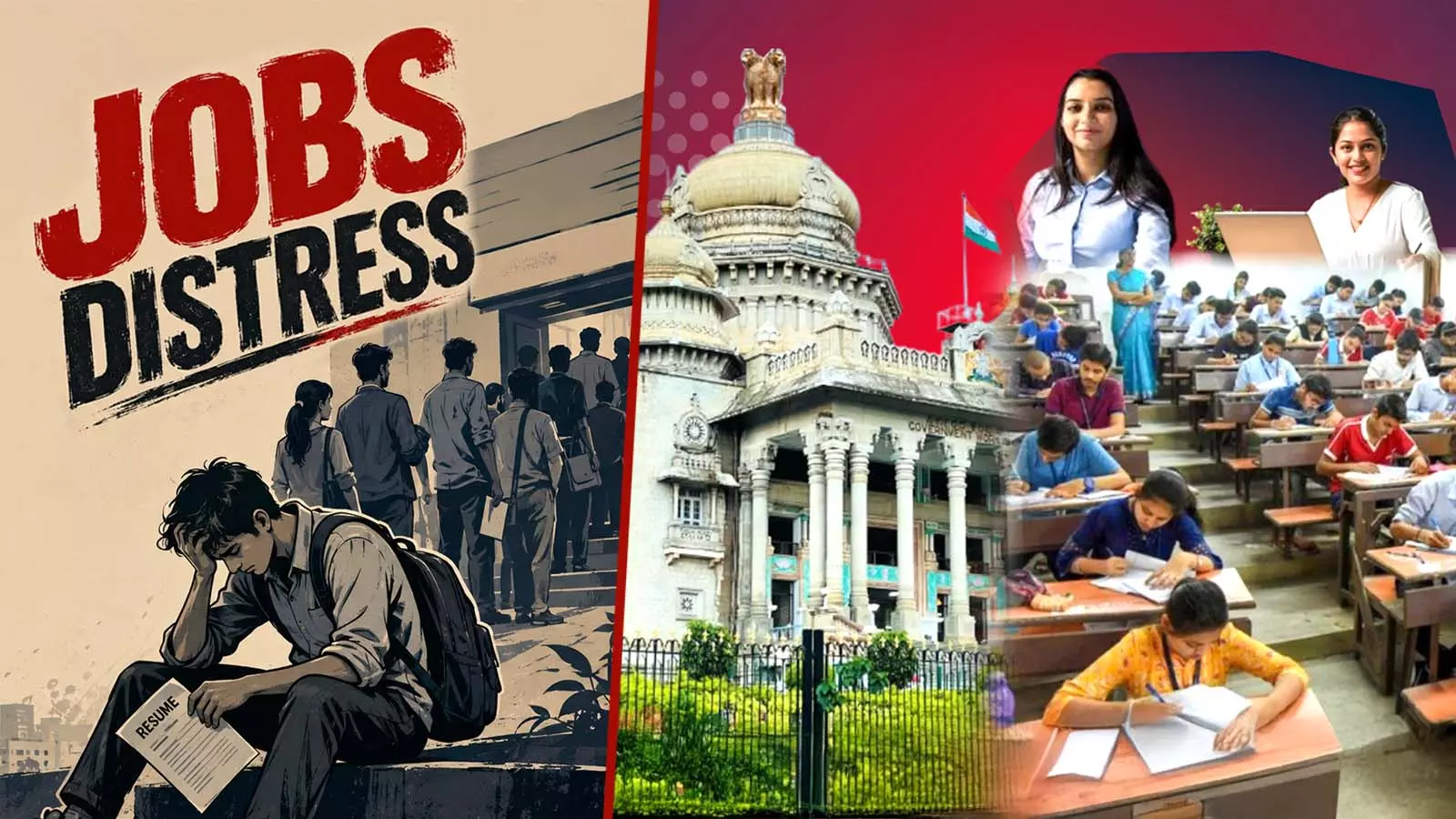
Years of delayed hiring have left millions of educated youth in the country desperate for work. In a tight job market, every government vacancy triggers a massive rush of applicants. Recruitment delay is another sad story altogether.
To fill vacant posts across various departments, the Karnataka government has launched a recruitment drive for 72,186 posts and has already begun issuing department-wise notifications.
Recruitment processes had stalled for five to six years because of irregularities in earlier recruitments and the internal reservation controversy. In the Karnataka Public Service Commission (KPSC), except for the recruitment notification for Karnataka Administrative Service (KAS) posts issued in 2017-18, it conducted no fresh recruitment until 2024.
State govt’s 2-4-6 formula
Recruitment notifications for Police Sub Inspector (PSI) and teacher posts too had not been issued for three to four years due to examination irregularities, investigations, court stays and the internal reservation dispute. Although the Congress government’s decision to commence recruitment, in line with the promise made in its manifesto, has raised hopes among lakhs of unemployed youth, a question remains: will the recruitment process actually be completed within the stipulated time? The reason is administrative and financial approval.
Also read: Supreme Court stays HC order quashing jobs for Karur stampede victims’ kin
The state government has adopted the 2-4-6 formula to speed up recruitment. This means it aims to issue recruitment notifications within two months, conduct examinations within four months and issue appointment orders within six months. However, given the recent functioning of the KPSC, Karnataka Examinations Authority (KEA) and other examination authorities, as well as the Finance Department’s tendency to delay decisions, implementing the 2-4-6 formula itself is a major challenge.
In the past, even when examinations were completed quickly, irregularities in the recruitment process led to cases being taken to court, delaying appointment orders for years. If a similar situation arises now, what will happen to those who cross the upper age limit? Although the state government has granted a five-year relaxation in the age limit, there is now a debate over how much benefit this will actually provide.
What is the status of Finance Department?
The Finance Department, which plays a crucial role in the government's functioning, is now in a difficult position. This is because the state government is spending more than Rs 60,000 crore annually on the five guarantee schemes it has implemented.
Also read: Cauvery row: Karnataka bandh largely peaceful
The government spends Rs 1,31,693 crore on government employees' salaries and pensions. The 2026-27 Budget states that Rs 90,557 crore is being spent on government employees’ salaries and Rs 41,136 crore on pensions. The government spends Rs 53,332 crore annually on interest payments on its debt, and together these expenditures account for 59 per cent of the state’s total revenue receipts.
Following the implementation of the recommendations of the 7th State Pay Commission, there has been a significant increase in the salaries of employees and pensions of retirees. Against this backdrop, the question is whether the state exchequer has sufficient funds to pay salaries and other allowances for the 72,186 new posts being filled.
So far, the Finance Department has given consent only to limited recruitment, mainly in essential services such as health, education and police. If it suddenly approves recruitment for 72,186 posts, ensuring a continuous flow of funds will be a major challenge.
‘Regular reviews needed’
“Recruitment to 72,186 posts is not impossible if it is conducted transparently and within a stipulated timeframe. What is needed is political will and commitment among officials. The fact that the Cabinet has already approved the recruitment of 72,186 posts should be understood as the Finance Department having given its consent,” D Chandrashekharayya, president of the Scheduled Caste-Scheduled Tribe Government Employees’ Association, told The Federal Karnataka.
“In 2023, of the 32,177 posts earmarked for the Kalyana Karnataka region, the Finance Department had given in-principle consent for 80 per cent of them. However, here, 75 per cent of the posts will belong to the Kalyana Karnataka cadre and 25 per cent to the residual cadre. Finance Department approval is not required for posts in the Kalyana Karnataka cadre. Approval is required only for the residual cadre. There is no other problem,” he added.
Further, he said, “If the ministers concerned conduct regular reviews of recruitment, the process will proceed smoothly. Besides, if the legal experts appointed by the government provide accurate and timely information to the courts, there should be no problem. There was considerable delay in the internal reservation issue because the correct information was not provided to the court.”
The state has 2.96 lakh vacant posts. The recruitment process for 72,186 posts has been launched as the first phase. He observed that delays would continue if elected representatives and officials fail to demonstrate commitment.
Lack of political will
The number of vacant posts in the state had risen to 2.96 lakh by 2025. While 79,694 posts are vacant in the Education Department, the Health Department has 37,572 vacancies and the Home Department has 28,188. The Higher Education Department has 13,599 vacancies, the Revenue Department 10,867, and Rural Development and Panchayat Raj 10,504 vacancies.
The state government’s announcement to recruit for 72,186 posts should not remain merely an assurance. Strong political will and disciplined financial management are essential to ensure its implementation.
The government’s challenge can succeed only if senior IAS officers supervise the recruitment process. However, without political and administrative will, the recruitment process is likely to be pushed further into the background. This neglect is one reason recruitment has not taken place over the past five to six years.
The State Government Employees’ Association has been demanding the scrapping of the New Pension Scheme and the restoration of the Old Pension Scheme (OPS). Chief Minister DK Shivakumar has also promised to restore the OPS at a government employees’ convention. If the government restores the OPS, it will impose a substantial long-term financial burden.
Is recruitment possible within the stipulated time?
Only 21 months remain before the current government’s term ends. Given the current situation of KPSC and KEA, completing the process of inviting applications, conducting examinations and releasing key answers itself will be a major challenge. If any examination irregularity reaches the court, it could take at least one to two years to publish the final selection list.
By then, if the election Model Code of Conduct comes into force for the 2028 Assembly elections, the recruitment process will be delayed once again. Naturally, the next government will then have to take over the entire recruitment process. For now, the recruitment drive may have provided some relief to quell anger among the youth, but financial and legal hurdles at the implementation stage could still cause further delays. The government can fulfil its promise only if the examination authorities complete the process transparently and swiftly, without allowing any irregularities. The government’s political will will play a crucial role.
What does the retirement calculation look like?
The state has 5.20 lakh direct government employees. There are 2.50 lakh employees in corporations, boards and authorities, while 4.50 lakh are retired employees.
Around 12,000 to 15,000 employees from various government departments, aided institutions and local bodies retire every year upon reaching the retirement age.
The number of retirements is expected to be higher in the School Education and Literacy Department, Police Department, Health and Family Welfare Department and Revenue Department because these departments have a larger workforce. There would have been no problem if recruitment had been carried out in accordance with retirements. However, since recruitment has not taken place for the past five to six years, the number of vacant posts has grown enormously. This has also slowed down the administrative machinery.
Following the implementation of the 7th Pay Commission in the state, expenditure on around 3,800 Group A posts has increased by 5 per cent under the new pay scales, while expenditure on around 11,400 Group B posts has risen by 15 per cent. Expenditure on around 53,000 Group C posts has increased by 70 per cent, while expenditure on around 7,600 Group D posts has gone up by 10 per cent.
Overall, although the state government has accelerated its recruitment drive, doubts remain about completing the recruitment process in full because of legal hurdles, financial management issues and other challenges. There is also growing talk that further delays could push the remaining recruitment processes to the next government.
You can read part 1 here: Legal twists, endless wait: How Bengal failed a generation of job seekers
Part 2: Scandal after scandal: Is this the end for Karnataka PSC?
Part 3: Kerala PSC faces credibility test over recruitment, exam lapses
Part 4: Telangana's police aspirants fume: Age is catching up, jobs aren't
Part 5: Karnataka's age relaxation for govt jobs: A lifeline too little, too late?