Legal twists, endless wait: How Bengal failed a generation of job seekers
Paper leaks and cancelled exams mask a deeper crisis—youth trapped in joblessness and underemployment, waiting years for posts that never arrive. First part of our Jobs Distress series covers West Bengal

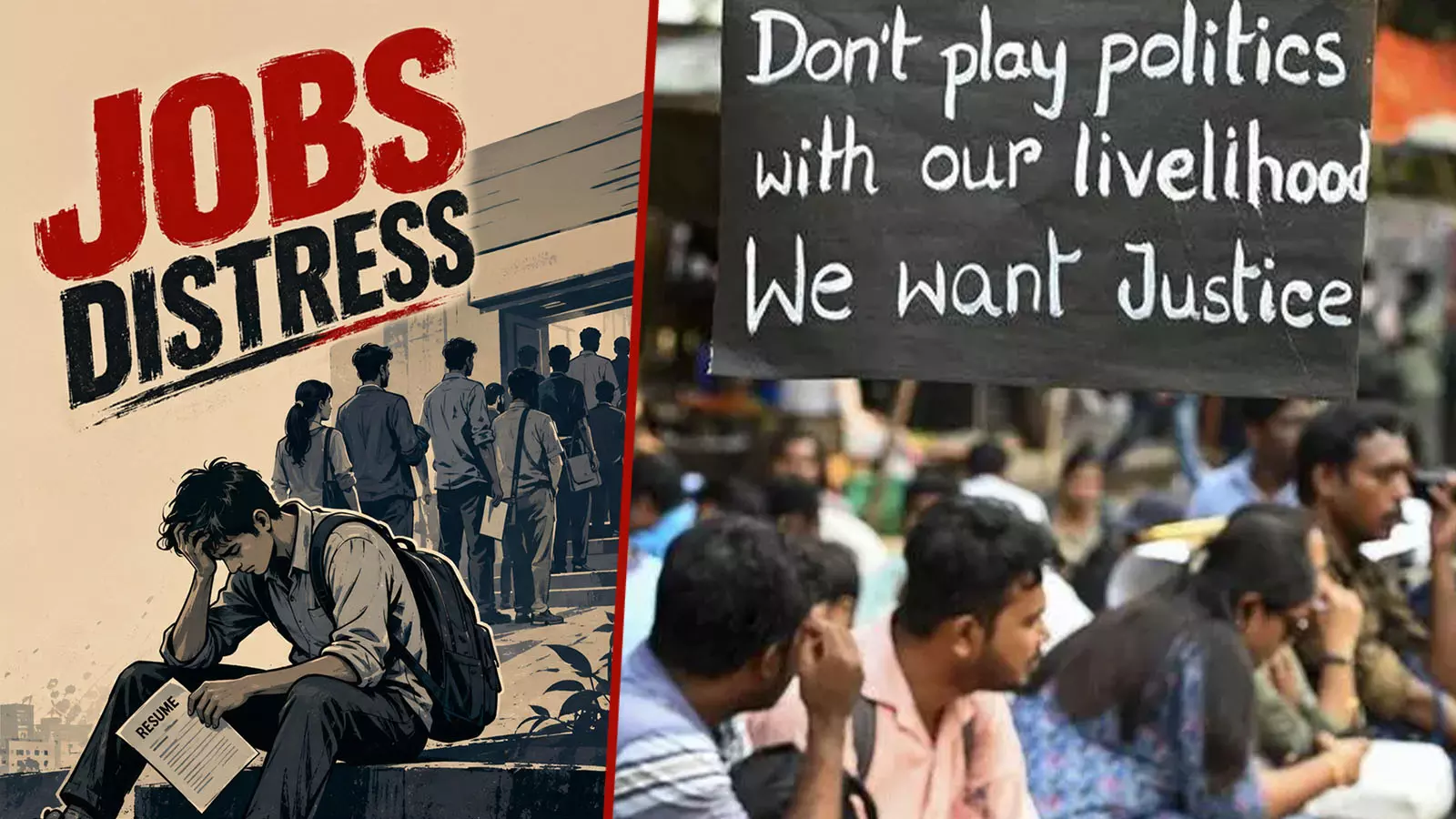
With 25,752 school jobs scrapped, 35,726 vacancies pending and 10 CBI cases unresolved, West Bengal’s hiring machinery has become a labyrinth of delays. And, it's not the only state where young and even middle-aged people are suffering from job distress.
Delhi last month, Jharkhand this month. Behind the rising rage over paper leaks and testing irregularities is one generic condition: high youth unemployment and underemployment. According to the Centre's latest Periodic Labour Force Survey data, India’s overall unemployment rate (for ages 15 and above) stood at around 5.5 per cent, with Gen Z (those born from 1997 to 2012) unemployment rates surging 11 to 15 per cent. What remains hidden behind these figures is underemployment, which is hard to determine precisely.
The state public service commissions and other employment agencies do hold competitive exams, but the outcome is often discouraging. The tests are compromised and cancelled; or the results are challenged in court and cancelled; or the results are not even declared. Sometimes, governments do not make appointments due to lack of funds even though thousands of posts remain vacant.
The result is years of wait, dashed hopes, and lost dreams. By the time the posts are announced, if at all, many candidates cross the age limit. To make ends meet, successful candidates gradually slide into other forms of employment. The luckier ones take up private jobs with a lower pay, while the not-so-lucky ones make do with odd jobs and even menial labour. Whether it’s Gen Z or millennials or even Gen X, India is losing generations waiting for their turn to come.
The Federal is bringing you a series of text and video stories on the employment distress across states. Here is the first off the block, from Bengal.
Sauntering along the narrow, winding footpaths and unpaved cart tracks, Dulali Hemram no longer pauses to admire the patches of emerald green that dot Gumai, a quaint tribal village in West Bengal’s West Midnapore district.
“Once, these paddy fields symbolised a better future. I was then full of dreams. Now I have lost all hope and stopped dreaming. I feel like I am slipping into depression,” Hemram said.
Her hopelessness stems from years of delays in West Bengal’s recruitment system, shaken by allegations of corruption, irregularities and prolonged legal battles.
Embroiled in a court battle and facing an endless wait for a teaching job, Hemram said she has already spent around Rs 60,000 that she painstakingly saved from her B.P.Ed. scholarship.
Lost in litigation: A decade and counting
Her ordeal began after she cleared the 2016 State Level Selection Test (SLST) for upper-primary physical education posts, for which the examination was held in 2017. By 2018, candidates, including Hemram, had completed document verification and personality tests.
But the recruitment process soon got bogged down by litigation. Some candidates challenged how the School Service Commission (SSC) prepared the interview list and dealt with vacancies. One key grievance was that the Commission had failed to disclose marks and other details required under the existing rule.
The Calcutta High Court later allowed the recruitment process to resume, subject to greater transparency. By then, 890 of the 1,693 recommended candidates had joined, leaving hundreds still waiting.
Also read: BJP workers block Ranchi roads, burn tyres over police crackdown on students
The panel expired on December 11, 2019. In 2022, the state government sought to accommodate the remaining candidates by creating 1,600 supernumerary posts, including 850 for physical education. The SSC began counselling candidates that October.
But the legal uncertainty continued. On December 4, 2025, the high court cancelled all 1,600 posts, ruling that an expired recruitment panel could not be revived through newly created posts.
Hemram and other wait-listed candidates have challenged the order, seeking to preserve their jobs. “I am tired of this prolonged battle. It has drained my energy, as well as whatever little resources I have. Travelling to Kolkata frequently from our village takes time and money. For poor people like us, it is a huge ask,” Hemram, 36, told The Federal.
Her responsibilities extend beyond her own struggle. She looks after her ageing parents and an autistic brother. The family survives on their Rs 1,000 monthly pensions, while Hemram takes up odd jobs.
Lost opportunities
Sheikh Jamal, from Kalanabagram village in East Burdwan district, has a similar story. A victim of the 2016 recruitment panel cancellation, he too has spent years waiting for an appointment.
Now 45, Jamal works as a driver, taking up assignments whenever people hire him to drive their vehicles. The work is irregular but helps him make ends meet while he waits for the government job he has pursued for years.
Decades of wait
SLST Upper-Primary Physical Education (2016)
2017: Exam held
2018: Verification/Personality test
Dec 11, 2019: Panel expired
Recommended vacancies: 1,693
Joined: 890
Dec 4, 2025: High Court cancelled 1,600 supernumerary posts created in 2022. Wait-listed candidates challenge the order.
SSC 2016 School Teachers & Non-Teaching Staff
2016: Recruitment issued
April 2025: Supreme Court cancels entire process due to widespread fraud and manipulation.
Affected: 25,752 appointments
Newly identified vacancies: 35,726
Applications: ~5.8 Lakh
Appeared: 3.19 Lakh (1st round); counselling and selection rounds underway.
Madrasah Group D Employees
2010: Notification
2011: Exam held
July 2025: High Court order
Posts: 292
July 2025: High Court resolved 15 years of legal disputes, directing the Madrasah Service Commission to complete appointments in 3 weeks.
The BJP government has raised the upper age limit for state government jobs to 45 years for Group C and D posts, but the relaxation is valid for only two years. For Jamal, who has already reached 45, the window is closing fast. If he fails to secure an appointment from the 2016 recruitment process, the government job he has spent years waiting for could be a lost dream.
The experiences of Hemram and Jamal illustrate a wider problem confronting thousands of government job aspirants in West Bengal.
New government, new announcement
Recruitment processes have been delayed by administrative gaps, court challenges and allegations of irregularities.
Some candidates have waited years between an examination and an appointment. Others have crossed the age limit while waiting for another opportunity.
Also read: Crackdown and counter-rallies: How NEET protest led to political showdown in Bengal
The state’s new BJP government has announced plans to fill one lakh government posts—50,000 in education, 20,000 in police and 30,000 across other departments. It has also said 33 per cent of these posts will be reserved for women.
The announcement comes against the backdrop of a recruitment system badly disrupted in several key sectors, particularly education, which accounts for half of the government’s proposed new posts.
Fresh recruitments, intense competition
In April 2025, the Supreme Court cancelled the 2016 recruitment process for 25,752 teachers and non-teaching staff in state-aided schools, finding the selection process irreparably tainted by manipulation and fraud.
The cancellation affected those appointed as well as candidates waiting for jobs.
The SSC subsequently identified 35,726 teaching vacancies. Around 5.8 lakh applications were received, while 3.19 lakh candidates appeared for the first major round.
Competition is similarly intense outside teaching. Around 6.8 lakh candidates appeared for the Group D examination in March 2026 for just over 5,400 vacancies, from more than 8.17 lakh applications. That means roughly 125 candidates competed for every post.
In July 2025, the high court cleared the way for the appointment of 292 Group D employees in state-run madrasas. The recruitment notification had been issued in 2010 and the examination held in 2011. Legal challenges kept the process unresolved for around 15 years before the court directed the Madrasah Service Commission to complete the recruitment within three weeks.
Also read: How CJP protest spread to UK, USA, Europe, got Indian diaspora's support
Matiul Rahman, a candidate from Malda, was 34 when he applied for the 2016 school recruitment examination. His name was sixth on the waiting list for chemistry at the higher-secondary level. By 2025, he was 44 and could no longer apply under the then rules governing the new recruitment.
The BJP government has raised the upper age limits to 41 years for Group A, 44 for Group B and 45 for Group C and D. But age relaxation cannot restore years lost to delayed recruitment.
Selection not end of worry
The WBCS Clerkship Examination 2023 was held in November 2024. Its Part I result was published in October 2025, with 89,821 candidates qualifying for the second stage, held in December.
Police recruitment has also faced delays and legal challenges. The 2024 recruitment process for 11,749 constable posts has been the subject of cases before the Calcutta high court, with candidates challenging aspects of the selection process.
Even after selection, candidates can face further delays as litigation remains another major source of uncertainty.
As of now, 10 CBI-probed cases involving alleged irregularities in recruitment and entrance examinations in West Bengal were awaiting trial despite completion of investigations.
The investigating agency has been considering approaches to high courts for transferring long-pending examination-fraud cases to special fast-track courts, with the aim of speeding up cases under the amended Public Examinations (Prevention of Unfair Means) law, according to CBI sources.
Also read: CJP announces nationwide ‘listening tour’ after NEET protest success
For those caught in recruitment limbo, waiting is rarely cost-free, as the experiences of Dulali Hemram and Sheikh Jamal illustrate.
Some continue preparing for government jobs well into their thirties. Others take private-sector jobs, often for lower salaries and with less job security, while continuing to wait for the government appointments they had earned.
BJP government's recruitment plans
Plans to fill: 1 lakh posts
Education: 50,000
Police: 20,000
Other departments: 30,000
Reservation for women: 33 per cent
Revised upper age limits:
Group A: 41 Years
Group B: 44 Years
Group C & Group D: 45 Years
An issue beyond vacancies
West Bengal’s recruitment crisis is consequently not simply about the number of vacant government posts. It is about how efficiently the state moves from identifying a vacancy to issuing an appointment letter.
“The government’s one-lakh recruitment plan gives it an opportunity to address part of the backlog. But the larger test will be whether the process becomes predictable,” said veteran journalist and political commentator Amal Sarkar.
That, he said, would require vacancies to be identified in time and clear schedules to be set for applications, examinations, results and appointments. It would also require safeguards for candidates who lose their eligibility because recruitment is delayed.
Also read: NEET protests: Delhi lit the spark, and small towns, cities are keeping it burning
The 15-year madrasa delay, cancellation of the 2016 recruitment panel, cancellation of 25,752 school appointments, 35,726 fresh teaching vacancies, competition for 5,400 Group D posts, 11,749 police vacancies and 10 CBI-probed cases point to a common weakness. Recruitment can take too long to move from a notified vacancy to an actual appointment.
For an aspirant, the consequences are measured in years.
For people like Hemram and Jamal, the real measure of change will therefore not be the number of government posts announced.
It will be the time between an examination and an appointment letter.
You can read the second part here: Scandal after scandal: Is this the end for Karnataka PSC?
And the third part from Kerala