SCO may be a pro-China club but India still needs to be there
The SCO may be China‑dominated, yet India’s seat at the table ensures visibility and leverage as global alliances fracture and new orders take shape

There is a fierce debate within India’s strategic community over the usefulness of being a member of the China-dominated Shanghai Cooperation Organisation (SCO) that is currently celebrating 25 years of existence. Prime Minister Narendra Modi is in Bishkek attending the summit. What does the SCO offer India, critics ask.
At a time of global flux, accelerated by US President Donald Trump’s disruptive approach to alliances and trade, uncertainty over the future of the Western order, China’s rise, and Russia’s repositioning have made the old binaries less convincing. At the moment, no nation is certain of what kind of global architecture would finally emerge; there is strategic mistrust all around.
Semblance of unity keeps US on its toes
The US, while remaining the most powerful economic and military power, is showing signs of decline. In these circumstances, every country is looking to hedge its bets. Both the SCO and BRICS are arrangements that give India a push to keep its strategic autonomy intact. So despite India’s often half-hearted participation in these groupings, they allow New Delhi to have a foot in both camps.
Also read: Modi, Putin, Xi's bonding steals spotlight at SCO; Pakistan's Shehbaz sidelined
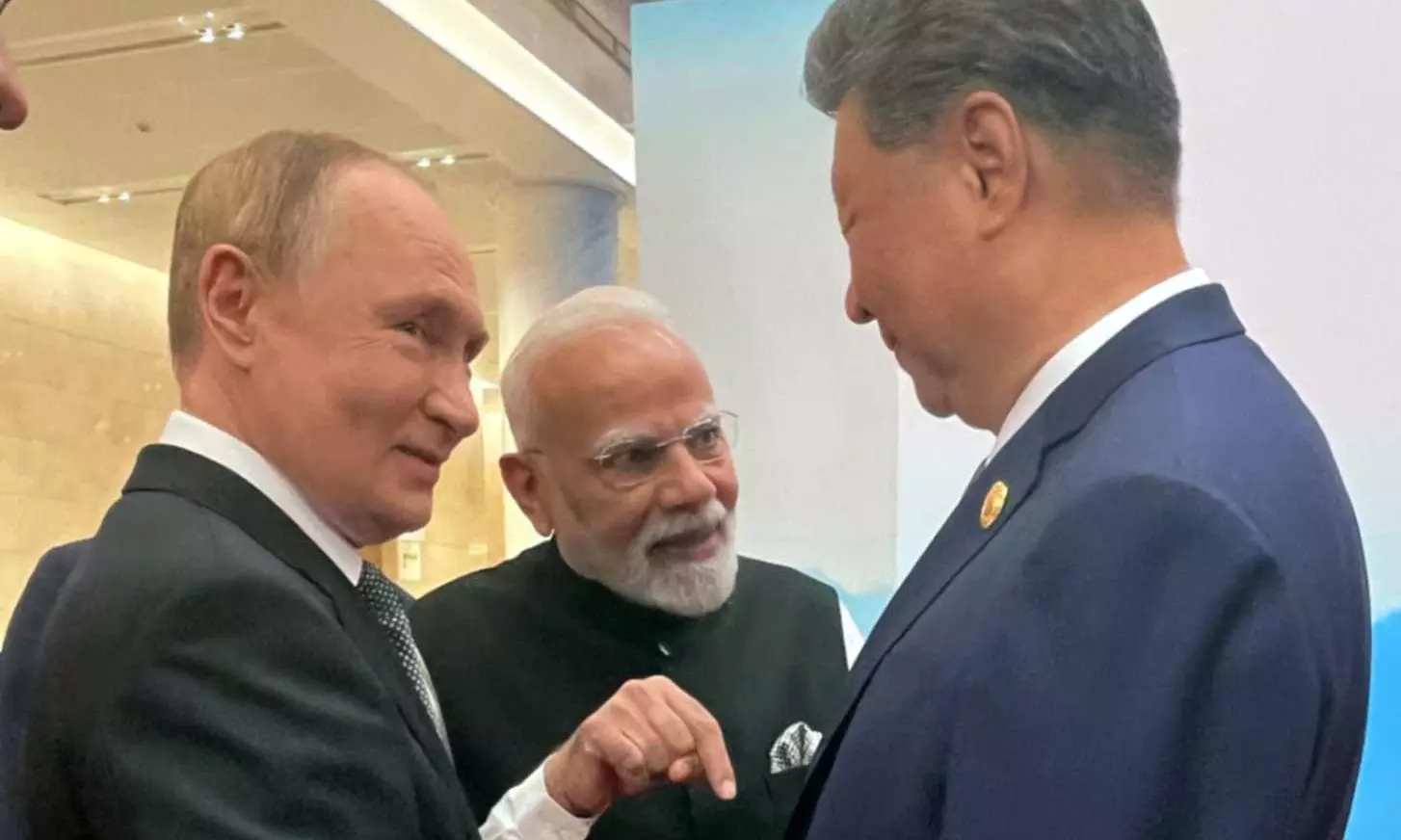
Last year, when India-US ties were at its lowest, the photograph taken during the SCO summit in Tianjin of Prime Minister Narendra Modi, Russian President Vladimir Putin, and Chinese President Xi Jinping, warmly chatting and laughing together, sent a message across to the US. India had options.
This is surely not the time to break away from any alliance as suggested by those who believe that India’s interests are best served by aligning with the US-Israel and the Western world. Even arch rivals India and China are trying to resolve their differences. Last month’s meeting between NSA Ajit Doval and Chinese foreign minister Wang Yi in Beijing for the 25th round of Special Representatives’ talks on the boundary question, talked of “early harvest” though no details are available. This underpins the fact that in the current churn happening across the globe, every nation is looking to hedge its bets.
Push for multi-polarity in unipolar world
But sceptics are not convinced. They say the SCO has little to offer New Delhi, as it is at heart China’s baby, despite the presence of Russia, India’s traditional ally. Those who are against it see India’s future closely aligned to the US-led Western alliance, which the SCO seeks to challenge.
In fact, the SCO was formed in June 2001 by China and Russia to keep the US and Western allies out of the newly independent Central Asian Republics. It was also a means to push for multi-polarity in a unipolar world that had emerged with the breakup of the former Soviet Union in 1991.
Also read: PM Modi at SCO Summit: Countries backing terrorism must get ‘firm message’
The SCO was the successor to the Shanghai Five formed in 1996. Yet the SCO has not been able to convince even its members that the grouping is in a position right now to challenge the Western financial stranglehold over the world economy.
Significant, though not cohesive
Most Central Asian nations do not look at the SCO from an ideological prism. “For them, it is one component of a broader multi-vector foreign policy that allows them to engage China and Russia while maintaining ties with the West and other regional powers,” said Ali Mamadov, Washington-based scholar and analyst of the George Mason University, Schar School of Policy and Government.
“I would distinguish between the SCO contributing to a more multipolar international order and actually emerging as a coherent rival to the Western-led system. Its geopolitical weight is certainly growing, but its expansion also makes internal consensus more difficult,” Mammadov explained. India, China, Pakistan and Iran, for instance, bring very different interests and strategic relationships into the organization. In that sense, the SCO becomes more significant as it expands, but not necessarily more cohesive, Mammadov added.
Why India must remain in SCO
Analysts in India opposed to the SCO point to the fact that India can do little in an increasingly China-centric grouping. India cannot shape its connectivity agenda. The economic payoff for New Delhi is minimal. The presence of Pakistan, China’s all weather friend, makes it even more unpalatable to many Indian analysts.
“Those who argue that India does not gain much from SCO and, therefore, the best option for India is to fortify further the links with Israel, the US, and the rest of the West, perhaps do not understand the evolving geopolitics of our times where out of the three great powers—America, China, and Russia—two are together and hence they outweigh the third,” said retired ambassador KP Fabian.
Also read: Why upcoming SCO and BRICS summits are thorny for India
The SCO may be China-dominated. It may never become an instrument through which India can advance all its interests. The organisation is valuable precisely because it brings India into the same room as China, Russia, the Central Asian republics and other powers at a moment when the world’s geopolitical map is being redrawn.
“It is important for India to remain in the SCO, if for nothing else but to get a sense of what is being discussed,” said Sanjay Baru, a former media adviser to the late Manmohan Singh.
India, the balancing factor
India and Central Asian nations both gain by being part of the SCO. New Delhi’s presence gives Central Asian states greater strategic room for manoeuvre. “They may not view India explicitly as a counterweight to China, but its participation helps prevent the SCO from becoming an exclusively Chinese or anti-Western geopolitical platform,” said Mammadov.
India may never be able to shape the SCO in its own image, nor should it have any illusions about China’s dominance of the organisation, yet at a time of strategic uncertainty, India cannot afford to reduce its options.