



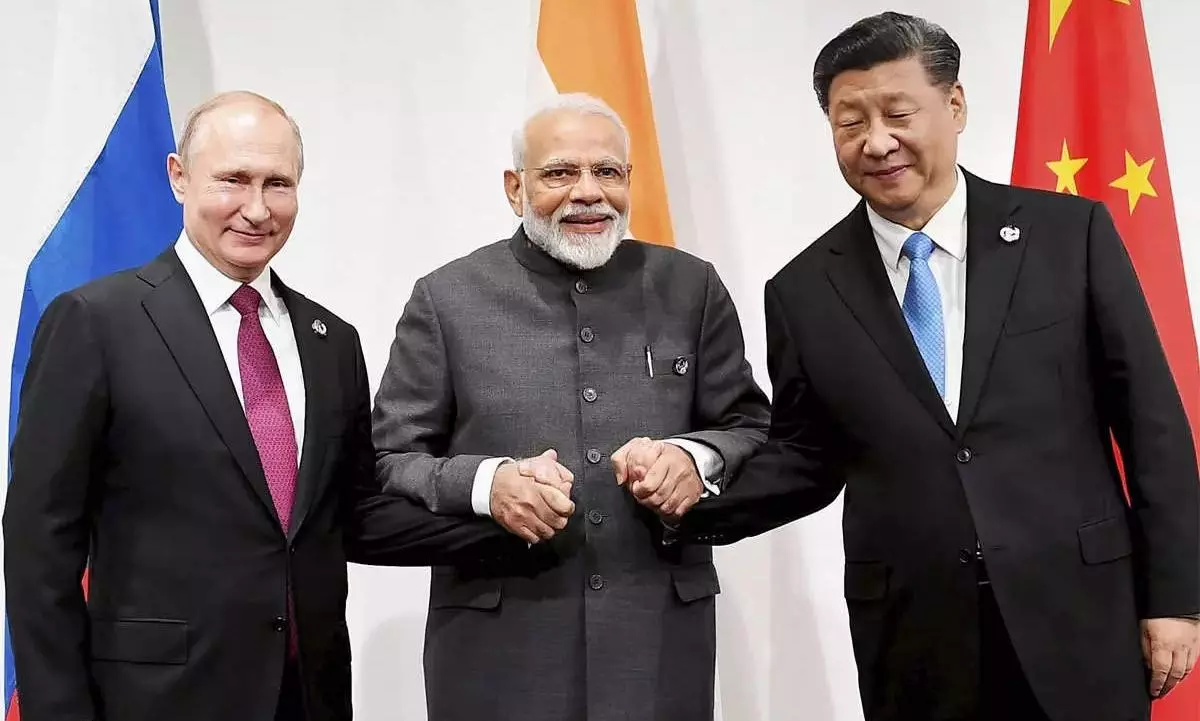
India enters summit season balancing terror concerns at SCO and trade cooperation at BRICS, navigating tensions with Pakistan, China, and global power blocs
Prime Minister Narendra Modi will be attending the 25th Shanghai Cooperation Organisation (SCO) summit at Bishkek, capital of Kyrgyzstan, on August 31/September with its nine other member representatives, and later, on September 12-13, he will play host to the 11-member BRICS nations, including Brazil, Russia, China, South Africa, Indonesia, Iran, Egypt, Ethiopia, Saudi Arabia, the United Arab Emirates, besides India.
For India, the SCO is quite prickly because of the presence of Pakistan. Both countries were accorded full membership in 2017. India’s main interest in SCO is its anti-terrorism component, which is institutionalised in the Tashkent-based Regional Anti-Terrorist Structure (RATS). India uses the SCO forum to focus on the anti-terrorism, with a tacit reference to Pakistan.
The Central Asian connect
The anti-terror aspect of SCO, when it was initially conceived in 2000, was that faced by the Central Asian republics of Kazakhstan, Kyrgyz, Tajikistan, and Uzbekistan. Russia and China have a stake in preventing the emergence of Islamist terror groups in these countries. SCO member states have national representatives at the RATS Executive Committee as well as the Beijing-based SCO Secretariat.
Also read: Ajit Doval, Wang Yi hold India-China talks on border, bilateral ties
When the Soviet Union fell in 1991, there was flurry of activity in New Delhi to connect with the Central Asian republics, which became known as the Commonwealth of Independent States (CIS). But the effort tapered off due to the developments in Afghanistan and the Taliban takeover of the country.
There are plans of oil pipelines from Kazakhstan, but they could not be carried through because of the hostile governments in Kabul and Islamabad. Now that the Taliban in their second avatar have been more New Delhi-friendly, there could be possibilities of reviving the Central Asian connect in general, if not of the oil pipeline.
The thorn in the flesh
India’s hopes of exerting pressure on Pakistan against providing a haven for anti-India jihadist groups has not met with success because of the strong support from China. The Central Asian republican governments are uncomfortable with the militant jihadi phenomenon. Prime Minister Modi has made it a point to attend every SCO summit, which is a necessary gesture to keep the issue of terrorism alive, even if it is on a backburner.
Though the SCO has its economic dimension, its basic agenda centres around terrorism, and by implication, it is jihadi terrorism because all of the central Asian member states of the SCO are Muslim. In a way, the apprehensions of these republics about terrorism is a source of comfort for India, and it is a reality check for Pakistan.
Also read: Trump's new economic squeeze on Iran has big challenge: China
There is the irony that Islamabad is engaged in fighting its homegrown jihadi groups like the Tehreek-e-Taliban Pakistan (TTP), and Pakistan points an accusing finger at the Taliban government in Kabul for supporting TTP. But it is not willing to shut the shops of Lashkar-e-Taiyyaba (LeT), Jaish-e-Mohammed (JeM), because these two organisations are part of Pakistan’s Kashmir policy. It becomes necessary for India to be on a constant vigil on the India-Pakistan border as well as in international fora.
The US-Israel factor
Though the BRICS has no security dimension, and it is essentially based on economic cooperation and collaboration, there is the ideological dimension and the aspect of power politics attached to it. Brazil, Russia, China and South Africa are not on good terms with the United States, especially under President Donald Trump. South Africa and Brazil have taken a strong stand against Israel over Israel’s role in the death of more than 70,000 civilians, including women and children. BRICS also includes Iran, as well as Saudi Arabia and the United Arab Emirates, with the two Gulf Arab states ranged against Iran.
India is acutely aware of the tense equations between members of BRICS and the United States as well as Israel. India has been quite assertive about its equation with Israel. Though India has its own reservations about Trump’s tariffs on Indian exports, it has not taken an adversarial stance against Washington. Critics of Modi government do point out the pro-Israel, pro-US position of India. But it has not prevented the government from maintaining its key diplomatic and economic relations with the others in BRICS, like South Africa and Brazil, who are critical of the US and opposed to Israel.
Balancing act
As the largest democracy and as one of the major economies, India recognizes the need to work along with countries and governments with whose policies it does not agree on many things. The attempt is not to push the differences under the carpet but to manage the divergences and work towards a common agenda.
Also read: As China salami-slices at LAC, India must not decouple border from bilateral ties
India likes to emphasize the dangers of terrorism but it will not leave the SCO in a huff because the other members do not perceive the threat in the same way. Nor will they pressure Islamabad in the matter, which is what India would like to see happen. India wants to stay in the SCO and try to persuade its members about the need for a common strategy against terrorism.
There will be moments of dissatisfaction but India would not allow that to result in diplomatic frustration. Similarly, India is quite keen that BRICS should not be seen as an anti-American group when it comes to global trade while continuing to push for greater intra-BRICS cooperation and trade alignment.
Going it alone
In many ways, India wants to steer its own path, unencumbered by alliance compulsions. It is the reason why India stayed out of the Cold War group-ism. India wanted to work with like-minded countries, and it would come as a surprise that former prime minister Jawaharlal Nehru was not keen about either the 1955 Bandung Afro-Asian Conference or the Non-Aligned Movement (NAM) at Belgrade in 1961.
Also read: US efforts to curb India-Russia ties will backfire, says Putin in strong remarks
India is not a superpower, but it does not feel like it’s jostling for space in groups. From Nehru to Manmohan Singh, Congress governments wanted to go alone. Without uttering the word “Vishwaguru”, independent India’s leaders felt that India had much to offer the world in terms of values and vision.
(The Federal seeks to present views and opinions from all sides of the spectrum. The information, ideas or opinions in the articles are of the author and do not necessarily reflect the views of The Federal.)
