



Why EOS-05 launch is more than just another rocket mission for ISRO
With GISAT‑1 lost and string of mission failures haunting ISRO, EOS‑05 on GSLV‑Mk II is more than a mission—it’s a test of credibility and strategic capability

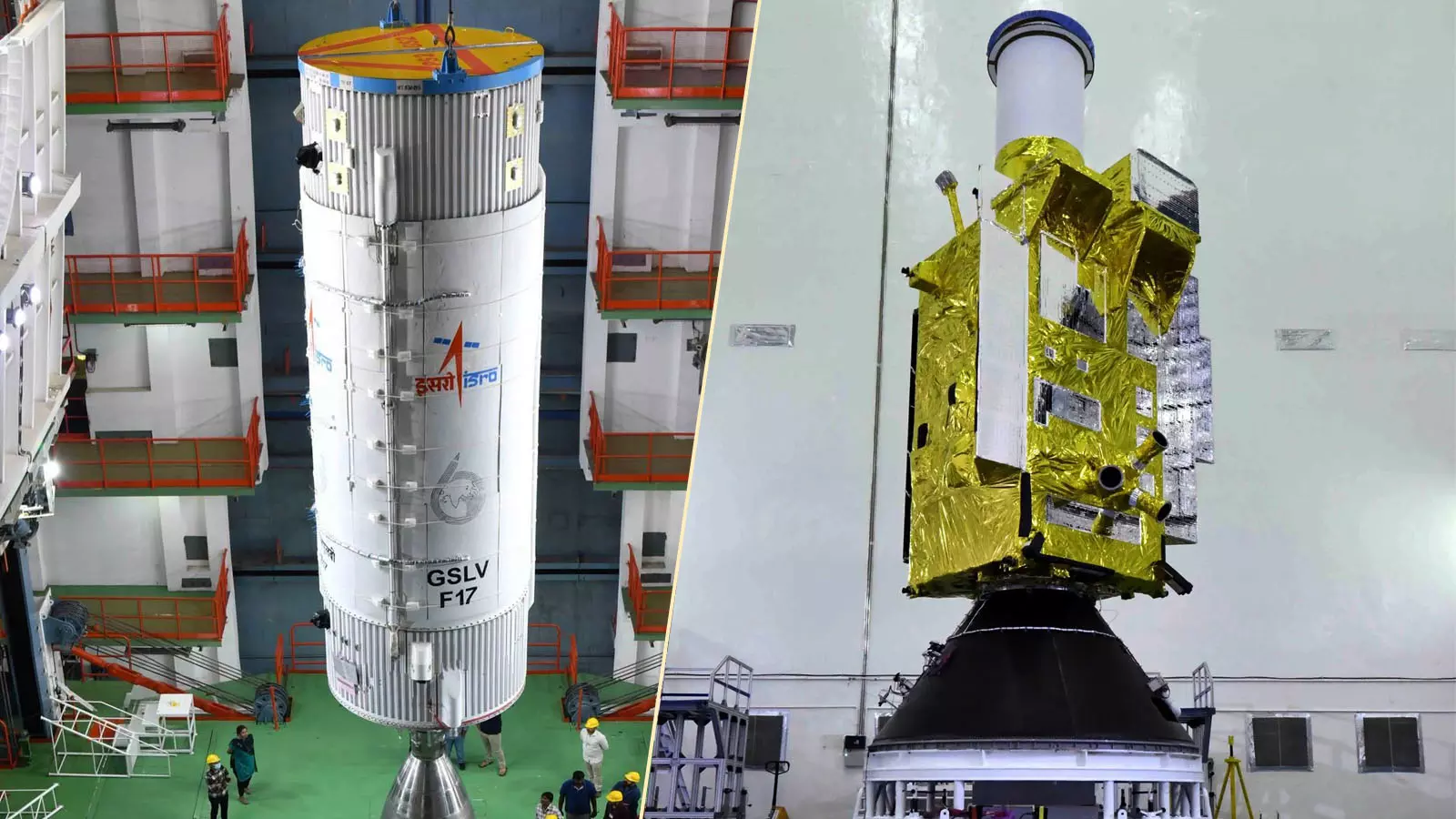
A lot of things—and not just the country’s strategic geo-imaging satellite GISAT-1A or Earth Observation Satellite EOS-05—will be riding for the Indian Space Research Organisation (ISRO) on its Geosynchronous Satellite Launch Vehicle-Mk II (GSLV-Mk II), which is reportedly expected to fly soon.
The upcoming mission comes after a string of setbacks involving India’s strategic satellites, resignation of several scientists, transfer of rocket and satellite technologies to the private sector, and other developments.
The GISAT-1A is a much-delayed replacement for GISAT-1, which was lost way back in August 2021, midway during the rocket’s flight. Curiously, it is still not known why there has been a five-year delay in sending up the strategic replacement satellite.
Also read: IN-SPACe overreach threatens ISRO's strategic future: G Madhavan Nair
The Indian space agency has been conspicuously silent on the reasons—whether it was due to pay load development, satellite manufacturing, changes in satellite specifications between GISAT-1 and GISAT-1A, non-availability of rocket, or other reasons.
ISRO not agile enough to make ‘agile geo-imaging satellite’
The Indian space agency describes EOS-05 as an “agile geo-imaging satellite” intended to provide near-real-time images of large areas at frequent intervals from a geostationary orbit. It is primarily meant for imaging natural resources and disaster events under cloud-free conditions.
The importance of such a satellite lies in its geostationary location.
Unlike conventional Earth-observation satellites in lower orbits, a geo-imaging satellite can repeatedly observe a large area, making it particularly useful for monitoring rapidly changing events and providing frequent images of a region of interest.
A former ISRO chairman said any satellite with a camera can be used for several purposes and so all can be, in a way, called strategic satellites.
The EOS-05 mission comes at a time when ISRO is sort of facing a structural transition—manufacturing technologies for its rockets and satellites being transferred to the private sector, the entry of private players, large-scale exodus of employees from strategic projects, and the government’s decision that the organisation should focus on research and development and major scientific missions.
Also read: ISRO's strategic satellite delays expose cracks in India's space readiness
Coupled with this is a string of failures involving strategically important missions, starting with GISAT-1 in 2021.
The delay in EOS-05 becomes particularly interesting because the satellite was not a recent addition to ISRO’s programme. Yet the satellite did not fly in 2022, 2023, 2024 or 2025.
The mission was subsequently associated with GSLV-F17 and was targeted for the fourth quarter of 2025–26. The latest ISRO Annual Report again listed GSLV-F17/EOS-05 as a mission planned for the fourth quarter of 2025–26.
That target too has passed.
What remains unclear is what caused the repeated slippage—whether it was related to satellite realisation, launch-vehicle readiness, payload integration, mission priorities or some combination of factors.
For a space programme where schedules are often revised for technical and operational reasons, the absence of a publicly stated explanation is noteworthy.
A string of strategic mission failures
India’s strategic space programme has suffered a series of setbacks involving both launch vehicles and satellites. Several navigation satellites have already lost full capability because of failures involving imported atomic clocks.
Many within the space sector trace the beginning of this difficult phase to the failure of the GISAT-1 mission in August 2021. The 2,268-kg GISAT-1 satellite was lost after the GSLV Mk II experienced a malfunction in its cryogenic upper stage.
Also read: ISRO’s PSLV failure: Who pays when rocket missions go wrong?
The three-stage rocket had already suffered two launch postponements because of technical glitches before finally lifting off.
ISRO's Failure Analysis Committee concluded that leakage through the Vent and Relief Valve resulted in abnormally low liquid hydrogen tank pressure during ignition of the cryogenic stage. The resulting malfunction of the Fuel Booster Turbo Pump eventually led to mission failure.
It would, however, be wrong to suggest that India’s space programme has been marked only by failures. ISRO has successfully flown several important missions during the same period. Following that setback, ISRO successfully used the GSLV Mk II to launch NVS-01, NVS-02, INSAT-3DS and the Indo-US NISAR satellite.
The concern is, therefore, not the existence of failures by itself, but the repeated setbacks involving satellites and missions of strategic significance.
GSLV-Mk II’s success rate hinders offer to private sector?
The GSLV Mk II rocket that will carry to space the GISAT-1A or EOS-05 ranks third amongst ISRO’s rockets in terms of success percentage.
ISRO developed the three-stage GSLV-Mk II rocket has a success rate of about 83.33 per cent since it started flying in April 2010. Out of the 12 times ISRO has flown GSLV-Mk II with its satellites till date, the rocket was successful 10 times and failed twice.
Perhaps that is one reason why the question of transferring GSLV-Mk II technology to private industry is different from that of other launch vehicles.
ISRO’s two other rockets, the Polar Satellite Launch Vehicle (PSLV) and LVM3, with success rates of over 90 per cent and 100 per cent respectively, are on offer for private-sector participation.
On the other hand, the technology for ISRO’s small rocket, Small Satellite Launch Vehicle (SSLV), with a 66 per cent success rate, has been agreed to be transferred to Hindustan Aeronautics Ltd (HAL).
The contrast raises an obvious question: As ISRO increasingly transfers manufacturing responsibilities and technologies to private industry, which launch systems should remain under the agency’s direct control, particularly when they carry strategically important payloads?
NVS-02 could not reach its intended orbit
The next major setback came with the launch of NVS-02.
Launched on January 29, 2025, during what was celebrated as the 100th rocket launch from Sriharikota, the Rs 300-crore navigation satellite was successfully injected into Geosynchronous Transfer Orbit by another Rs 300-crore GSLV Mk II.
However, the satellite failed to reach its designated geostationary orbit because the oxidiser valves required for orbit-raising operations failed to open.
ISRO acknowledged the problem but never explained why the valves failed.
Satellite experts believe the problem may have originated in the electrical connector supplying power to the oxidiser valve.
Also read: Modi govt emasculating ISRO through aggressive privatisation agenda: Congress
Ordinarily, mission-critical systems on launch vehicles and satellites are designed with complete redundancy. Officials familiar with satellite systems had earlier told this writer that the valves, electronics and power systems all possessed redundant backups.
For crewed missions, critical systems generally incorporate three or four levels of redundancy. Equally important, redundant systems should remain completely independent and not converge through a common failure point.
Industry experts say critical components should also be sourced from different vendors to minimise batch-related risks. If these principles were followed, what prevented power from reaching the oxidiser valve?
A retired senior official of ISRO opined that both the primary and redundant power supplies might have passed through the same connector, effectively defeating the objective of complete redundancy.
Back-to-back failures raise questions
Even more disturbing for India’s space establishment were the back-to-back failures of two PSLV missions carrying strategically important satellites.
On May 18, 2025, PSLV-C61 failed about six minutes after lift-off, resulting in the loss of the EOS-09 (RISAT-1B) surveillance satellite and the launch vehicle. The combined loss was estimated at around Rs 850 crore.
EOS-09 carried a Synthetic Aperture Radar capable of all-weather surveillance and was intended to significantly strengthen India's strategic observation capability.
Also read: TN rocket port in private hands: Is IN-SPACe becoming Centre’s space privatisation arm?
A retired senior ISRO official suggested the PSLV-C61 failure may have originated from a faulty valve or electrical connector that resulted in loss of pressure during third-stage operation.
Less than eight months later, on January 12, 2026, PSLV-C62 also failed.
The rocket was carrying Anvesha (EOS-N1), DRDO’s latest hyperspectral reconnaissance satellite, along with 15 smaller Indian and foreign satellites.
Anvesha was equipped with advanced hyperspectral sensors capable of identifying objects and materials invisible to conventional optical systems.
ISRO Chairman Dr V Narayanan said the rocket developed a disturbance towards the end of third-stage performance, causing deviation from its intended flight path.
A rocket expert familiar with PSLV missions told this writer that the failure appeared strikingly similar to PSLV-C61.
“There is simply too much coincidence in back-to-back failures involving missions critical to national security,” remarked a retired senior ISRO official.
Failure reports kept secret
Following the PSLV-C62 failure, the Government of India constituted a high-level committee headed by former principal scientific adviser K Vijayraghavan, with former ISRO chairman S Somanath serving as co-chairman.
The move came after National Security Adviser Ajit Doval quietly visited the Vikram Sarabhai Space Centre in Thiruvananthapuram.
Also read: Why are top scientists quitting ISRO?
Although the Failure Analysis Committees investigating PSLV-C61 and PSLV-C62 have reportedly submitted their reports, they have not been released publicly, unlike previous ISRO failure reports.
That departure from past practice has raised fresh questions within the space community.
Officials had earlier told this writer that discussions relating to PSLV-related corrective measures are now being conducted strictly on a “need-to-know” basis.
The repeated failures are worrying not merely because of their financial implications but because they directly affect India’s strategic capabilities.
More than just another launch
Therefore, the upcoming launch for ISRO and its top management is something crucial and not yet another space mission.
For, the upcoming launch comes after the costly failures of strategic satellites—Earth observation satellite EOS-09 on May 18, 2025, with a loss of about Rs 850 crore, and navigation satellite NVS-02 on January 29, 2025, involving about Rs 300 crore.
The loss of these critical satellites—especially NVS-02, which was meant to replace the ageing IRNSS-1E in India’s regional navigation system—represents not just a technical failure but a strategic one.
The financial cost of the failed launches, including replacements and lost opportunities, could run into hundreds of crores, and one must also factor in the opportunity cost.
In 2017, another navigation satellite, IRNSS-1H, was lost as the Polar Satellite Launch Vehicle’s (PSLV) heat shield did not separate, trapping the satellite inside. ISRO later attributed the problem to a malfunction in the pyro separation system.
Also read: Centre changes ISRO resignation rules amid exodus of experienced scientists
But on July 30, 2025, ISRO successfully launched the Indo-US joint satellite project NISAR, said to be the costliest Earth observation satellite, involving an outlay of about USD 1.5 billion.
Against this backdrop, the successful launch of about 2,367 kg EOS-05 will have significance well beyond putting another satellite into orbit.
One of the notable aspects of this mission is that the satellite will be ejected at sub-geo-synchronous transfer orbit—an intermediate elliptical orbit where the apogee (farthest point from Earth) is lower than the targeted geosynchronous altitude of about 35,780 km.
This orbit is generally done when the satellite weight is relatively higher and the rocket cannot push it further. From the sub-GTO, the satellite is taken to its geostationary orbit by firing its on-board motors.
The GSLV-Mk II’s payload capacity to GTO is up to 2,250 kg whereas the GISAT-1A/EOS-05’s weight is about 2,367 kg.
For ISRO, therefore, the upcoming space mission is not merely another launch date. It is a test of the GSLV-Mk II, a delayed strategic capability, and, perhaps most importantly, the space agency’s ability to restore confidence after a series of costly setbacks.
