







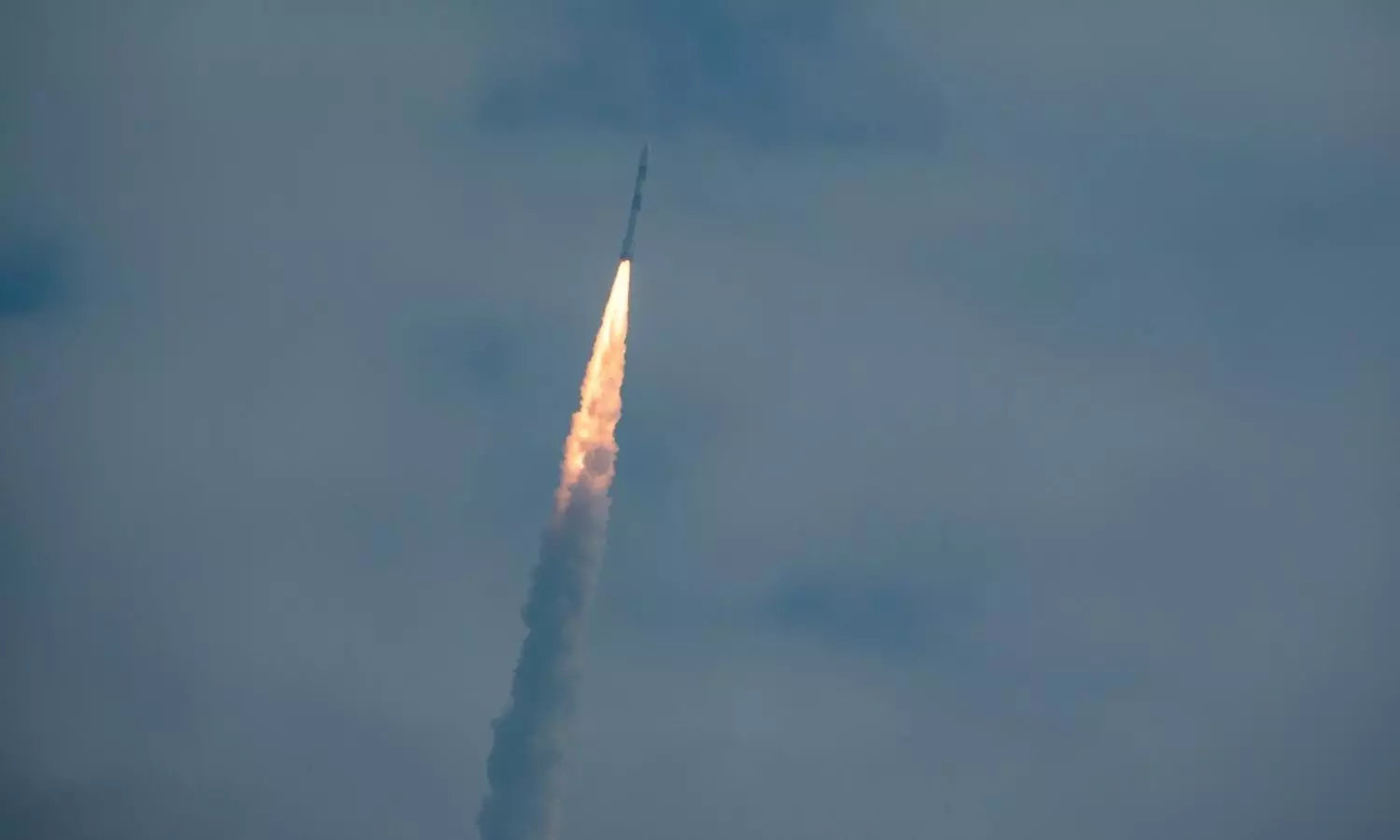
ISRO’s PSLV failure: Who pays when rocket missions go wrong?
With satellites costing anywhere from a few million to several hundred million dollars, rocket launch failures bring the role of space insurance into sharp focus

Rocket launches are inherently uncertain, a reality underscored once again after ISRO’s mission carrying 16 satellites failed to achieve its objectives, reducing years of engineering effort and substantial financial investment to debris within minutes.
Also Read: ISRO’s PSLV-C62 mission fails, 16 satellites lost in space
The setback highlights a less visible yet critical aspect of the modern space race: who bears the financial loss when a mission goes wrong?
Owners of the satellites
The satellites aboard the PSLV-C62 mission, which lifted off before encountering a failure, belonged to a mix of government, commercial and academic organisations from India and several other countries.
The primary customer was the Defence Research and Development Organisation (DRDO), which owned the main payload, EOS-N1 (Anvesha), a strategic hyperspectral imaging satellite.
Other co-passenger satellites were developed by organisations including Dhruva Space, OrbitAID Aerospace, Space Kidz India, CV Raman Global University, Assam Don Bosco University, Dayanand Sagar University and Laxman Gyanpith.
International entities included Orbital Paradigm (Spain), AlltoSpace (Brazil), SSTL (Thailand and the UK), Antharkshya Pratishtan (Nepal), along with payloads for customers from Mauritius, Luxembourg, the UAE, Singapore, France and the United States.
Space insurance
With satellites costing anywhere from a few million to several hundred million dollars, such failures bring the role of space insurance into sharp focus.
At its core, space insurance transfers the financial risk of launch and satellite failure from operators to insurers. Typically, the launch provider holds the policy, with costs passed on to the satellite owner. Coverage, however, is far from standardised.
Unlike car or health insurance, every space mission is governed by bespoke contracts, with nearly everything, from coverage duration to payout conditions, open to negotiation.
Shared responsibility
In many cases, launch companies such as SpaceX offer insurance-backed terms. If a rocket explodes on the launch pad or fails en route to orbit, the satellite owner may receive a partial or full refund, while the launch provider claims compensation from its insurer.
Also Read: ISRO plans to send astronauts to Moon by 2040
Once a satellite separates successfully, however, responsibility often shifts. If a spacecraft reaches orbit but later suffers a deployment failure, such as a jammed antenna, the loss typically falls on the satellite owner unless in-orbit insurance has been purchased.
Some operators choose to fly uninsured, betting on reliability to reduce premium costs. Others opt for partial coverage, protecting only the riskiest launch phase while assuming responsibility thereafter. These trade-offs can save millions upfront but also carry the risk of total loss.
Layered insurance coverage
Space insurance dates back to 1965, when Lloyd’s of London underwrote the first satellite policy for Intelsat I, known as Early Bird. Although the mission succeeded and no claim was made, it established a precedent for insuring space assets.
Modern missions rely on layered insurance coverage. Pre-launch insurance protects spacecraft during manufacturing, testing and handling on Earth, covering damage caused by accidents in clean rooms or during transport.
Launch insurance, widely seen as essential, covers the high-risk phase from ignition to deployment, compensating for explosions, engine failures or trajectory errors.
Once operational, satellites may be protected by in-orbit insurance, which covers malfunctions, power failures, design flaws or collisions with space debris. Such policies may fund repairs, replacement satellites or lost revenue, with some including partial-loss clauses that trigger payouts if capacity is reduced rather than completely lost.
Failures trigger heavy losses
Despite rising launch volumes, the space insurance market is under strain. Of roughly 10,000 active satellites currently in orbit, only about 300 are insured, most of them large geostationary communications satellites.
In low Earth orbit, now home to more than 9,000 satellites, fewer than 50 carry insurance. Small satellites and CubeSats are often inexpensive enough for operators to self-insure, absorbing losses as part of routine operations.
Also Read: ISRO's 'Bahubali' rocket places US communication satellite into orbit
This shift has squeezed insurers. Traditional high-premium missions are declining, while the global annual premium pool remains relatively small, estimated at USD 500-600 million.
A handful of major failures can wipe out years of profits. In 2023 alone, nearly USD 1 billion in claims, including a record USD 420 million payout linked to a Viasat satellite malfunction, pushed the sector into significant losses, according to a Business Today report.